

If AI can change who sees an ad, what price they get, or how a lead is scored, or analyze psychographics for lead generation, I need controls in place before launch.
This article comes down to one simple point: no single tool covers every AI risk in marketing. I’d group the 10 options into four jobs:
- Governance platforms: IBM watsonx.governance, Vertex AI
- Monitoring tools: Fiddler AI, TruEra, WhyLabs
- Explanation tools: SHAP, LIME
- Bias testing tools: AIF360, Microsoft Responsible AI Toolbox / Fairlearn
- Human oversight layer: Hello Operator
If I’m choosing fast, I’d use this rule:
- Pick IBM watsonx.governance or Vertex AI if I need policy controls, audit logs, and approval steps
- Pick Fiddler AI, TruEra, or WhyLabs if I need drift checks and model watchlists
- Pick SHAP or LIME if I need to explain one decision or inspect model behavior
- Pick AIF360 or Fairlearn if I need bias testing and mitigation in code
- Pick Hello Operator if I need human sign-off inside campaign work
The article also makes a clear risk point for U.S. teams: AI issues in targeting, pricing, and personalization can trigger FTC scrutiny, legal exposure, and brand damage. That’s why review should happen before deployment, not after.
Ethical AI and Responsible Marketing Practice
sbb-itb-daf5303
Quick Comparison
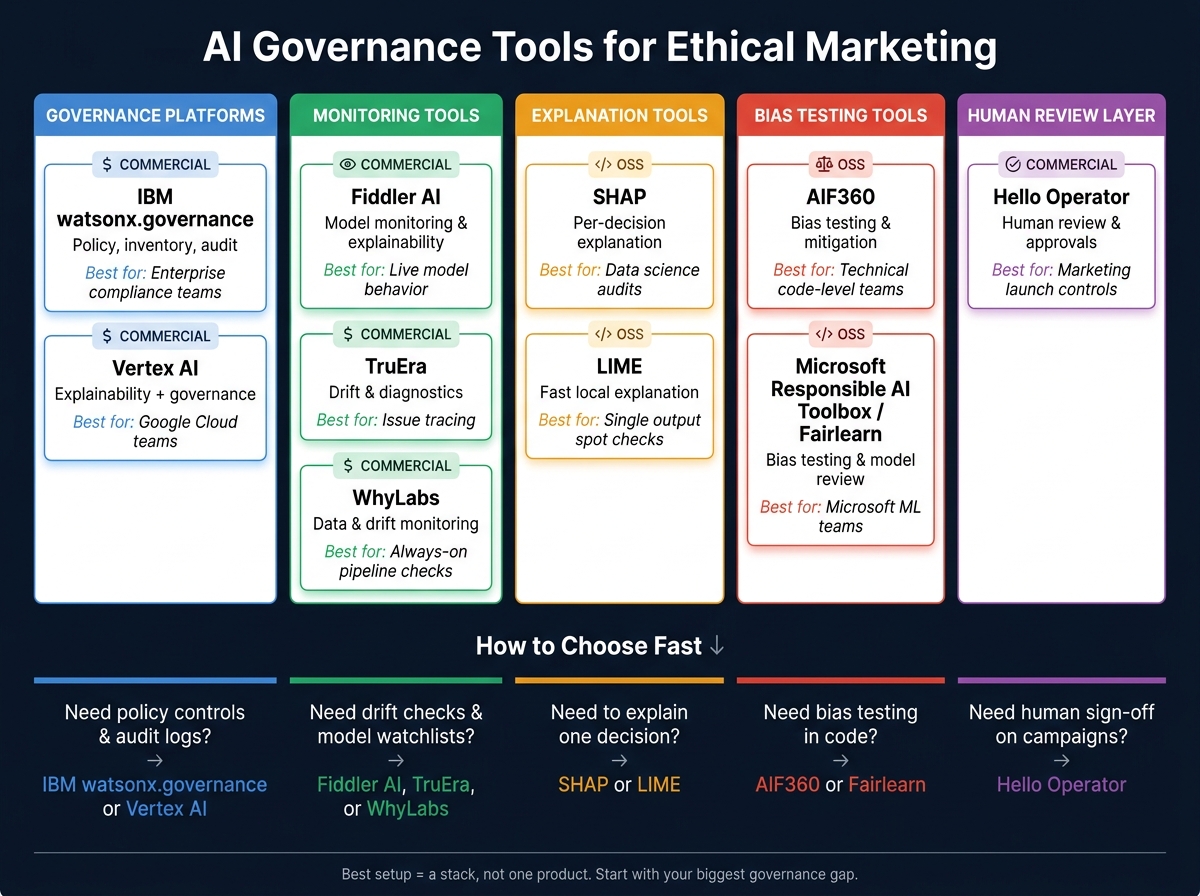
AI Governance Tools for Ethical Marketing: Side-by-Side Comparison
| Tool | Main Job | Best Fit |
|---|---|---|
| IBM watsonx.governance | Policy, inventory, audit | Enterprise marketing and compliance teams |
| Fiddler AI | Model monitoring and explainability | Teams watching live model behavior |
| TruEra | Drift and diagnostics | Teams that need issue tracing |
| WhyLabs | Data and drift monitoring | Always-on model and pipeline checks |
| Vertex AI | Explainability plus governance | Google Cloud teams |
| SHAP | Per-decision explanation | Data science review and audits |
| LIME | Fast local explanation | Spot checks for single outputs |
| AIF360 | Bias testing and mitigation | Technical teams working in code |
| Microsoft Responsible AI Toolbox / Fairlearn | Bias testing and model review | Microsoft-centered ML teams |
| Hello Operator | Human review and approvals | Marketing teams that need launch controls |
My takeaway: the best setup is usually a stack, not one product. I’d start with the biggest gap first - policy review, drift checks, bias testing, or human approval - then add the next layer.
1. IBM watsonx.governance
IBM watsonx.governance stands out when marketing teams need lifecycle control, not just reports on a single model.
It manages the full AI lifecycle and gives marketing teams one place to oversee targeting, lead scoring, and personalization. That matters because these systems rarely live in isolation. They affect who sees an ad, how leads get ranked, and which messages different audiences receive.
Explainability
The platform lays out model logic and data flow in dashboards. It also provides explainability statements for internal review and audits. So instead of treating a model like a black box, teams can trace how it works and what data feeds it.
Fairness Controls
It integrates AIF360 to detect bias in ad delivery and audience segmentation. It also tracks fairness metrics such as demographic parity, equal opportunity, and equalized odds.
On top of that, it supports Model Cards that record data provenance, intended use, and bias results. That paper trail makes later audits much easier.
Monitoring & Auditability
The AI Inventory tracks all models in use, which cuts down on untracked AI and centralizes audit trails and policies. For marketing teams, that's a big deal. It's hard to govern what no one knows exists.
This setup also helps organizations show compliance with frameworks such as the NIST AI Risk Management Framework.
Marketing Workflow Fit
It assigns model owners to watch performance and escalate risky decisions. That ties accountability to named roles instead of relying on automated alerts alone.
That mix of visibility, fairness checks, and role-based oversight makes it a strong baseline governance layer.
2. Fiddler AI

Fiddler AI adds explainability and monitoring for marketing models used in targeting, lead scoring, and personalization. That makes it a strong fit for teams that need close, day-to-day oversight of model behavior.
Explainability
Fiddler's transparency dashboards show what drives each decision. In plain terms, teams can see the factors behind model outputs instead of treating results like a black box. That matters for compliance review and internal audit, where people need clear, audit-ready explanations they can actually work with.
Monitoring & Auditability
Fiddler fits teams that need continuous monitoring rather than occasional checks. Marketing teams can use that visibility to keep model behavior in view and tied to accountability over time. If a model starts acting differently, review can happen faster instead of turning into a scramble after the fact.
Marketing Workflow Fit
The platform supports clear ownership around AI systems. Teams can route alerts and reviews to named owners, which helps speed up escalation when something needs attention. For marketing teams managing audience targeting, lead scoring, and personalization, that ownership layer keeps oversight close to the decisions being made in the moment.
3. TruEra

The previous tool is more about day-to-day visibility. TruEra takes a different angle: early warning and steady monitoring. It gives teams continuous governance, which matters when you need to spot bias, drift, and model issues in marketing systems before they start causing problems.
Explainability
TruEra shows the data inputs, model behavior, and decision logic behind a result. That means teams can explain why a model ranked an audience segment or lead in a certain way.
Fairness Controls
TruEra detects bias across customer segments, so teams can catch exclusion or under-targeting before it starts shaping campaign results.
Monitoring & Auditability
One of TruEra’s main strengths is continuous monitoring for drift and vulnerabilities. For marketing teams, that means a better shot at catching changes early, before those shifts start affecting decisions.
Marketing Workflow Fit
TruEra works well for personalization, lead scoring, and audience targeting workflows where teams need steady review and audit-ready explanations.
4. WhyLabs

Earlier tools lean more toward explainability and fairness checks. WhyLabs is aimed at operational monitoring instead. As an AI observability platform, it helps marketing teams watch data pipelines and models so they can catch drift before it throws off targeting or messaging.
Monitoring & Auditability
WhyLabs uses its open-source library whylogs to track data quality in real time. It can flag missing values, schema changes, and outliers. Those are the kinds of data problems that can quietly distort personalization or segmentation output.
That matters more than it may seem at first glance. If the input data shifts, real-time marketing decisions can drift with it. WhyLabs helps teams spot those issues early, and its centralized logs make it easier to trace when a data problem affected a campaign decision.
Marketing Workflow Fit
WhyLabs fits best in always-on campaign optimization, segmentation, and personalization workflows where models run all the time and need steady oversight. Think of it as a system for watching the pipes, not just the output.
Its main strength is operational oversight, not deep fairness checks or model explainability. So if your biggest risk is silent data failure rather than model interpretation, WhyLabs can be a strong fit.
5. Vertex AI Explainable AI and governance features
WhyLabs is more about day-to-day model monitoring. Vertex AI adds the governance layer on top of that, with built-in explainability, review support, and approval controls.
Explainability
Vertex AI visualizes model logic and data flow for internal review, which helps with audit and review work. It also supports Model Cards that document training data, intended use, performance metrics such as accuracy, recall, and F1, plus known limitations.
That matters for a simple reason: if a team can’t see how a model was trained, what it was built for, and where it falls short, review turns into guesswork. Using Model Cards for each internal model keeps model logic discoverable across the full model lifecycle.
Fairness Controls
Vertex AI supports fairness metrics such as Demographic Parity and Equal Opportunity. Teams should pick the priority metric before deployment, because fairness metrics can conflict with each other.
In practice, that means a model may look good under one fairness test and less so under another. Setting the main standard early gives reviewers a clear frame for approval and follow-up checks.
Monitoring & Auditability
Vertex AI includes an AI inventory that tracks models across the model lifecycle. This makes it easier to spot shadow AI and make sure lead-scoring or budget-allocation models are registered and audited, similar to how teams manage automated marketing reports. It also supports inventory tracking and audit trails over time.
That shift is important. Monitoring tells you what is happening. An inventory and audit trail help show who approved what, when it changed, and whether it was reviewed.
Marketing Workflow Fit
For regulated marketing teams, Vertex AI fits a three-lines-of-defense review flow: developers, validators, and internal audit. That setup ties explainability, fairness controls, and auditability into one governance process.
For higher-stakes use cases, that kind of setup helps keep oversight connected to day-to-day model operations instead of treating review as a one-time checkbox.
6. SHAP
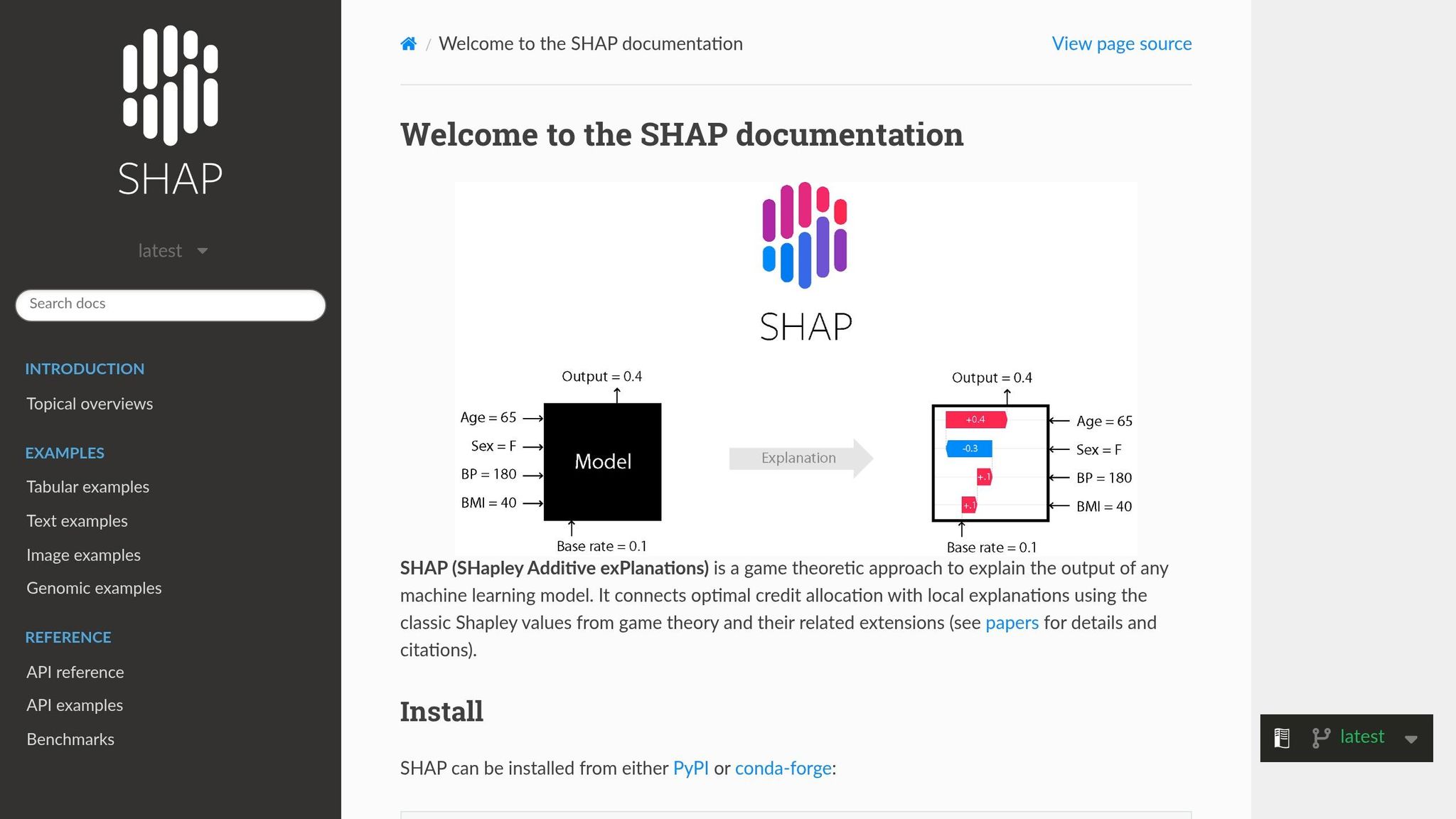
While platform tools handle governance, SHAP helps you explain one prediction at a time. SHAP (SHapley Additive exPlanations) breaks down a single model output and shows how much each feature pushed that result up or down. Put simply, it helps answer: Why did the model make this call?
Explainability
Use SHAP to trace which inputs drove a score, rank, or segment assignment. This is especially useful when you need to inspect how a model reached a specific outcome instead of just looking at system-level reports.
It can also surface cases where proxy features, such as postal codes, surnames, or schools attended, carry hidden correlations with protected attributes like race or gender. If that happens, treat it like a warning light on the dashboard:
- Log the explanation according to your AI guidelines and safety policy
- Review the proxy feature
- Document the decision
Fairness Controls
SHAP can point out suspect input patterns when model behavior looks biased or unstable. But it does not fix those issues on its own. For testing or model constraints, pair it with Fairlearn or AIF360.
Marketing Workflow Fit
SHAP fits well into audit reviews, incident analysis, and model-release checks. It is especially helpful after an incident, when legal and compliance teams need a clear trail back to the exact inputs behind a decision.
A simple habit helps here: keep a proxy-feature register and retest it at every release.
Use SHAP when your team needs per-decision explanations for review, rather than a full governance layer.
7. LIME

Where SHAP explains a prediction feature by feature, LIME gives you a fast local approximation for spot checks. LIME (Local Interpretable Model-agnostic Explanations) explains a single prediction by fitting a simpler local model around that one case.
Explainability
LIME is built for spot-checking individual decisions: why a certain offer, lead score, or ad placement was triggered. That makes it handy when someone wants a plain-English answer for one outcome, not a deep read of the whole model.
Its feature-based visual output is easy for non-technical reviewers to follow. A marketing manager can see labels like "last purchase date" or "browsing time" instead of raw coefficients. LIME is also fast enough for quick production spot checks.
Fairness Controls
LIME does not measure or correct bias. It can bring proxy features like postal codes to the surface for follow-up review, which is useful, but that alone doesn't solve the problem. Teams should pair it with AIF360 or Fairlearn for measurement and remediation.
Marketing Workflow Fit
LIME works best when a team needs a fast, readable explanation for a specific model decision. Its outputs can feed into explainability statements and internal audit dashboards, which helps create a documented record of why an automated decision was made.
Use it as an explanation layer inside broader governance controls. LIME is a diagnostic tool, not a substitute for ethical model design.
8. IBM AI Fairness 360 (AIF360)
IBM AI Fairness 360 is an open-source (OSS) library built to find and reduce algorithmic bias.
Diagnosis is only half the job. AIF360 also helps teams fix bias inside the model pipeline, which matters when a system is already affecting business decisions.
Fairness Controls
AIF360 measures bias with standard fairness metrics and supports mitigation at three points: before training, during training, and after training. In marketing, that matters a lot. Think audience targeting, lead scoring, personalization, and churn prediction. In each of those cases, a model can end up disadvantaging a group based on age, race, or gender.
AIF360 uses a three-layer mitigation approach:
| Mitigation Layer | When It Runs | Best For |
|---|---|---|
| Pre-processing | Before model training | Correcting historical bias in training data; easiest for auditors to understand |
| In-processing | During model training | Most direct model-level integration; ensures the model learns fairness as a constraint |
| Post-processing | After inference | Fast adjustments on live campaigns without retraining |
For marketing ops teams, post-processing can be the quickest fix. If live campaign outputs show bias, teams can adjust them without retraining the model. That's a practical stopgap when governance teams need action now, not just a report on what went wrong.
Marketing Workflow Fit
AIF360 fits into the Fairness pillar of an ethical AI marketing framework. It can help teams maintain a proxy variable registry by flagging proxy features tied to protected attributes, and its fairness scores can work as risk signals.
That said, AIF360 is a technical library, not a full governance platform. So it usually makes more sense as part of a stack. Teams may pair it with SHAP or LIME to give non-technical stakeholders plain-language explainability, then add an MLOps layer for documentation and model inventory.
9. Microsoft Responsible AI Toolbox (including Fairlearn)
Microsoft Responsible AI Toolbox makes the most sense for teams already working inside Microsoft ML workflows. It adds bias checks, explainability, and documentation without forcing a big process change. While AIF360 leans more toward fairness repair, Fairlearn is a better fit for teams that want those controls built into a Microsoft-centered pipeline. In practice, Fairlearn is the piece most tied to defining fairness and spotting model bias inside existing ML pipelines.
Fairness Controls
Pick the metric that fits the campaign. For example:
- Demographic Parity for ad delivery
- Equal Opportunity for lead scoring
- Equalized Odds for personalization
There’s a catch here. Demographic Parity and Equal Opportunity can conflict when base rates differ across groups. So marketing teams can’t just check every fairness box at once. They need to choose, on purpose, which fairness metric lines up with the campaign context.
Fairlearn can also flag proxy variables like postal codes and surnames for review. That matters because bias doesn’t always show up through obvious fields. Sometimes it sneaks in through stand-ins.
Explainability
The toolbox supports Model Cards that document training data, intended use, and bias findings. That gives review teams something concrete to work from during audits and model approvals.
Marketing Workflow Fit
This toolbox works best as a bias governance layer inside an existing ML pipeline. Its audit trails and documentation are well suited to internal review and U.S. compliance workflows.
Treat Fairlearn’s fairness scores as KRIs, not KPIs.
If your team needs a lighter way to handle explanation and review, the next tools are narrower and more diagnostic.
10. Hello Operator

Hello Operator builds governance into marketing workflows instead of treating it like a last-minute model review. The focus is on putting oversight inside the campaign process itself, including ad placement, creative approval, and content release.
Marketing Workflow Fit
Hello Operator brings review, approval, and escalation into day-to-day campaign work by assigning ownership and setting clear decision rights for AI-assisted tasks. It also helps teams through workshops and custom AI solutions that turn policy and oversight into something people can actually use. That workflow-first approach makes it useful in the comparison below.
Monitoring & Auditability
The platform keeps human review as the final step before AI outputs go live. Teams can assign model owners to specific systems and set an AI Code of Conduct that spells out what automation is not allowed to do, even if it might improve performance. Centralized policies help keep automated outputs within approved brand and risk limits.
Brand Safety and Content Guardrails
Brand-safety rules can block disallowed content before launch. In practice, that means certain messaging types can be stopped at the release stage before a campaign goes live.
Side-by-Side Comparison by Governance Priority
No single tool handles every part of AI governance. That’s why it helps to compare them based on the things marketing teams care about most: explainability, bias detection, monitoring, and workflow fit. The tables below show where each tool helps most and which governance gap it closes.
Explainability
The main technical explanation tools are SHAP and LIME. SHAP gives both local and global feature explanations. LIME is better for fast local explanations tied to a single decision. For non-technical reviewers, model cards usually give the clearest summary of intended use, data, and bias checks.
Vertex AI includes explainable AI features and model cards. IBM watsonx.governance leans more toward lifecycle governance and risk management. Both fit enterprise review workflows well.
| Tool | Explainability Role | Practical Fit for Marketing Teams |
|---|---|---|
| SHAP | Local and global technical explanations | Best when a data scientist needs to show why a model made a specific decision |
| LIME | Local technical explanations | Best for individual prediction review |
| Vertex AI | Explainable AI features and model cards | Better for enterprise review and non-technical stakeholders |
| IBM watsonx.governance | Lifecycle governance and risk management | Best for compliance and policy oversight |
Human approval sits in the release process. It’s separate from model explanation.
Bias Detection
Once explanations are clear, the next step is simple: is the model fair?
IBM AI Fairness 360 (AIF360) and Fairlearn are the strongest options for measuring and reducing bias, but both need technical setup. Fiddler AI, TruEra, and WhyLabs are a better match for production monitoring, where drift and data quality problems need constant attention. Enterprise platforms like IBM watsonx.governance and Vertex AI are stronger at policy review than direct bias measurement.
| Tool | Bias Metrics / Monitoring Role | Mitigation Support | Practical Fit |
|---|---|---|---|
| AIF360 | Extensive fairness metrics | ✓ | Best for technical bias mitigation |
| Fairlearn / Microsoft Responsible AI Toolbox | Extensive fairness metrics | ✓ | Best for technical bias mitigation |
| Fiddler AI | Production monitoring | Alerts | Best for ongoing drift checks |
| TruEra | Production monitoring | Diagnostics | Best for tracing model issues |
| WhyLabs | Data quality and distribution monitoring | Drift detection | Best for continuous monitoring |
| IBM watsonx.governance | Policy-level oversight | Governance enforcement | Best for enterprise review |
| Vertex AI | Pipeline-integrated governance | Model pipeline support | Best for teams already using Google Cloud |
Monitoring & Auditability
After fairness checks, continuous monitoring becomes the last line of defense against drift.
Fiddler, TruEra, and WhyLabs focus on live monitoring and drift detection. IBM watsonx.governance and Vertex AI add audit trails and approval steps on top of that monitoring layer. Those audit trails matter. Without them, unreviewed models can slip into marketing stacks without anyone noticing.
| Tool | Drift Detection | Logging & Audit Trails | Approval Workflows | Alerts |
|---|---|---|---|---|
| Fiddler AI | ✓ | ✓ | Limited | ✓ |
| TruEra | ✓ | ✓ | Limited | ✓ |
| WhyLabs | ✓ | ✓ | None | ✓ |
| IBM watsonx.governance | ✓ | ✓ (centralized) | ✓ | ✓ |
| Vertex AI | ✓ | ✓ | ✓ | ✓ |
| AIF360 / SHAP / LIME | None | None | None | None |
Marketing Workflow Fit
Governance only works if it fits the way the team already works.
Most governance tools were built for data science and compliance teams, not campaign managers. IBM watsonx.governance and Vertex AI fit best inside enterprise MLOps and cloud ecosystems. Fiddler AI, TruEra, and WhyLabs make the most sense when a data science or ops team already owns model oversight.
Hello Operator fits differently. It works as a human review layer inside existing marketing workflows.
| Tool | Martech Stack Integration | Human Review Checkpoints | Cross-Team Collaboration |
|---|---|---|---|
| IBM watsonx.governance | Enterprise-level (MLOps) | Policy-driven approvals | Compliance + Legal focus |
| Fiddler AI | Model serving layer | Monitoring alerts | Data Science + Ops |
| TruEra | Model serving layer | Root cause reviews | Data Science + Ops |
| WhyLabs | Data pipeline | Drift alerts | Data Science |
| Vertex AI | Google Cloud ecosystem | Model card reviews | Engineering + Compliance |
| AIF360 / Fairlearn | Code-level integration | None built in | Data Science |
| SHAP / LIME | Library-level | None built in | Data Science |
| Hello Operator | Existing martech stack | Pre-launch human approval | Marketing + Legal + Ops |
Pros and Cons
Each tool handles a different part of AI governance. So the best pick usually comes down to three things: your team's technical skill, how heavy your compliance load is, and where AI shows up in your marketing process.
The fastest way to choose isn't by stacking up feature lists. It's by matching the tool to your main governance job.
| Tool | Best For | Main Advantage | Main Limitation | Ideal Team Profile |
|---|---|---|---|---|
| IBM watsonx.governance | Centralized compliance and audit readiness | Full lifecycle governance with centralized audit trails | Requires skilled setup and maintenance; can be harder to integrate into existing workflows | Legal, Compliance, and Marketing Leadership |
| Vertex AI (Explainable AI and governance features) | Google Cloud-native governance | Pipeline-integrated oversight with model documentation | Requires Google Cloud; less useful outside that stack | Engineering, Compliance, and Marketing Ops |
| Fiddler AI | Real-time campaign monitoring | Live drift detection with model performance alerts | Focused on technical metrics; limited ethical or legal context out of the box | MLOps and Data Engineering teams |
| TruEra | Root-cause diagnostics | Root-cause analysis for tracing model performance drops | Requires existing models to monitor; not built for non-technical users | Data Science and MLOps teams |
| WhyLabs | Data quality and distribution monitoring | Continuous monitoring with strong drift alerts | Limited governance depth beyond technical monitoring | Data Engineers and Data Scientists |
| SHAP | Technical explainability audits | Rigorous local and global feature explanations | Requires data science expertise to interpret; no dashboard | ML Engineers and Data Scientists |
| LIME | Single-prediction explainability | Fast local explanations for individual decisions | Narrow scope; no monitoring or governance features | ML Engineers and Data Scientists |
| IBM AI Fairness 360 (AIF360) | Bias measurement and mitigation | Extensive fairness metrics with pre- and post-processing mitigation; free | High implementation effort; no centralized dashboard for non-technical stakeholders | Data Scientists and ML Engineers |
| Microsoft Responsible AI Toolbox (including Fairlearn) | Bias detection and model assessment | Broad fairness metrics with model documentation and bias review | Requires technical setup; limited workflow automation | Data Scientists and ML Engineers |
| Hello Operator | Human-in-the-loop oversight for marketing teams | Human-in-the-loop campaign review; workshops and custom AI support; best for teams needing structured oversight before launch | Less scalable than pure software; depends on ongoing service engagement | Marketing Leaders, Creative Directors, and CMOs |
At that point, the last big divide is pretty simple: technical monitoring vs. human review.
If your team needs drift alerts, model diagnostics, or feature-level explanations, tools like Fiddler AI, TruEra, WhyLabs, SHAP, and LIME fit that job. If the bigger concern is compliance review, launch control, or cross-team oversight, options like IBM watsonx.governance, Vertex AI, and Hello Operator make more sense.
The trade-off is straightforward. Some tools help you watch models closely. Others help people review decisions before those models affect campaigns, approvals, or customer-facing work. That distinction usually tells you more than a long feature checklist ever will.
Conclusion
Taken together, the tools above show a simple truth: ethical AI marketing works best when you treat it as layered governance, not a one-time fix.
That means putting a few checks in place that work together, not relying on a single tool to do all the heavy lifting. In practice, ethical AI marketing needs layers like oversight platforms, explainability tools, fairness test kits, monitoring tools, and human review workflows.
Human-in-the-loop support from Hello Operator helps teams turn those controls into everyday practice through campaign review, approvals, and training.
The right move is to start where risk is highest. Focus first on your biggest governance gap, then add the next layer.
FAQs
Which AI governance layer should I implement first?
Start with a core AI framework that spells out roles, responsibilities, and ethical guidelines in plain terms. First, map your current data flows, spot compliance gaps, and assign clear ownership for AI decisions.
Then put the plan in writing with an AI Code of Conduct. Smaller teams can keep it simple with a three-tier risk model. Mid-sized teams usually need orchestration hubs backed by active human oversight.
How do I choose the right fairness metric for marketing use cases?
Skip the one-size-fits-all approach. Start by auditing your data for past bias and making sure it reflects the demographics you actually want to serve.
From there, run bias checks on a regular basis and use tools like Fairlearn or IBM AI Fairness 360 to measure performance across different groups. Keep your documentation clear, and maintain ongoing human oversight so decisions stay ethical and in line with your brand values.
When should human review happen in an AI marketing workflow?
Human review should be part of the workflow from the start, not something you tack on at the end.
That matters most for high-risk decisions like pricing, budget changes, and audience exclusions. Those cases should go through mandatory approval before anything moves forward.
Human review also makes sense for customer-facing content that includes company information. The same goes for testing new models in shadow mode and for regular audit checkpoints. Those checkpoints help teams check for bias, confirm performance, and make sure AI-driven decisions stay in line with brand values.
Related Blog Posts

