

If AI touches customer-facing marketing, I should assume disclosure, review, and logging are part of the job. As of July 31, 2026, state rules, FTC action, and platform policies all point the same way: tell people when they are dealing with AI, label higher-risk content clearly, and keep records that show who checked it and what went live.
Here’s the short version:
- Chatbots need upfront notice. In states such as California, the bot should identify itself before the conversation starts.
- Synthetic people, voices, and testimonials need the clearest labels. These uses carry the most legal and brand risk.
- Disclosure and recordkeeping are different. One is for the customer. The other is for my team if questions come later.
- Human review matters most for claims and sensitive topics. Health, finance, insurance, pricing, and similar areas need tighter sign-off.
- Simple systems work. A spreadsheet or task tool can track prompts, edits, approvals, labels, and publish dates.
- The safest rule is often the strictest one that applies. If one state or platform asks for more direct wording, use that standard.
A few numbers from the piece show why this matters:
- 14 U.S. states have enacted chatbot disclosure laws
- 78 bills have been introduced across 27 states
- California’s SB 243 allows penalties of up to $2,500 per violation, plus $1,000 per violation through private lawsuits
- FTC civil penalties can reach $50,120 per violation for willful or repeat offenses
- 30% of Gen Z consumers call undisclosed AI ads “inauthentic,” while 73% of Gen Z and Millennial consumers say disclosure would either help purchase intent or make no difference
If I had to boil the whole guide down to one checklist, it would be this:
- Map where AI appears
- Sort each use by risk
- Add plain-language labels by channel
- Route sensitive work to human review
- Log prompts, edits, approvals, and live disclosures
- Review the policy on a set schedule
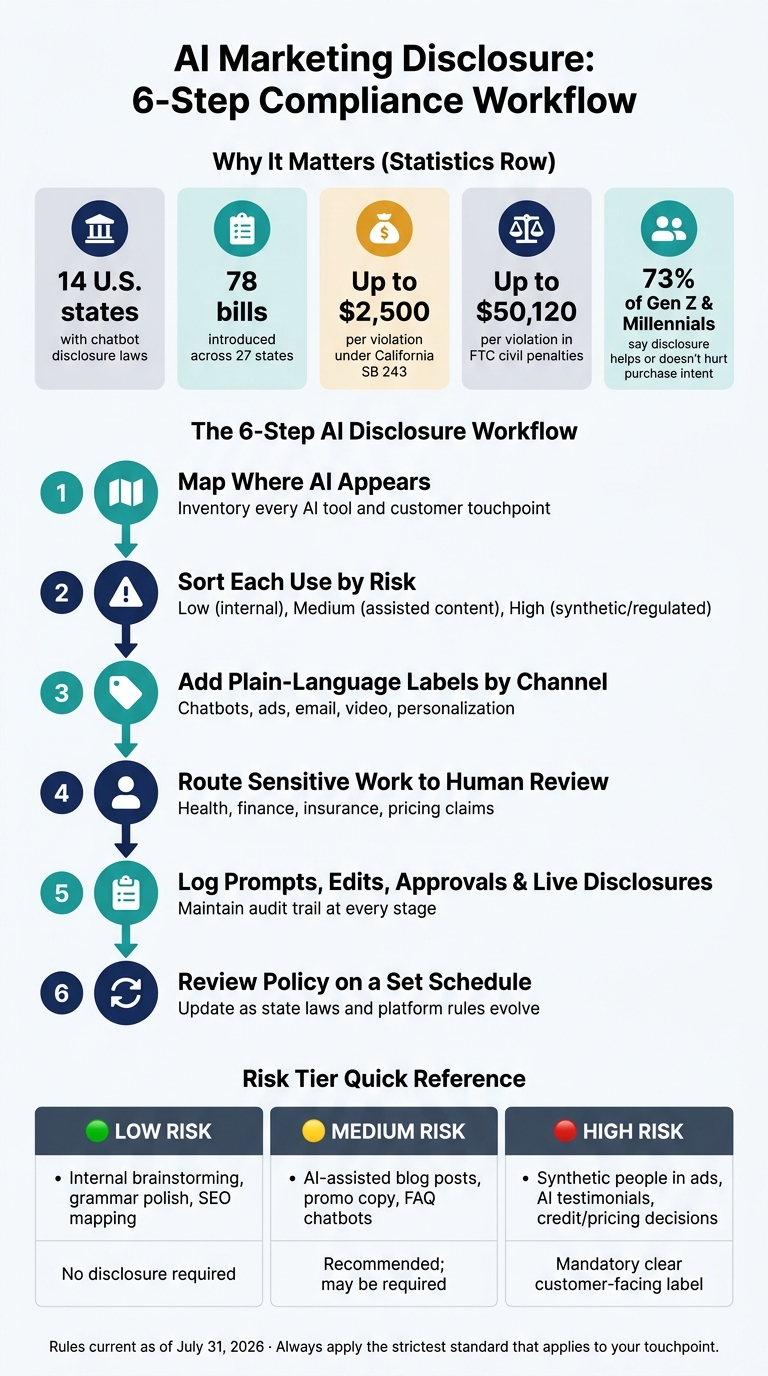
AI Marketing Disclosure: 6-Step Compliance Workflow
Don't Get Sued: New York's New AI Advertising Law for Sellers
sbb-itb-daf5303
Quick Comparison
| Area | What I should do | Main risk if skipped |
|---|---|---|
| Chatbots | Identify the bot at the start and keep the label visible | Users think they are talking to a person |
| Ads and images | Label AI-made or heavily edited content | Misleading visuals or fake people |
| Video and audio | Mark synthetic performers on-screen or in captions | Hidden AI likeness or voice use |
| Add a short AI note when AI drafted the message | Customer confusion about source | |
| Personalization | Explain that AI shaped the offer and why | Opaque targeting or offer decisions |
| Internal process | Keep prompt and approval records | No proof of review or oversight |
In other words: this isn’t just about adding a disclaimer. It’s about having a repeatable system for labels, review, and proof.
The Rules: When Marketing Teams Should Disclose AI Use
In the U.S., AI disclosure rules come from three main places: the FTC, state laws, and platform policies. The safest move is simple: use the strictest rule that applies to that customer touchpoint. Public disclosure tells people when AI is part of the experience. Internal records show who checked the work before it went live.
Legal Requirements vs. Ethical Best Practice
Some disclosure triggers are black-and-white legal rules. California's SB 243 requires upfront bot disclosure. New York's S.8420-A requires labels for synthetic performers, which means AI-made human likenesses. Colorado's SB 24-205 applies to consequential decisions. And major ad platforms now label some AI-assisted ads.
At the federal level, the FTC can treat deceptive AI use as a Section 5 issue. Civil penalties can reach $50,120 per violation for willful or repeat offenses.
Then there's the ethics side. AI-written promo copy, edited product photos, or AI-assisted support replies may not always trigger a legal duty to disclose. But leaving that out can still create brand risk. If AI changes how a customer sees your product, your company, or your offer, disclose it even when the law doesn't force your hand.
A Simple Risk Tier Model for Marketing Use Cases
| Risk Tier | Example Use Case | Disclosure Expectation | Required Reviewer |
|---|---|---|---|
| Low | Internal brainstorming, grammar/tone polishing, SEO keyword mapping | Not required | Content Creator |
| Medium | AI-assisted blog posts, promotional copy, standard FAQ chatbots, edited product photos | Recommended for trust; may be required depending on jurisdiction | Marketing Manager |
| High | Synthetic people in ads, AI-generated testimonials, automated credit/pricing decisions | Mandatory clear customer-facing label | Legal/Compliance Team |
This model helps teams avoid two common mistakes: saying too much about low-risk internal work, or saying too little about public-facing content. If AI directly shapes what a customer believes, buys, or qualifies for, treat it as high risk. If it stays inside the workflow and never reaches the public, it's low risk.
As a default, follow California's SB 243 standard: clear, conspicuous, proactive disclosure. In plain English, say "I am an AI chatbot, not a human" instead of using softer wording like "virtual assistant." And keep that label visible throughout the chat, not buried in fine print.
Next, the rules need to be applied by channel, since chatbot labels, ad labels, and personalization notices each call for different wording.
Channel Rules: How to Disclose AI Across Customer Touchpoints
Use the risk tier from the previous section to decide how much disclosure each channel needs. A general rule on paper doesn't help much unless it turns into clear action at the exact moment a customer sees, hears, or reads something.
Chatbots, Website Assistants, and AI-Supported Customer Conversations
Disclose before the first meaningful reply. A clear label like "Chat with our AI Assistant" works well, and the opening message should say: "I am an AI chatbot, not a human."
That label shouldn't disappear after the first line. Keep it visible during the whole conversation with a persistent AI badge or icon in the chat header or message stream. That way, users can tell at any moment that they're talking to a bot.
If the chat moves from the bot to a person, say that right away: "Connecting you to a human agent now."
AI-Generated Content in Ads, Email, Social, Images, Video, and Audio
Big ad platforms are already doing some of this work themselves. Google and Meta both show AI labels through built-in disclosure panels.
The level of disclosure should match the type of content. For AI-assisted text, a light note is often enough. For synthetic people, voices, or heavily edited visuals, the label should be much more obvious. If an email was drafted with AI help, a short footer such as "This message was drafted with AI assistance." is usually enough.
Video and audio need more care. If an ad uses an AI-generated person instead of a human actor, New York now requires a synthetic-performer label.
Put simply, the label should fit the medium. Chat needs a persistent disclosure. Ads need platform labels. Personalization needs an in-context explanation.
| Channel | Disclosure Trigger | Recommended Label | Placement |
|---|---|---|---|
| Website Chat | Any consumer interaction | "I am an AI chatbot, not a human." | First message and persistent badge |
| Digital Ads | AI-generated or substantially altered content | "Created or edited with AI" | Platform AI label or disclosure panel |
| Influencer/Video/Audio | AI-generated person, voice, or synthetic performer | "Synthetic performer" label | On-screen overlay or caption |
| AI-drafted promotional content | "This message was drafted with AI assistance." | Footer or near the sender name | |
| Human Handoff | Transition from bot to agent | "Connecting you to a human agent now." | Point of transfer |
| Personalization | AI influences recommendations or offer decisions | "Recommended because you viewed similar products." | Near the offer or explainability panel |
Automated Personalization, Profiling, and Offer Decisions
When AI shapes an offer, don't stop at the label. Add a plain-English reason too. People should know that AI influenced the offer and why they're seeing it.
This matters even more in higher-risk cases. States like Colorado require disclosure when AI makes or substantially influences consequential decisions tied to credit, employment, healthcare, or housing. In practice, that means using a short explanation alongside a control panel where people can review or change personalization settings.
For lower-risk personalization, use consent-based data and give people a settings control.
Next, add human review and logging so these disclosures stay accurate in live campaigns.
Controls: Human Review, Brand Voice Limits, and Logging
Good disclosure needs a process. Not just good intentions.
That process comes down to three things: review, clear brand rules, and basic logging. These controls turn the disclosure rules from the previous section into something a team can repeat. Without them, labels start to drift, get missed, or stop matching what was published as a campaign grows.
Human-in-the-Loop Review for Claims, Sensitive Topics, and Synthetic Content
Simple marketing assets can follow a basic draft-review-approve path. But regulated claims and synthetic content need a stricter route.
If content touches health, financial, or insurance claims, legal or compliance should review it before approval. The same goes for synthetic content, including AI-generated voices, faces, or video performers. That work should always move through the tighter review path.
The cost of skipping review isn't small. The FTC can impose civil penalties of up to $50,120 per violation for deceptive AI practices as of 2026. In early 2026, the Illinois Attorney General secured a $750,000 settlement against a financial services firm whose chatbot collected personal financial data while impersonating a human advisor without disclosure.
And review doesn't stop at launch. Once the asset is live, someone should keep watch for complaints, accuracy flags, and content drift. Put one person in charge of that job so ownership is clear.
Brand Voice Guardrails and the Limits of AI-Generated Content
AI tools are fast. But speed can cause a mess if your rules are vague.
These tools don't know your brand on their own. If you leave gaps, they'll fill them. That's where off-tone language, overstated claims, and quiet compliance issues creep in.
Put your brand voice into a written standard. Spell out approved tone descriptors, claim limits by product category, and approved disclosure wording. Also document what kinds of edits are allowed and disallowed. That keeps the rules concrete for anyone using the tools, instead of leaving people to guess.
"Meta's push to automate more of the ad creation process is generating frustration among advertisers, who say AI tools are distorting products, altering brand messaging and sometimes enabling creative changes automatically." - Business Insider
That quote gets to the point. Creative drift is a real risk. Review samples against the guardrail document, and if AI keeps crossing the same lines, adjust your prompt templates.
Prompt Logging and Audit Trails for Small Teams
Small teams don't need fancy systems to track disclosure. A spreadsheet or task tool can do the job, as long as it captures the right details at each step.
Log the prompt, the output, the edits, the approval, and the live disclosure. That way, if someone asks what happened later, you can show it. At a minimum, record:
- the exact prompt used
- the raw AI output before edits
- a summary of human changes
- the disclosure language that was added and where it appeared
- the name of the person who approved the final published version
That last field matters because it shows who owned the final call.
| Stage | Owner | Required Log Fields | Disclosure Check |
|---|---|---|---|
| Generate | Creator / Prompt Engineer | Tool used, prompt text, raw output, timestamp | Internal record only |
| Review | Editor / Subject Matter Expert | Edits made, fact-check status, brand voice alignment | Flag if AI was primary creator |
| Approve | Marketing Lead / Compliance | Approver name, final version link, approval date | Confirm disclosure is "clear and conspicuous" |
| Publish | Channel Manager | Publication URL or ID, live disclosure type | Verify live asset matches approved version |
| Monitor | Support / Community Manager | User feedback, accuracy reports, escalation logs | Confirm disclosure remains visible during interaction |
The aim is simple: show what AI produced, what people changed, and which disclosure went live. Once that workflow is written down, the next move is putting it into a small-team policy.
Rollout Plan for Small Teams and Final Takeaways
Once your logging workflow is set up, the next move is turning it into something your team can repeat without friction. For a small team, that usually means a phased rollout, not a giant launch all at once. The aim is simple: build a system people can follow every time. Start with the same labels, review steps, and logs from the earlier controls section, then roll them out step by step.
A 30-60-90 Day Rollout Plan for Policy, Pilots, and Training
| Phase | Main Task | Owner | Deliverable |
|---|---|---|---|
| 30 Days: Audit & Policy | Inventory top AI tools for automated marketing reports and other software in use; classify each as low-risk assistive use or customer-facing creation; map which state rules apply | Marketing Lead / Legal | AI tool inventory and risk assessment |
| 60 Days: Pilots & Labels | Update chatbot triggers, ad labels, and website disclaimers; draft standardized disclosure templates by channel | Web / Content Team | Updated customer touchpoints |
| 90 Days: Training & Governance | Train staff on disclosure rules, finalize prompt log process, and set a policy review schedule | Operations | Final workflow and logs |
When the pilot is working, turn it into a short internal policy that people can check fast and use without second-guessing.
What to Include in a Minimal AI Disclosure Policy
Keep the policy short, but make sure it covers the basics. At minimum, include:
- Scope: Which teams and activities it applies to
- Tools list: Every AI tool in use, with its risk classification
- Risk tiers: Low-risk assistive use, customer-facing creation, and high-risk regulated content
- Channel labels: Pre-approved disclosure language and placement by channel
- Roles: Named reviewers responsible for approval and monitoring
- Logging: What gets recorded and where it is stored
- Review schedule: A regular cycle for updating the policy as regulations change
Conclusion: Core Rules for Keeping AI Marketing Transparent
Transparency in AI marketing is a workflow, not just a label. The core rules are pretty direct: know which AI use needs disclosure, apply labels that are clear and conspicuous, keep humans in the review loop for anything regulated or synthetic, log what was generated and what changed, and revisit your policy as state laws keep shifting.
Put another way, transparency should be built into the workflow from the start, not tacked on at the end. If your team needs hands-on help, Hello Operator offers AI marketing workshops and human-in-the-loop systems to operationalize disclosure.
FAQs
Do all AI marketing uses need disclosure?
No. Disclosure is mostly required when AI acts like a person in a way that could mislead a reasonable consumer. Think chatbots, voice assistants, or deepfakes.
Human-reviewed marketing copy is often exempt. But the rules differ by place, and they’re changing. Being transparent helps keep trust intact and can lower enforcement risk.
What counts as high-risk AI content?
High-risk AI content is any content where the odds of harm, privacy trouble, or rule-breaking are high.
In marketing, that often means AI is being used to:
- handle identifiable customer data
- make automated decisions
- project ROI
- make pricing claims
It can also fall into the high-risk bucket when it touches matters of public interest, emotion recognition, or deepfakes.
In those cases, human oversight should be mandatory. A formal privacy or legal review should be required too.
What should we log for AI-generated marketing?
Keep centralized, immutable audit logs for all AI-generated marketing activity. If something gets reviewed later, you need a clear trail that shows what happened, when it happened, and who was involved.
Each action should include:
- a unique Audit ID
- a policy-check record
Your log should track:
- system inputs and outputs
- timestamps for consent decisions and preference updates
- disclosure events, including the text shown, the user involved, and acknowledgment
- version-controlled disclosure language
- changes to AI systems, compliance policies, or access controls
This kind of recordkeeping helps teams trace decisions step by step instead of piecing things together after the fact.
Related Blog Posts

