

When it comes to personalized search optimization, businesses have a wealth of tools to choose from. These tools are designed to improve user experience, drive conversions, and increase revenue by tailoring search results to individual preferences. Here’s a quick summary of the top tools:
- SEMrush: Offers persona-based content prompts and AI visibility tracking for large language models (LLMs), helping brands optimize for AI-generated responses.
- Ahrefs: Focuses on real-time, privacy-conscious analytics and AI traffic isolation, providing insights into how users interact with AI-driven search results.
- BrightEdge: Leverages AI tools like Copilot and Autopilot to automate SEO updates and monitor brand mentions in generative AI platforms.
- Optimizely: Combines AI and rules-based personalization to create real-time user interest profiles and dynamic content delivery.
- Dynamic Yield: Uses AI to predict individual preferences and adjust product grids dynamically based on user behavior.
- Algolia: Processes trillions of search requests annually, delivering highly customized results with AI-driven user profiles and real-time affinities.
- Adobe Target: Provides machine learning-driven personalization, real-time audience segmentation, and dynamic content updates across channels.
- Searchspring: Specializes in genomic analysis of shopper behavior to deliver precise product recommendations and improve product discovery.
These tools offer features like user behavior tracking, AI-powered recommendations, and seamless integration with existing platforms, making them essential for businesses aiming to stay competitive in the era of personalized search.
Quick Comparison:
| Tool | Key Feature | Integration Options | Pricing (if available) |
|---|---|---|---|
| SEMrush | Persona-based content prompts, AI tracking | WordPress, HubSpot, Google Analytics | Not specified |
| Ahrefs | Real-time analytics, AI traffic isolation | Google Looker Studio, custom APIs | Starts at $99/month |
| BrightEdge | AI tools for SEO automation | Google Analytics, Adobe Suite | Not specified |
| Optimizely | Real-time interest profiles, dynamic delivery | Snowflake, Salesforce, Slack | Not specified |
| Dynamic Yield | Affinity-based personalization | Experience OS, Mastercard Insights | Not specified |
| Algolia | AI-driven user profiles, real-time affinities | Shopify, WordPress, BigCommerce | Not specified |
| Adobe Target | Machine learning personalization | Adobe Suite (Analytics, AEM, etc.) | Not specified |
| Searchspring | Genomic analysis, product recommendations | Shopify, BigCommerce, Magento | Starts at $699/month |
Each platform has unique strengths, so selecting the right tool depends on your business needs, budget, and technical setup.

Comparison of 10 Personalized Search Optimization Tools: Features, Integrations, and Pricing
1. SEMrush
Personalization Capabilities
SEMrush has stepped up its game by analyzing a variety of audience search behaviors to fine-tune personalized search results. With the launch of Persona-Based Prompt Generation in December 2025, SEMrush now creates content prompts tailored to specific audience traits - whether they’re budget-conscious or highly knowledgeable in a subject. This feature allows you to simulate customer queries on AI platforms like ChatGPT and Google AI Overviews, making your content more aligned with user needs.
The One2Target tool dives deep into audience data, analyzing demographics, income levels, and even social media habits and interests. Why does this matter? Research shows that 76% of consumers are more likely to engage with messaging that feels tailored to them. SEMrush also keeps tabs on your brand’s presence in AI-generated responses, offering insights into sentiment - whether it’s positive, neutral, or negative.
And it doesn’t stop there. These tools also provide real-time insights into user behavior, helping you stay ahead of the curve.
User Behavior Tracking and Analysis
In early 2026, Coalition Technologies used SEMrush’s AI Visibility tracking to measure their brand’s presence in large language model (LLM)-generated answers. The result? A staggering 429% increase in AI referral traffic. Jordan Brannon, President of Coalition Technologies, highlighted the importance of this feature:
"Are we actually ranking inside of an LLM? The AI visibility score that's provided by Semrush is a piece of how we're reporting that."
SEMrush monitors over 239 million relevant LLM prompts globally and is trusted by more than 10 million marketers, including 35% of Fortune 500 companies. The Topic Opportunities report pinpoints prompts where competitors are recommended by AI while your brand is overlooked, giving you a clear path to create AI-optimized content that ranks. Additionally, SEMrush Copilot provides tailored SEO recommendations and sends automated alerts if your traffic takes a hit.
All of this works seamlessly with the tools you already use, making integration a breeze.
Integration with Existing Platforms
SEMrush connects effortlessly with popular platforms like WordPress, HubSpot, Wix, Squarespace, Google Analytics 4, and Looker Studio. Its WordPress plugin allows you to publish AI-optimized content directly to your website, while Zapier integration automates workflows across your entire marketing setup. For enterprise users, SEMrush offers an extensive database with 26.8 billion keywords from 142 geo-databases. Its Personal Keyword Difficulty metric even provides ranking scores tailored to your specific domain instead of relying on broad industry averages.
With these tools, SEMrush ensures your marketing efforts are not only efficient but also highly targeted.
sbb-itb-daf5303
2. Ahrefs

User Behavior Tracking and Analysis
Ahrefs Web Analytics provides a real-time, privacy-conscious way to track user behavior without relying on cookies or personal data. Unlike Google Analytics, which can take 24–48 hours to deliver insights, Ahrefs processes and delivers data in just one minute. Plus, its lightweight script - under 2kb - loads much faster compared to Google Tag Manager's hefty 98kb.
One standout feature is AI Traffic Isolation, which lets you separate and analyze traffic from AI platforms like ChatGPT, Perplexity, and Gemini. This helps you see how these users interact with your site compared to traditional search visitors. Another key tool, Brand Radar, monitors your brand's visibility in AI-generated content, tracking mentions and citations across various AI indexes. In early 2026, Ahrefs introduced Custom AI Prompt Tracking, enabling teams to see how their brand appears in response to specific, nuanced queries on major AI platforms.
Tim Soulo, Ahrefs' Chief Marketing Officer, highlighted the importance of this feature:
"Custom prompts are about granularity. Brand Radar's native index gives brands a broad view across the most commonly searched topics, but custom prompts let teams get much more specific about where they want to gauge their AI visibility."
Ahrefs also sheds light on "the great decoupling", where pages maintain stable rankings but experience a drop in click-through rates (CTR) due to AI Overviews capturing user clicks. A study of 150,000 keywords revealed a 34.5% decrease in clicks for queries featuring AI Overviews. Louise Linehan, a Content Marketer at Ahrefs, explained:
"If rankings and impressions are stable but CTR is falling, the issue is SERP behavior (i.e. AI Overview presence) - not SEO performance. Meaning, you can stop 'fixing' pages that aren't broken."
These insights, combined with the platform's advanced tools, make Ahrefs a powerful ally for marketing teams seeking AI ROI.
Integration with Existing Platforms
Ahrefs integrates seamlessly with various tools, enhancing your marketing operations. Its Ahrefs MCP (Model Context Protocol) server connects real-time data directly to AI chatbots like ChatGPT, Claude, and Microsoft Copilot, effectively turning them into personalized marketing assistants. For data visualization, Ahrefs offers connectors for Google Looker Studio, allowing users to integrate backlink, keyword, and technical SEO data into custom dashboards - available on Advanced plans and above.
With over 100 API endpoints, Ahrefs supports internal tools, automated reporting, and tailored dashboards. It also works with Google Search Console to deliver insights on site structure and performance trends. The Patches feature simplifies technical SEO fixes, letting you implement changes like meta tags and redirects directly on your site without needing a developer.
Ahrefs Web Analytics is free for up to 1 million events per month per site. For higher needs, pricing starts at $99/month for up to 5 million events, $299/month for up to 20 million events, and $999/month for up to 100 million events. With a 91.2% customer satisfaction rating and trusted by 44% of Fortune 500 companies, Ahrefs is a go-to solution for search and AI optimization.
3. BrightEdge

AI-Powered Insights and Automation
BrightEdge uses tools like Copilot and Autopilot to bring AI-driven personalization to search strategies. Copilot serves as a virtual assistant, analyzing your content and recommending optimizations tailored to specific buyer personas. Meanwhile, Autopilot takes care of implementing on-page SEO updates automatically, eliminating the need for manual adjustments.
The platform's AI Catalyst monitors how generative AI platforms reference your brand. With AI engines now driving 15% of website traffic - 95% of that coming from OpenAI - this insight is critical. By April 2026, requests from AI agents accounted for 88% of human organic search activity. This highlights the importance of ensuring AI platforms represent your brand effectively. As BrightEdge CEO Jim Yu put it:
"If you block or fail to optimize for these agents, you're not blocking bots - you're blocking customers."
BrightEdge's Data Cube X helps marketers identify valuable keywords by analyzing search features like Featured Snippets and Questions. This tool also reveals user intent - whether they are seeking information or ready to make a purchase. A key takeaway: URLs cited in Google AI Overviews don’t appear in the traditional top 10 organic results 66% of the time, requiring a distinct strategy for AI-driven visibility.
These insights are essential for adapting to how users interact with search across different platforms.
User Behavior Tracking and Analysis
BrightEdge takes its AI tools further by using agentic AI for lead behavior tracking to refine strategies. For example, mobile AI Overviews are three times more likely to appear for shopping-related queries compared to desktop, emphasizing the need for device-specific content strategies.
The AI Hyper Cube tracks how generative AI platforms describe your brand, which often differs from traditional metadata. For example, ChatGPT tends to use functional terms like "offers" and "provides", while Google AI Overviews focus more on competitive positioning. Despite these differences, both platforms recommend the same brands 76% of the time.
BrightEdge has also uncovered industry-specific trends. For instance, AI Overviews appear for 63% of healthcare-related queries, but only 5% of finance-related queries. Customers using BrightEdge have seen impressive results, including a 95% boost in organic revenue and a 171% increase in page 1 rankings.
Integration with Existing Platforms
BrightEdge integrates seamlessly with other tools through its BrightEdge Connect API, connecting platforms like Google Analytics and Adobe Digital Marketing Suite, similar to other top AI tools for automated marketing reports.
Its Content Optimizer works directly within content management systems, guiding teams to create SEO-friendly content from the outset. This approach allows businesses to measure how social signals - like Likes, Tweets, and Shares - affect search rankings and user experiences. Additionally, Local Search Management supports optimization in 169+ cities and tracks performance globally across 128+ countries, enabling brands to adapt content for specific regions while maintaining consistency.
Processing an impressive 100TB of data each week, BrightEdge ensures enterprise-grade security. Trusted by 57% of the Fortune 500, the platform provides the scalability and reliability required for large-scale search optimization.
AI for Search & Personalization: Helpful or Creepy?
4. Google Optimize
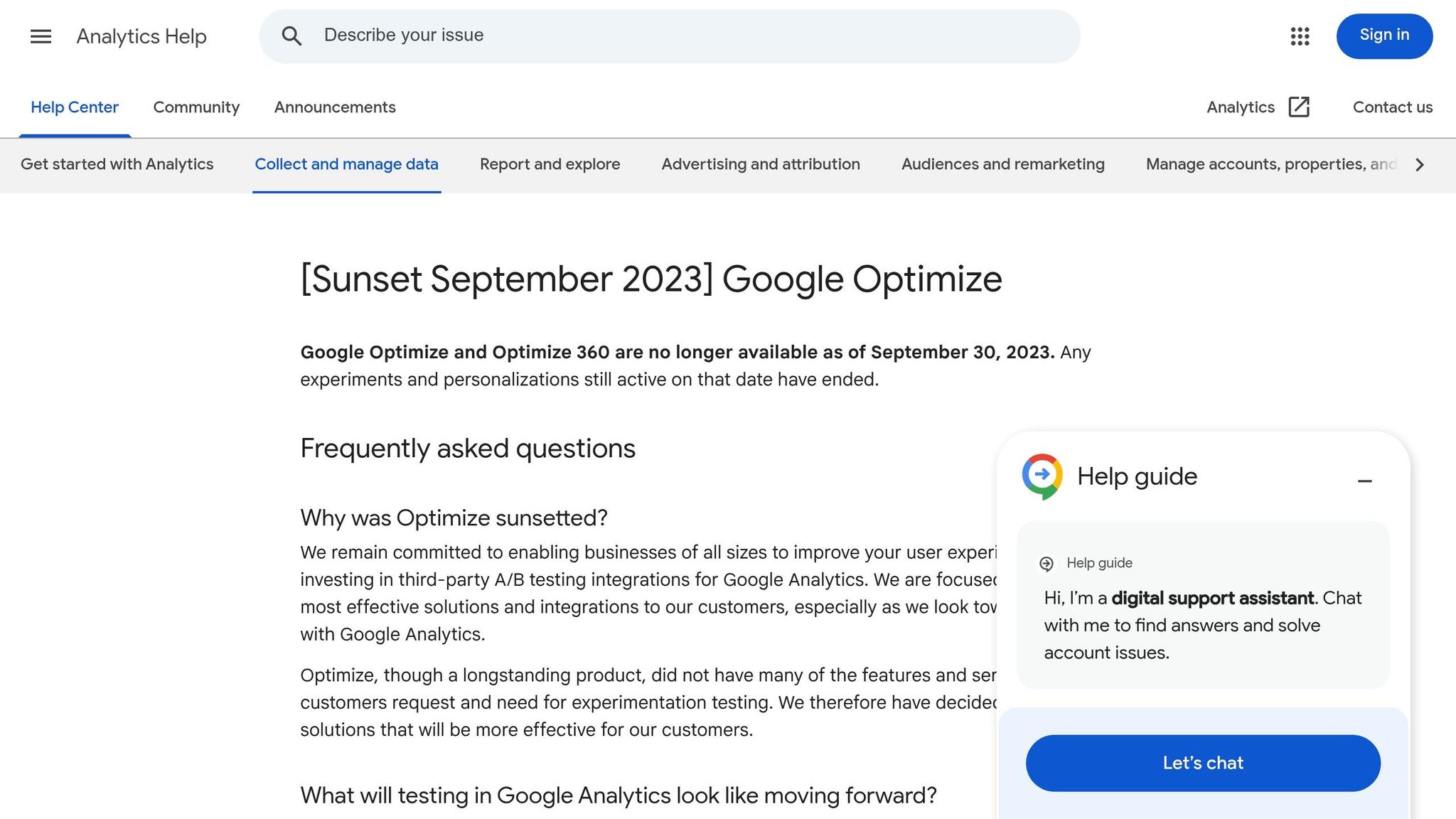
Important Note: Google Optimize and Optimize 360 were officially discontinued on September 30, 2023. However, the tools offered features that still inform the design of modern personalization platforms. While no longer active, they played a key role in shaping today's advanced personalization capabilities.
Personalization Capabilities
Google Optimize allowed businesses to create tailored content using its Visual Editor, which could modify site elements in real time. This enabled consistent, personalized experiences across multiple pages.
The Deploy Leader feature was particularly useful, as it turned successful A/B test variants into permanent site changes. This meant marketers could implement optimized experiences instantly without additional effort.
A standout example comes from Rituals Cosmetics, a European bath and body brand. In September 2018, they ran over 50 unique product promotions simultaneously. Digital Director Martijn van der Zee highlighted the platform's impact:
"With personalization features in Optimize, we've been able to quickly build personalized site experiences at scale. And with the analysis capabilities in Optimize, we're able to easily measure the impact these experiences are having on our business."
Integration with Existing Platforms
Google Optimize was tightly integrated with Google Analytics, which allowed businesses to leverage their existing data for testing and personalization. The enterprise version, Optimize 360, took this a step further by enabling the use of pre-defined Google Analytics audiences for targeted campaigns. This ensured personalized experiences reached the right customer segments.
The platform also supported precise targeting using behavioral and geographic data. For example, businesses could display location-specific promotions, such as free shipping offers for users in San Francisco. Since the tool's discontinuation, Google has shifted toward supporting third-party A/B testing tools through Google Analytics APIs.
User Behavior Tracking and Analysis
Google Optimize excelled at turning user behavior data into actionable insights. Marketers could create targeted experiences based on factors like purchase history or location, ensuring that personalized messaging followed users throughout their journey - from landing pages to conversions.
Its built-in analysis tools measured the effectiveness of each personalization, helping businesses refine their strategies over time. Although the platform has been sunset, its features continue to inspire the functionality of today's personalization tools.
5. Optimizely
Personalization Capabilities
Optimizely combines AI-powered automation with rules-based personalization to create tailored search experiences. Its Opal engine uses natural language processing (NLP) to build real-time interest profiles, ensuring products are prioritized based on how users interact with the platform.
You can choose between two approaches for personalization: manually configuring settings through Audiences (using data like location or device type) or relying on AI-powered predictive algorithms that adapt to user behavior over time. According to Francesco Montesanto, Content Marketing Manager at Optimizely:
"Personalization engines combine rules-based systems and machine learning to create dynamic, context-aware experiences."
For the best results, a hybrid approach works well - leveraging AI for predictive insights while setting specific triggers for key pages, such as pricing. Optimizely also integrates seamlessly with existing tools, further enhancing these personalization capabilities.
Integration with Existing Platforms
Optimizely’s integration capabilities ensure smooth data flow across systems, avoiding silos. The platform connects with data warehouses like Snowflake, BigQuery, and Databricks, as well as CRMs, CDPs, and tools like Salesforce, Google Ads, Adobe Analytics, and Slack.
With flexible API options, Optimizely supports both headless and hybrid setups, making it compatible with various content management systems and tech stacks. This unified system simplifies tasks like planning, creating, delivering, and measuring content - all from a single dashboard. Users have reported impressive results, including a 35% increase in test impact and a 37% rise in website engagement.
User Behavior Tracking and Analysis
Optimizely tracks user actions in real time, capturing everything from clicks and scrolls to hovers and exit intent. It segments engagement into distinct stages: early (e.g., blog visits, searches), middle (e.g., demo requests, reviews), and late (e.g., pricing pages, repeat visits). This segmentation allows the system to fine-tune search results based on where users are in their buying journey.
The Contextual Bandits feature uses machine learning to automatically present the most relevant search results, reducing the need for manual adjustments. As Optimizely explains:
"AI-powered recommendations act upon the unique interests of each visitor in real time to help you deliver personalization with minimal manual effort."
This AI-driven personalization has delivered impressive returns, with companies reporting an average ROI of 300% within 12 months - and some top performers achieving over 800%.
Dynamic Content Delivery
Optimizely ensures personalized search results are delivered across web, mobile, and email channels. Its real-time segmentation detects shifts in user behavior and adjusts results instantly. Conditional triggers allow for tailored responses, such as showing different results based on scroll depth or exit intent. Holdbacks can also measure the ROI of these adjustments. Additionally, the NLP dashboard identifies content gaps, ensuring dynamic updates improve user experiences and keep content relevant.
6. Dynamic Yield

Personalization Capabilities
Dynamic Yield uses AI to create affinity profiles that predict individual user preferences. Its Sorting Optimizer adjusts product grids dynamically based on a combination of user behavior, affinity, and business logic. This means two customers visiting the same category page might see completely different product arrangements, each tailored to their browsing habits.
The platform's Algorithm Studio allows brands to craft custom recommendation algorithms. Combined with its Deep Learning Recommendations, it can predict the next best product for shoppers in the early stages of their journey. According to Dynamic Yield, personalization efforts focused on user behavior have led to an 89% increase in purchases. Additionally, product recommendations account for 25% of revenue for some retailers.
Dynamic Yield also integrates easily with existing systems, making personalization even more seamless.
Integration with Existing Platforms
Dynamic Yield's Experience OS architecture is built to work smoothly with existing tools, whether you're using an eCommerce platform, CMS, data management system, or web analytics software [60,62]. It supports both server-side and client-side deployment, enabling businesses to gather data from multiple sources and deliver personalized content efficiently [59,62].
The Experience OS App Store offers pre-built extensions to enhance your current setup. Wilbert Vivas, eCommerce Manager at Cabela’s Canada, shared:
"Dynamic Yield's templating engine has empowered our team to build new experiences and get them up and running immediately. We're able to deliver a truly customized shopping experience and personalize at lightning speeds".
Many users report being fully operational in under a month, with noticeable results in as little as 10 days.
User Behavior Tracking and Analysis
Dynamic Yield takes personalization further with advanced behavioral tracking. By collecting real-time behavioral and contextual data, the platform creates AI-driven affinity profiles for each visitor. Its Predictive Targeting engine uses this data to match content variations with the most engaged audience segments automatically [59,61].
The platform also incorporates Mastercard Spend Insights, leveraging proprietary models to target customers based on their spending habits in specific regions. It even collects zero-party data - information willingly shared by users - through tools like gift finders and surveys, helping undecided shoppers while ensuring privacy compliance. This approach has delivered measurable success. For instance, Chal-Tec's Shop Manager Christian Ebhardt noted:
"We used the Multi-Touch Campaign capabilities to drive changes and test the entire website journey... increase of over 27% in the conversion rate for these customers".
Dynamic Content Delivery
Dynamic Yield’s Affinity Allocation feature adapts page elements in real time as user preferences evolve. This includes automatically restructuring page layouts, menu items, and categories to provide journey-aware recommendations across platforms like web, mobile, email, and ads.
For example, Dormify saw a 34% increase in mobile add-to-cart rates after launching a mobile-specific page layout for a key shopping experience. Optimizing product listing pages has also led to a 55% rise in add-to-cart rates. Beyond that, the platform ensures consistent messaging across SMS, email, and even in-store kiosks, creating a unified customer experience.
7. Hello Operator

Personalization Capabilities
Hello Operator leverages Generative Engine Optimization (GEO) to organize brand content in a way that makes it easy for AI search engines to reference. As AI-driven responses increasingly take the place of traditional search clicks, this tool ensures businesses stay visible. As Hello Operator puts it:
"If AI can't find you, your customers won't either." - Hello Operator
The platform also creates custom AI agents tailored to your brand's voice. These agents simulate real-world situations to test sales messaging against specific personas. For example, they can mimic challenging scenarios like presenting to doubtful executives, helping to identify and address potential weaknesses in your communication strategy.
Integration with Existing Platforms
Hello Operator seamlessly connects with tools like Slack, Microsoft Teams, email, and shared folders. Importantly, clients retain complete ownership of all AI solutions and content. Additionally, the platform supports content creation and localization in seven languages, making it easier to connect with diverse audiences without needing extra software.
The AI Inbound & Discovery service is priced at $3,950 and includes features like organic drop triage, technical audits, and GEO-readiness assessments. For $5,950 per month, businesses can opt for the Faster Horses automation package, which comes with a 15-day cancellation policy.
These integrations also provide advanced tracking features, enabling businesses to fine-tune their personalization strategies effectively.
User Behavior Tracking and Analysis
Hello Operator's Organic Drop Triage employs AI to analyze shifts in traffic or leads following updates. This involves identifying and resolving issues with crawlability, indexation, and rendering to ensure your site performs well for both human users and AI systems. The platform also conducts citation gap analysis to pinpoint missing placements in AI search results.
"As AI answers replace clicks, we make sure you're still the top recommendation so discovery and lead gen stay healthy." - Hello Operator
8. Algolia

Personalization Capabilities
Algolia processes an astounding 1.5 trillion search requests annually, serving more than 17,000 customers worldwide. Its personalization relies on AI-driven 1:1 customization, tailoring experiences to individual preferences in real time rather than lumping users into broad categories like "luxury shoppers".
The platform creates unique user profiles by tracking actions - such as clicks, views, and purchases to automate lead generation - over the past 90 days. These actions are then analyzed to identify "affinities" for specific attributes like brand, color, or genre. When a user performs a search, these affinities re-rank the results dynamically, ensuring each person sees items most relevant to their preferences, rather than a generic popularity-based list.
Algolia's Agent Studio enhances this personalization by combining large language models (LLMs) with real-time search data and memory functionality. Unlike standard LLMs that might generate inaccurate responses, Agent Studio uses Retrieval Augmented Generation (RAG) to ground its output in live index data, ensuring reliable and contextually accurate results.
These tailored profiles integrate smoothly into Algolia's broader system, ensuring a cohesive and consistent experience across platforms.
Integration with Existing Platforms
Algolia's API-first architecture makes it easy to integrate into existing tech stacks. With a single API and support for popular programming languages, the platform connects seamlessly. For non-technical teams, no-code connectors simplify integration with platforms like Shopify, Magento, BigCommerce, Adobe Experience Manager, Contentful, and WordPress.
Algolia also provides tools like the Intelligent Data Kit and Algolia Fetch, which allow businesses to automatically enrich search results by pulling real-time data from external APIs like DeepL, Stripe, and Google Maps. Additionally, it integrates with customer data platforms such as Segment and BigQuery to ingest behavioral events and product data.
"Algolia's built-in A/B Testing provides our business users with the agility to iterate on search relevance, and continuously improve our users' experience".
- José R. Pérez-Agüera, Director of ecommerce product management at Mercadona
User Behavior Tracking and Analysis
Algolia continuously refines search results by monitoring user behavior. Through the Insights API, it tracks standardized events like clicks, views, conversions, likes, and purchases. Each event is linked to a pseudonymous token, tying actions to a user profile across multiple sessions.
Businesses can assign weights (1–100) to different events and attributes. For example, a "purchase" might carry more weight than a "view", signaling a stronger intent. The Personalization Impact setting (ranging from 0 to 100) lets businesses control how much individual preferences influence search rankings. At a setting of 50, results aligned with user affinities can rank up to two times higher than non-matching results.
To ensure the system works as expected, Algolia recommends starting with conservative personalization settings and using the Personalization Simulator to validate outcomes before deploying changes. The platform also suggests focusing on returning or authenticated users, as they provide richer data and tend to drive higher average order values compared to first-time visitors.
Dynamic Content Delivery
Algolia extends its personalization features by delivering dynamic content that evolves in real time. Search results are dynamically reranked to prioritize the most relevant items for each user. Features like inline segmentation and personalized autocomplete offer tailored suggestions based on a user’s search history and preferences.
The platform also automates search refinement with dynamic synonym suggestions and query classification, helping users narrow down their searches more effectively. Additionally, Agent Studio simplifies orchestration, AI engineering, and cloud infrastructure management, all without extra GenAI-related costs. It even allows businesses to "bring-your-own-LLM", offering transparent pricing based on providers like OpenAI, Anthropic, or Google Gemini.
9. Adobe Target

Personalization Capabilities
Adobe Target excels at blending dynamic content delivery with detailed user profiling, making it a standout tool in personalized search optimization. Using machine learning, the platform tailors experiences to each visitor. Its Auto-Target feature identifies the best combination of content, offers, or entire pages based on user profiles and behavior patterns. Powered by Adobe Sensei, the User‑Based Recommendations algorithm examines a customer’s browsing and purchase history to reveal preferences and update suggestions in real time. Additionally, Next‑Hit Personalization adjusts the user journey during each session [74,75], while Model Controls exclude irrelevant factors like device type or weather from campaigns.
According to an IDC report, Adobe Target has delivered impressive results, including a 651% ROI over three years. One implementation saw a 38% increase in conversion rates, while another achieved 182,000 additional annual clicks and reduced bounces by 150,000. These features allow Adobe Target to adapt dynamically across various channels, offering a seamless and personalized experience.
Integration with Existing Platforms
Adobe Target integrates deeply with other Adobe tools to create unified personalization strategies. For example, pairing it with Adobe Real‑Time CDP allows websites to refresh in real time based on user actions, such as simultaneous interactions with a call center [74,76]. Adobe Analytics integration provides detailed reporting through A/B test dashboards. With Adobe Experience Manager (AEM), the tool uses "Experience Fragments" to deliver personalization at scale, whether for traditional or headless web setups. When combined with Adobe Commerce, it merges AI-driven merchandising with personalized content for a tailored shopping experience.
This robust integration ensures Adobe Target continuously refines its personalization strategies using real-time data.
| Integration Partner | Primary Use Case | Key Benefit |
|---|---|---|
| Adobe Analytics | Reporting & Analysis | Comprehensive A/B test dashboards |
| Real‑Time CDP | Data Activation | Real-time audience segment activation |
| AEM Sites | Content Management | Scalable personalized website experiences |
| Adobe Campaign | Email Personalization | Personalized offers in email campaigns |
| Adobe Commerce | E‑commerce Optimization | AI-driven merchandising for tailored shopping |
User Behavior Tracking and Analysis
Adobe Target’s decisioning engine tracks real-time user interactions across channels like web, mobile, and social platforms [74,75]. It builds detailed profiles from user actions - such as views, clicks, and purchases - and uses these profiles to refine personalization continuously. Marketers can set rules for specific audience segments or let machine learning automatically select content to maximize conversion potential.
Rob Hornick from Adobe highlights the power of the platform:
"Adobe Target Recommendations' new User‑Based Recommendations algorithm allows you to deliver an individually personalized 'Recommended For You' experience to each of your customers that is tailored to their unique behavior."
This approach has been shown to increase engagement by 125%, create 76 new audience segments, and direct B2B users to relevant support articles - helping reduce service costs [75,81].
Dynamic Content Delivery
Adobe Target adapts content dynamically throughout a user’s journey. Its Visual Experience Composer lets marketers test and optimize content placements - like choosing between side banners and pop-ups - without needing technical support. For instance, a "Recommended For You" section can complement a "Recently Viewed Items" tray on a homepage, helping users rediscover products. These User‑Based Recommendations can also be integrated into cart pages or checkout flows, excluding redundant suggestions to enhance user experience.
By continuously adapting content based on real-time insights, Adobe Target enables businesses to improve conversions and maintain engagement.
"Adobe Target optimizes and personalizes the most essential digital interactions, so you can improve the metrics that matter most - conversions, retention, revenue, and more."
- Adobe
10. Searchspring

Personalization Capabilities
Searchspring takes real-time data collection a step further with its genomic analysis, refining how it delivers personalized search results. By studying shopper behavior in the moment, the platform ranks and displays the most relevant products for each user. It factors in details like order history, recently viewed items, and current session activity to craft tailored product recommendations. One standout feature, Predictive Product Bundling, uses segmented targeting combined with real-time insights to suggest bundles that align with a shopper's buying potential.
The platform’s Dynamic Custom Profiles enhance personalization by instantly adapting recommendations based on data like search terms and filter selections. Merchandisers also have the flexibility to apply "Boost Rules" to highlight specific products, such as high-margin or newly launched items, while still allowing the AI to adjust to individual shopper preferences. Additionally, Searchspring learns product relationships by analyzing collective shopper behavior, adding another layer of precision.
Alicia Davis, Digital Project Specialist at Incu, highlights the platform's intuitive capabilities:
"For us, the power of Athos Commerce is its ability to read between the lines, understand our shoppers' intent, and use smart logic to help customers discover products they'll love."
Integration with Existing Platforms
Searchspring integrates smoothly with leading e-commerce platforms like Shopify, BigCommerce, Miva, Magento, and Adobe Commerce. Its setup process is straightforward - users simply add a custom HTML snippet to their site pages to activate personalized recommendations. From a centralized console, users can configure algorithm types, adjust page placements, and tweak template settings, with updates automatically applied across the store.
As of March 2025, Searchspring operates as part of the Athos Commerce Platform, which combines site search, merchandising, and personalization into one cohesive discovery system. The platform ensures search results stay relevant by syncing product intelligence and customer data through robust import and export capabilities. It has earned a customer satisfaction score of 4.0/5 from 380 reviews on Cuspera.
User Behavior Tracking and Analysis
Searchspring excels at tracking and analyzing shopper behavior to refine its recommendations over time. By monitoring metrics like order history, session activity, and search terms, the platform creates flexible logic to deliver relevant content - even for first-time visitors. This blend of predefined targeting and dynamic analysis ensures a personalized shopping experience from the start.
The platform also leverages genomic relationships between products and buying patterns to enhance product discovery and reduce the time it takes for shoppers to make a purchase. Personalized recommendations can appear on various site pages, including the home page, cart pages, and even zero-results pages. For the latter, using widgets like "Trending" or "Recently Viewed" helps keep visitors engaged and minimizes bounce rates.
Dynamic Content Delivery
Searchspring uses AI to analyze product relationships and deliver personalized content dynamically. It supports multiple recommendation types, including Cross-Sell, Cart Cross-Sell, Similar Products, Personal (history-based), Session-based, Trending, and Recently Viewed. These recommendations can be displayed across the site - on the home page, product pages, cart pages, and even in follow-up emails.
To boost Average Order Value (AOV), the platform’s "Cart Cross-Sell" feature suggests complementary products based on items already in a shopper's cart. Pricing starts at $699/month for the Essential plan, while the Expert plan includes advanced personalization options. The platform’s AI-powered features have been rated 4.05/5 by users, with analytics and custom reporting features receiving ratings of 4.05/5 and 4.15/5 respectively.
Conclusion
Personalized search has become a necessity - 84% of consumers now expect tailored experiences. The tools highlighted in this guide empower businesses to meet those expectations while delivering measurable outcomes.
Companies leveraging advanced personalization often see conversion rate boosts of 20% or more and generate 40% higher revenue from hyper-personalization compared to competitors. Additionally, personalization can cut customer acquisition costs nearly in half and improve marketing ROI by up to 30%. For example, when Electronic Merchant Systems tailored their outreach by merchant industry and intent in 2025, they achieved a 32% increase in inbound conversions and a 19% growth in revenue per lead. Nathaniel Short, Chief Revenue Officer, shared:
"At EMS, we didn't just 'add personalization.' We used a handful of key insights to make every touch point genuinely helpful for small business owners".
When implementing these tools, it's important to align the platform with your team's capacity and data readiness. For businesses with fewer than 50,000 monthly sessions, investing in a complex enterprise platform may be overkill. Instead, focus on impactful areas like cart abandonment or first-time visitor experiences, and scale your efforts gradually.
Choose tools that offer built-in A/B testing capabilities. Testing allows you to validate each personalization effort against a control group, ensuring that your strategy delivers real results.
The shift from reactive to proactive engagement is already happening. Today’s AI tools don’t just react to user behavior - they predict needs and deliver relevant content at the perfect moment. This proactive approach is particularly effective when generating AI content ideas for high-growth sectors. Darren Chait, Head of Growth Marketing at Calendly, emphasized this point:
"Every personalization campaign we run through Optimizely has resulted in significant improvements in conversion rate. And we have much higher levels of engagement, because we have an experience that's relevant to what you're doing and the stage you're at, as a customer".
FAQs
How do I choose the right tool for my business size and budget?
To find the right personalization tool, think about your business size, budget, and specific requirements:
- If you run a small business, look for tools that offer affordable pricing or even free plans. Larger companies, on the other hand, often need tools that can be tailored to their more complex needs.
- Pinpoint the features that matter most to you, such as predictive segmentation or the ability to engage customers across multiple channels.
- Make sure the tool works seamlessly with your existing systems and is easy for your team to start using without delays.
How can I measure if personalization is improving conversions?
To gauge how well personalization is working, use A/B testing and analytics to monitor key metrics like click-through rates and conversion rates. You can also run holdout tests or experiments to measure the incremental lift - essentially, the additional performance boost directly tied to personalization. These approaches provide clear insights into whether your personalization strategies are delivering real, measurable results.
How do I optimize for AI answers without hurting traditional SEO?
To ensure your content works well for both AI-generated answers and traditional search engines, you need a strategy that blends the best of both worlds. Here's how:
- Focus on AI-Friendly Content: Structure your content with clear, concise answers that align with how AI systems process information. Use natural language and sprinkle in keywords thoughtfully - don't overdo it.
- Leverage Structured Data: Adding structured data (like schema markup) helps AI and search engines understand your content better, increasing your chances of being featured in AI responses or rich search results.
- Keep an Eye on AI Citations: Monitor how AI tools reference your content. This can give you insights into how your information is being used and where you might need to tweak your approach.
At the same time, don't neglect the basics of traditional SEO:
- Backlinks and Site Speed: High-quality backlinks and fast-loading pages are still essential for maintaining strong search engine rankings.
- User Experience: A smooth, enjoyable user experience keeps visitors on your site longer and improves your overall visibility.
By combining these approaches, you can position your content to perform well in AI-driven environments without sacrificing traditional SEO performance.
Related Blog Posts

