
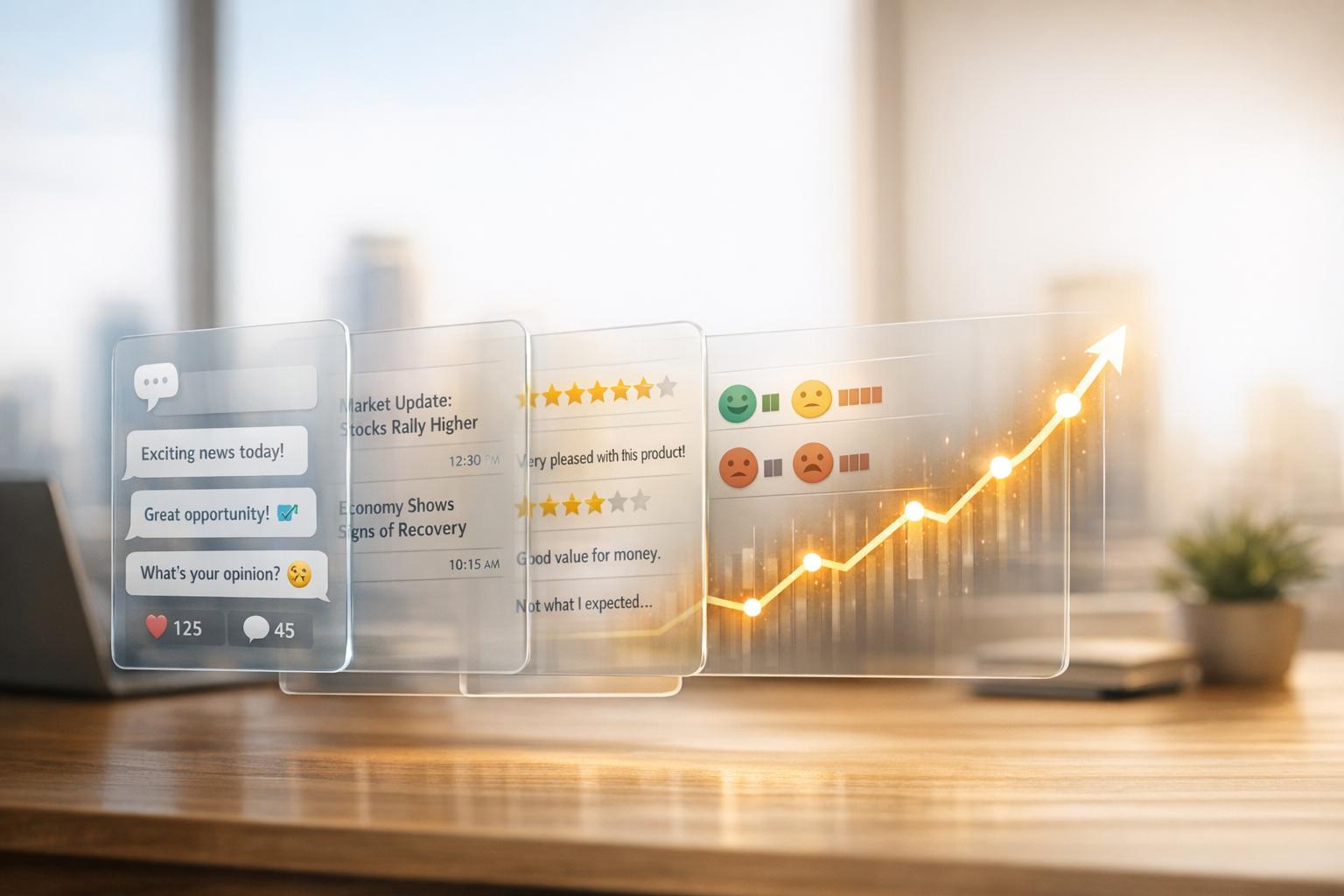
Sentiment analysis uses AI and NLP to analyze public opinions from sources like social media, financial news, and customer reviews. By identifying positive, negative, or neutral sentiment, businesses can detect early market trends and make informed decisions before traditional metrics reveal changes. Here's why it matters:
- Early Market Signals: Sentiment data often predicts stock movements and customer behavior faster than quarterly reports or sales figures.
- Data Sources: Social media, news, earnings reports, and customer feedback provide rich insights into market sentiment.
- Real-Time Monitoring: Tracking sentiment shifts helps identify risks and opportunities as they emerge.
- Practical Applications: Companies use sentiment analysis for forecasting, customer satisfaction, and competitive analysis.
Key takeaway: Sentiment analysis helps businesses stay ahead by turning unstructured data into actionable insights.
How to start with Sentiment Analysis in Stock Trading
sbb-itb-daf5303
Data Sources for Sentiment Analysis
The quality of data sources plays a huge role in how accurate sentiment analysis can be. By combining multiple sources, analysts can get a more complete view of market sentiment. For example, a research team analyzed 260,000 tweets alongside 6,000 news articles about Apple and Microsoft, achieving an 82% accuracy rate in predicting stock movements. This shows how blending different data channels can outperform relying on just one. Below are some key data sources that help refine sentiment analysis.
Social Media Platforms
Platforms like Twitter (now X), Reddit, and StockTwits provide real-time insights into investor sentiment, often surfacing trends faster than traditional media. These platforms can reduce the time lag for market signals from days to mere minutes. A 2020 study published in the Journal of Financial Economics found that sentiment on Twitter could predict abnormal stock returns the next day, especially for smaller companies. One of the most striking examples of this was the 2021 GameStop short squeeze, where Reddit discussions drove the stock price far beyond its fundamentals, forcing institutional investors to take retail sentiment seriously.
That said, social media data needs careful filtering. Bot detection and account verification are crucial to ensure the data reflects real users rather than coordinated manipulation. Additionally, not all posts carry the same weight - factors like author influence, follower count, and engagement levels should be considered when interpreting sentiment.
Financial News and Earnings Reports
Traditional sources like news articles, quarterly earnings calls, and analyst reports provide deeper context and reflect institutional sentiment. Although slower than social media, these sources can complement real-time signals by offering a more in-depth view of market conditions. For instance, management tone during earnings calls can reveal strategic priorities and future guidance that social media chatter might overlook.
A practical example of combining these sources is the VanEck Social Sentiment ETF (BUZZ), which tracks positive sentiment across social media, news, and blogs to identify promising U.S. large-cap stocks. Additionally, comparing social sentiment with official earnings reports can highlight discrepancies - if Twitter complaints contradict a company’s claims of improved operations, that could signal a potential risk.
Customer and Competitor Feedback
Customer reviews, surveys, and forums like Yahoo Finance offer a ground-level perspective on operational issues and brand perception, especially in industries like consumer goods, technology, and healthcare. These insights often surface long before financial statements reveal the impact. For example, the American Association of Individual Investors (AAII) survey provides a quantitative measure of overall investor sentiment, helping to balance out the noise from social media.
Competitor sentiment is another valuable angle. Employee reviews, discussions in developer communities, and customer feedback on rival products can reveal emerging threats or opportunities. Monitoring trends and sudden shifts in customer satisfaction is particularly important - these changes often signal shifts in financial performance months ahead of official reports.
How Sentiment Analysis Predicts Market Trends
Turning raw data into actionable insights involves a three-step process: cleaning the data, assigning sentiment scores, and tracking changes in real time. This structured approach helps detect market shifts early, building on the earlier discussion of data sources and laying the foundation for using real-time sentiment insights effectively.
Data Preprocessing and Analysis
Before data can be analyzed, it needs to be cleaned. Raw inputs from social media, news articles, and reports require standardization to ensure consistent processing. This means removing unnecessary characters, normalizing text, and addressing jargon so that phrases like "bullish outlook" and "BULLISH OUTLOOK!!!" are treated equally.
Natural Language Processing (NLP) tools like TextBlob or VADER step in to assign polarity scores to the text, typically on a scale from -1 (very negative) to +1 (very positive). These tools evaluate word choice, context, and intensity to interpret sentiment. For instance, a headline with "demand collapse" signals bearish sentiment, while "strong earnings guidance" suggests optimism. Once the data is clean and quantified, analysts can use AI tools for automated marketing reports to start mapping sentiment trends to market movements.
Sentiment Scoring and Trend Mapping
After assigning individual polarity scores, analysts calculate an aggregate sentiment score by averaging all the data points. The formula is simple:
S = ∑ sᵢ / N,
where sᵢ is each sentiment score, and N is the total number of entries analyzed. These scores, when aligned with historical market data and analyzed through regression, reveal how sentiment shifts correspond to price changes.
Regression analysis provides a predictive framework, expressed as:
Pₜ = α + βSₜ + εₜ,
where Pₜ represents price changes, and Sₜ is the sentiment score. A real-world example of this occurred during the March–April 2020 oil market crash. On March 1, 2020, positive sentiment was at 45%, and WTI crude oil was priced at $48. By April 20, 2020, positive sentiment had dropped to just 5%, while negative sentiment surged to 90%, with terms like "demand collapse" and "storage crisis" dominating the narrative. That same day, WTI crude prices plunged to an unprecedented -$37. By plotting sentiment polarity against market prices, analysts can visually confirm whether rising sentiment aligns with price increases.
Real-Time Monitoring for Early Risk Detection
Real-time sentiment monitoring adds another layer of insight, translating shifts in sentiment into early warning signals. This approach captures what experts call "narrative momentum" - the speed and coherence with which a market interpretation spreads, influencing prices even before fundamental data catches up. By treating sentiment as dynamic time-series data, analysts can track both the intensity and persistence of specific narratives.
The April 2020 crude oil crash highlights this capability. On March 15, 2020, negative sentiment reached 50%, with oil still priced at $36. By April 1, 2020, negative sentiment had climbed to 70%, while the price dropped to $22 - a clear signal of growing volatility before the final collapse.
As Permutable AI explains, "The challenge is no longer whether sentiment matters, but how to operationalise sentiment data in a way that is systematic, scalable and usable inside real trading and risk frameworks".
This kind of monitoring helps businesses differentiate between emerging narratives (potential opportunities) and widely accepted views (potential risks), enhancing decision-making on market entry and exit points. When a narrative starts to gain traction, markets often reprice during these acceleration phases, even if the fundamentals remain unchanged. By tying sentiment shifts to specific events - like policy announcements or supply disruptions - companies can spot regime changes or reversals before they fully materialize in market prices.
How to Implement Sentiment Analysis in Your Business
Taking sentiment data from theory to practice involves setting clear goals and identifying the right data sources. Whether you're aiming to understand brand perception, gather product feedback, or assess market risks, you need measurable objectives and reliable inputs like social media posts or financial reports. From there, decide on the best approach: rule-based systems (like simple keyword tracking), machine learning models (which can analyze context), or hybrid methods that often provide the most accurate results for tasks like marketing and brand management. This groundwork helps you choose the right tools for your needs.
Choosing the Right Tools and Solutions
Your choice of tools should align with your technical capabilities and business goals. If you have Python developers on your team, they can create custom solutions using libraries like tweepy for data collection and pandas for processing. These can be paired with APIs such as Hugging Face's Inference API, which provides access to over 400 pre-trained sentiment analysis models. If coding isn't an option, no-code platforms like Zapier can automate the process. For example, Zapier can connect data sources like Twitter to sentiment analysis engines and reporting tools like Google Sheets - all without writing a single line of code.
A great example of sentiment analysis in action comes from British Airways Holidays. They used an NLP-powered tool to analyze customer reviews, identifying emotions that turned customers into loyal advocates. This allowed them to address complaints proactively and improve overall customer satisfaction. Similarly, Divante (now Cloudflight Poland) scanned social media for software development-related keywords, launching targeted campaigns that increased both brand awareness and sales. For businesses that want ready-made solutions, platforms like Hello Operator offer customized AI tools and expert support to tailor sentiment analysis to your specific needs.
Integrating Sentiment Analysis into Business Workflows
To make sentiment analysis useful, it must be part of your everyday operations. Marketing teams can tweak ad campaigns based on changing public sentiment, while sales teams can identify and engage with potential customers discussing relevant topics on social media. In finance, sentiment analysis acts as an early warning system, alerting analysts to risks or market shifts before they become widely apparent. The key is creating processes that route sentiment insights to the appropriate teams - whether it's product development responding to feature requests or customer support addressing complaints before they escalate.
Set clear benchmarks to measure success. For instance, an 80% positive sentiment score is often considered strong. Regular tracking, whether weekly or monthly, helps you compare against past performance and adjust strategies as needed. Automating tasks with tools like AWS Lambda enables real-time monitoring. Once workflows are in place, ensure your team knows how to interpret and act on the data.
Training Teams for AI-Driven Decision Making
Even the most advanced tools need human oversight. Teams should be trained to see sentiment as more than just a "mood" metric - it reflects how events are interpreted and discussed. Since AI can struggle with sarcasm, irony, and certain cultural nuances, a human-in-the-loop approach is crucial for refining automated results. Grounding sentiment scores in specific events also helps make the data actionable.
Start small by running a pilot project within one department before rolling it out across the organization. Make sure there's a clear process for sharing how sentiment analysis has led to changes, as this transparency can boost customer loyalty. Businesses that effectively address feedback can see customer satisfaction rise by up to 15%. For additional support, Hello Operator offers AI marketing workshops to help teams learn how to interpret sentiment data and apply it to decision-making processes. This ensures your organization can consistently turn insights into meaningful actions.
Measuring Sentiment Analysis Performance

Sentiment Analysis vs Traditional Market Analysis Comparison
To understand how well your sentiment analysis system is working, you need to rely on solid performance metrics. One of the most reliable is the F1 score, which balances precision and recall. As SearchUnify puts it:
"The F1 score is a critical measure to track, for it is the harmonic mean of Precision and Recall values... it provides a broader perspective, and is more reliable than the accuracy metric".
Why does this matter? Because raw accuracy can sometimes paint a misleading picture. For instance, if 95% of your customer feedback is positive, a model that always predicts "positive" would show 95% accuracy, but it would entirely miss the negative feedback - an issue that could hurt your business.
Key Performance Metrics
When evaluating sentiment analysis systems, there are four main metrics to focus on:
- Accuracy: This measures the ratio of correct predictions to total predictions. However, it struggles with unbalanced datasets.
- Precision: This tells you how many of your positive predictions are actually correct (TP / [TP + FP]). It's especially important when false positives come with a cost.
- Recall: This measures how many actual positive cases your system successfully identifies (TP / [TP + FN]). It's crucial when missing negative signals could have serious consequences.
Performance varies depending on the type of sentiment analysis. Basic polarity classification typically achieves 82–88% accuracy, emotion classification 75–82%, and aspect-based sentiment 78–86%. With fine-tuned Transformer models, you can push accuracy up to 91–95%. Beyond these technical metrics, it’s also vital to track business outcomes like Customer Satisfaction (CSAT), Net Promoter Score (NPS), and Customer Effort Score (CES). These metrics provide a clearer picture of how sentiment analysis impacts your business and helps guide strategic decisions to improve customer experiences.
Sentiment Analysis vs. Traditional Market Analysis
One of the biggest advantages sentiment analysis has over traditional market research is speed. While surveys and focus groups can take weeks or even months to yield results, sentiment analysis can process millions of social media posts, reviews, and articles in real time.
Here’s a quick comparison:
| Feature | Sentiment Analysis | Traditional Market Analysis |
|---|---|---|
| Speed | Real-time or near real-time | Slow; periodic (weeks or months) |
| Scalability | Handles millions of posts easily | Limited by manual human capacity |
| Data Source | Unstructured (social media, reviews, calls) | Structured (surveys, focus groups) |
| Cost at Scale | Decreases with automation | Increases with human labor |
| Insight Depth | Identifies emotional drivers | Often limited to numerical scores |
Another key difference is that sentiment analysis can predict trends instead of just reacting to them. Take the March 2020 market crash, for example. The CNN Fear & Greed Index dropped below 10 points, signaling extreme panic. While traditional analysis focused on economic damage and falling prices, this sentiment indicator suggested fear had peaked, hinting at a market bottom. Investors who acted on this insight were well-positioned for the recovery.
Improving Models Over Time
Once you’ve assessed your system's performance, it’s time to refine it. Language evolves, and new cultural references emerge, leading to "concept drift" - a gradual decline in model accuracy. The solution? Continuous retraining. Regularly updating your model with fresh, labeled data ensures it stays relevant. As the Edge Delta team explains:
"Transformers are the current standard, but not 'set and forget.' Fine-tuning helps, but monitoring, retraining, and drift control are ongoing requirements".
To improve accuracy, set up feedback loops. For instance, when customer service reps override automated sentiment scores or when business outcomes don’t align with predictions, capture those cases to identify blind spots. Additionally, prioritize recent data over older examples to better reflect current sentiment trends.
If maintaining an in-house data science team isn’t feasible, platforms like Hello Operator offer tools for ongoing model optimization and AI workshops. These resources can help ensure your sentiment analysis remains both accurate and actionable over time.
Conclusion
Sentiment analysis opens up opportunities for forward-thinking market predictions that traditional research methods just can't deliver. While sales data shows you what’s already happened, sentiment data takes it a step further - measuring investor psychology, customer frustrations, and competitor weaknesses in real time to forecast what’s coming next.
The key to success lies in blending strategic insight with quick action. As we’ve explored, sentiment data isn’t just informative - it’s actionable. It helps businesses identify competitor blind spots and subtle market shifts, giving them a chance to react before these trends fully unfold. Thanks to modern LLM-based models, businesses can now pick up on nuanced signals that older systems would have missed. For example, phrases like "growth slowed less than expected" can now be recognized as a bullish indicator, rather than just neutral noise.
These insights don’t stop at predictions; they fuel real change across operations. Even companies without in-house data science teams can leverage tools like Hello Operator. This platform provides on-demand AI marketing experts and customized solutions, seamlessly integrating sentiment analysis into existing workflows. Their AI workshops also equip teams to interpret sentiment data and make smarter decisions - no deep technical skills required.
In short, sentiment analysis equips businesses to stay ahead of the curve and make decisions that shape the future.
FAQs
How reliable is sentiment data for predicting price moves?
Sentiment data has shown it can be a powerful tool for predicting price movements, with studies highlighting accuracy rates ranging from 83% to 89%. That said, it’s not a standalone solution. Its true strength lies in being paired with other analysis methods, which helps enhance its overall dependability.
How do you filter bots and hype from social media sentiment?
To sift through the noise of bots and exaggerated claims on social media, advanced AI tools like natural language processing (NLP) and machine learning (ML) play a crucial role. These technologies can evaluate the emotional tone of posts, helping to separate authentic human sentiment from automated or overly hyped content. Models like BERT and deep learning techniques take this a step further by processing unstructured social media data in real time. This allows them to pinpoint genuine market signals while reducing the influence of bots and inflated narratives.
How can I tie sentiment shifts to real business actions?
To keep a pulse on how people feel about your brand, track real-time sentiment from places like social media, customer reviews, and surveys. These insights reveal emotional patterns over time, which can guide decisions like improving customer service or tweaking your products. For example, if negative sentiment starts climbing, you can act quickly to address the issue.
Combine sentiment data with other metrics, such as customer retention, to measure its overall impact. This approach helps you make fast, informed decisions that align with customer emotions and shifting market trends.
Related Blog Posts

