

Predictive content analytics helps you forecast how your content will perform before publishing. Using AI and machine learning, these tools analyze data to predict engagement, optimize strategies, and improve ROI. Here's a breakdown of the top tools:
- Hello Operator: Custom AI solutions with human expertise. Pricing starts at $3,750/month.
- Domo: User-friendly with pre-built models and 1,000+ integrations.
- Microsoft Azure Machine Learning: Advanced ML capabilities for technical teams. Pay-as-you-go pricing.
- SAS Viya: Combines statistical modeling with scalability for enterprises.
- Alteryx: Drag-and-drop interface for non-technical users. Custom pricing.
- ThoughtSpot: Natural language search for quick insights. Enterprise-level pricing.
- Adobe Analytics: Predicts customer behavior with Adobe ecosystem integration.
- RapidMiner: Visual workflows for predictive modeling.
- H2O.ai: Open-source platform with AutoML for rapid model creation.
- IBM SPSS Statistics: Advanced statistical tools for detailed forecasts.
Each tool offers unique features tailored to different needs, from no-code platforms to advanced machine learning solutions. Choose based on your team’s technical skills, budget, and integration requirements.
Top 5 Predictive Analytics Tools and Software for 2023 Part 1
1. Hello Operator
Hello Operator provides an analytics-driven service that helps businesses predict how their content will perform, combining tailored AI tools with expert human insights. Their hybrid approach blends custom AI technology with on-demand marketing specialists, making it possible for organizations to optimize content performance without needing a dedicated data science team or extensive technical expertise.
Their platform creates custom AI applications that integrate seamlessly with your existing marketing tools. These applications analyze your proprietary data to deliver actionable insights. From tracking blog performance and video engagement to monitoring email campaigns and social media metrics, Hello Operator crafts secure workflows using APIs and custom code to meet your unique content analytics needs. This setup enables advanced predictive modeling, smooth integration, and solutions that grow with your business.
Predictive Modeling Capabilities
Hello Operator’s predictive modeling tools are designed to work specifically with your data, capturing subtle patterns and behaviors that generic tools might miss. Their AI applications are tailored to align with your audience’s behavior, preferred content formats, and overall business goals, ensuring your content strategy is built on a solid foundation of accurate predictions.
What sets them apart is their “human-in-the-loop” approach. This means that while the AI generates predictions, human experts interpret these insights, taking into account your broader strategy, market conditions, and objectives. This balance between AI and human expertise ensures the insights are both precise and practical.
Integration with Content and Marketing Tools
Hello Operator’s AI workflows integrate seamlessly with popular content management systems, analytics platforms, marketing automation tools, and communication channels. By embedding insights directly into the tools your team already uses, they make it easier to act on data-driven recommendations without disrupting your workflow.
Their solutions are designed to work for teams of all sizes, adapting to the unique needs of each organization.
Scalability for Teams of Different Sizes
Whether you’re a small team looking for specialized AI support or a large enterprise with complex analytics needs, Hello Operator’s service is built to scale. Smaller teams can access high-level expertise without hiring a full-time data science team, while larger organizations can develop comprehensive, custom applications tailored to their advanced requirements. This flexible model allows businesses to adjust their engagement based on their current needs and budget.
Pricing and Accessibility
Hello Operator offers two flexible service tiers:
- Ongoing & On-Demand Plan: Starting at $3,750/month, this plan includes full-stack AI marketing support via Slack, regular AI workflow updates, SEO optimization, daily content production, and agency-level access.
- Project-Based Plan: Starting at $5,950/month, this option delivers strategic planning, custom AI applications, and dedicated project management. There are no long-term contracts, and services can be paused or canceled with 15 days’ notice.
Additionally, they offer AI workshops and training at custom pricing to help teams build their skills in predictive analytics.
2. Domo
Domo is a cloud-based platform powered by AI, designed to bring predictive analytics within reach for marketing teams. With pre-built models and the ability to create custom ones, it equips teams to forecast and analyze with precision. Its user-friendly approach makes predictive modeling accessible and adaptable to various needs.
Predictive Modeling Capabilities
Domo emphasizes simplicity and flexibility. It provides no-code, pre-built forecasting tools alongside a drag-and-drop interface for building custom models. This allows teams to predict content performance, understand customer behavior, and optimize marketing strategies - all without needing advanced technical expertise.
Integration with Content and Marketing Tools
Domo connects seamlessly with over 1,000 data sources and business applications. This extensive integration network pulls data from CMS platforms, marketing tools, analytics systems, and customer databases, consolidating it into a single, secure hub. The result? A streamlined, centralized space for managing and analyzing your data.
Scalability for Teams of Different Sizes
Whether you’re a small team using pre-built models or a large organization crafting custom ones, Domo adapts to your needs. Its drag-and-drop interface and conversational data exploration tools make it easy for business users and data analysts to collaborate. This fosters efficient, data-driven decision-making across teams.
Pricing and Accessibility
Domo’s pricing is designed to grow with your organization, though specific pricing tiers aren’t publicly disclosed. Advanced features may come with higher-tier plans. By mastering Domo, teams can simplify analytics workflows and gain faster, more actionable insights.
3. Microsoft Azure Machine Learning
Building on Domo's user-friendly analytics, Microsoft Azure Machine Learning offers a powerful platform that combines enterprise-level flexibility with automation.
Microsoft Azure Machine Learning is a cloud-based solution designed to help businesses build, train, deploy, and manage predictive models at scale. With support for a variety of algorithms, it caters to both simple predictive tasks and complex analytics challenges. The platform's blend of automated machine learning (AutoML) and custom algorithm development makes it well-suited for tasks like predicting metrics, audience engagement, or conversion rates.
Predictive Modeling Capabilities
Azure ML goes beyond basic forecasting, offering tools designed for advanced content analytics. It supports various algorithms and enables data teams to craft models tailored to specific needs. Whether you're forecasting the best times to publish content, identifying topics that resonate with particular audiences, or determining which formats drive the most engagement, Azure ML has the tools to get the job done.
Its AutoML feature simplifies the process by automatically selecting the best algorithms, performing feature engineering, and validating models. This allows teams to quickly create predictive models, such as lead scoring systems, without requiring deep expertise.
Another standout feature is its ability to handle multiple data types and perform complex analyses. Teams can set up automated retraining pipelines, ensuring models stay accurate as new data comes in. This is especially valuable for organizations managing large-scale content across multiple channels, where manually updating models would be inefficient.
Integration with Content and Marketing Tools
Azure ML integrates seamlessly with Power BI, creating a unified environment for analytics. Teams can build predictive models in Azure ML and view the results directly in Power BI dashboards, streamlining workflows and reducing the need to juggle multiple tools.
For organizations already using Microsoft products like Office 365, Dynamics 365, or SharePoint, Azure ML offers native connectivity. This allows data to flow smoothly from content repositories to predictive models. Combined with other Azure services, it creates a robust system for automating data preparation and ensuring data quality before model training.
Scalability for Teams of Different Sizes
Thanks to its cloud-native design, Azure ML scales effortlessly to meet the needs of both small teams and large enterprises with complex deployments. It’s built to accommodate users ranging from business analysts to experienced data scientists, though the experience can vary depending on technical skill levels.
For smaller teams, the platform's automation reduces the need for specialized expertise, enabling existing staff to build predictive models. However, it does come with a steep learning curve, which may require an initial investment in training or hiring specialized talent. Additionally, some users have reported limited access to Python libraries, which could restrict advanced customization for those relying on specific machine learning frameworks.
Pricing and Accessibility
Microsoft Azure Machine Learning offers a 30-day free trial and a pay-as-you-go pricing model, making it an attractive option for organizations looking to test its capabilities before committing. With pay-as-you-go, businesses only pay for the resources they use, such as model training, inference, and data storage. This flexibility is particularly beneficial for teams with fluctuating workloads.
Costs for content analytics depend on several factors, including the volume of data processed, the complexity of models, and how often models need retraining. While the pricing structure allows for scalability, organizations should also account for potential expenses like training or hiring skilled data scientists. Microsoft supports users with extensive documentation, tutorials, and certification programs. Additionally, a large community of Azure ML users actively shares tips and solutions through forums and GitHub repositories, which can help teams get up to speed quickly.
4. SAS Viya
SAS Viya is a robust analytics platform designed to deliver advanced data insights while remaining accessible for users predicting content performance. It’s a go-to tool for organizations seeking to dive deep into predictive analytics, combining machine learning, forecasting, and visualization to make sense of complex data. Its ability to handle massive datasets efficiently sets the stage for advanced predictive modeling capabilities.
Predictive Modeling Capabilities
SAS Viya caters to both technical and non-technical users with a dual approach. It features a user-friendly visual interface for creating and deploying models without coding, while also offering coding options for those who need deeper customization. This approach fosters collaboration between business analysts and data scientists. For content analytics, the platform helps forecast trending topics, predict engagement rates, and fine-tune publishing schedules. Its automated forecasting tools analyze historical performance data to identify patterns and project future outcomes, reducing the need for frequent manual updates.
Integration with Content and Marketing Tools
SAS Viya’s strengths in forecasting are further enhanced by seamless integration with the SAP Analytics Cloud ecosystem. It supports end-to-end analytics workflows, from data preparation and cleansing to advanced statistical modeling. This integration enables content teams to begin with basic predictions and eventually tackle more advanced analyses, such as audience behavior trends and content ROI. The platform also provides tools for in-depth visual data exploration, making it easier to uncover actionable insights.
Scalability and Limitations
As a cloud-native solution, SAS Viya is built to scale for a variety of needs, whether it’s a mid-sized marketing team or a large enterprise managing extensive content libraries. Its combination of user-friendly design and advanced customization options allows teams to expand their analytical capabilities without disrupting existing systems. However, one limitation is the lack of pre-built models; organizations with unique tracking requirements may need to invest time in creating custom models.
Pricing and Accessibility
Pricing information for SAS Viya isn’t publicly available, but its enterprise-grade positioning suggests it comes with a premium price tag. Organizations can request customized quotes based on factors like the number of users, data volume, and any additional modules needed for content performance prediction. A key benefit is the inclusion of free user training, which helps marketing teams quickly get up to speed with the platform, bridging the gap between analytics and marketing expertise.
With a strong track record in statistical analysis and a reputation for reliability, SAS Viya remains a trusted choice for businesses looking to scale their data mining and predictive modeling efforts.
5. Alteryx
Alteryx is all about simplifying data preparation and blending, helping teams turn raw information into actionable predictions. Unlike many platforms that dive straight into modeling, Alteryx understands the common challenge of dealing with messy, disconnected data sources. Its drag-and-drop interface makes it approachable for business analysts without formal data science training, while still offering advanced tools for technical users who need more complex capabilities.
Predictive Modeling Capabilities
Alteryx's visual workflow builder allows users to create predictive models without writing any code. You simply drag components onto a canvas, connect them, and watch as your data flows from cleaning to modeling. This streamlined process can cut down project timelines from weeks to just a few days.
For content teams, this means you can quickly build models to forecast which topics will drive more engagement, determine the best times to publish, or identify formats that resonate with specific segments of your audience. The platform covers everything - data cleaning, analysis, and even model deployment - all within one environment.
What makes Alteryx stand out is its versatility. Non-technical users can rely on pre-built predictive tools through the visual interface, while advanced users can integrate R for more detailed statistical modeling. This dual approach ensures that as your team's skills grow, the platform can keep up without the need for a costly migration. By focusing on solid data preparation, Alteryx makes building predictive models a smoother process.
Integration with Content and Marketing Tools
One of Alteryx's strengths is its ability to connect with a wide range of data sources, including CMS platforms, marketing automation tools, social media, and customer databases. With its extensive library of data connectors, you can easily pull data from different systems and blend it into unified datasets for analysis.
This integration is especially useful when you want to link content performance to customer behavior. For example, you can combine engagement metrics from your CMS with conversion data from your marketing automation platform and demographic details from your customer database. This gives you a complete picture of how your content influences the customer journey. Plus, the platform automates recurring data pipelines, so fresh data is continuously fed into your predictive models without requiring manual updates.
Scalability for Teams of Different Sizes
Alteryx's design and integration capabilities make it adaptable for teams at various stages of analytics development. Smaller marketing teams can benefit from its active user community, where you’ll find shared workflows, templates, and practical tips. This means you don’t have to start from scratch - many solutions are already available and tested by others.
For larger enterprises, Alteryx offers features like governance tools, version control, and collaboration options. These make it easier for multiple teams to work together while maintaining data quality and consistency. The platform also handles large datasets efficiently, whether you're a mid-sized company analyzing thousands of content pieces or a global enterprise managing millions of data points across various markets.
Pricing and Accessibility
While Alteryx doesn’t disclose its pricing publicly, it’s positioned as a solution that simplifies workflows and lowers barriers for teams. Its code-free approach reduces the need for specialized data science hires, which can help offset licensing costs by improving productivity and speeding up hiring processes.
Pricing will vary depending on factors like the number of users, data volume, and required integrations. However, the platform’s automation capabilities mean that once your workflows are set up, they continue generating insights with minimal ongoing effort. Combined with community resources and pre-built solutions, Alteryx can help you achieve faster results and lower overall costs compared to platforms that require heavy customization.
6. ThoughtSpot
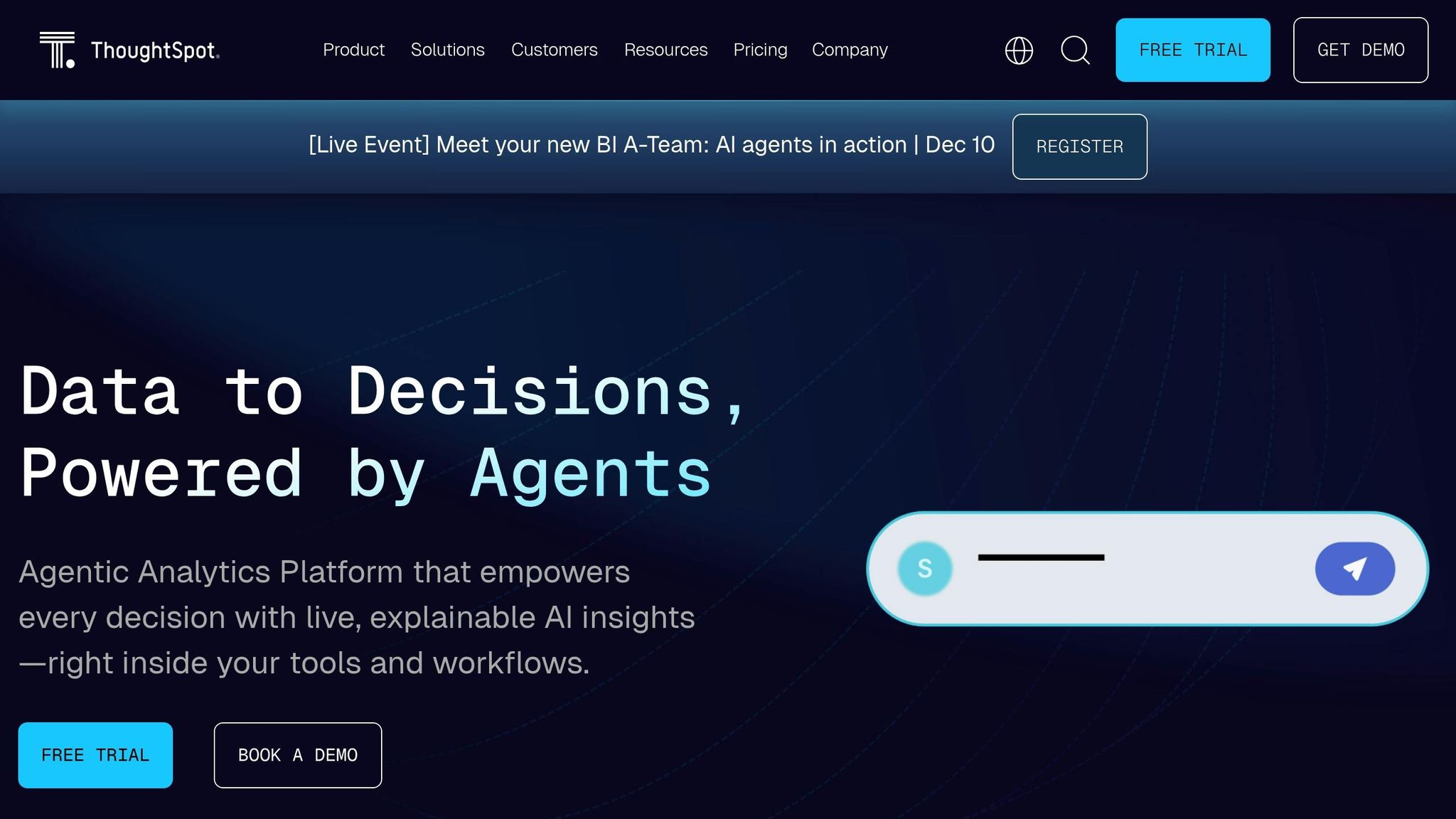
ThoughtSpot takes the idea of traditional dashboards and predictive insights a step further by using natural language search to make data analysis more accessible. Instead of navigating complex dashboards or learning specialized query languages, you can simply type your questions in plain English and get instant answers. This search-driven approach removes barriers, making it easier for content managers and marketers - especially those without technical expertise - to quickly make informed, data-driven decisions. It complements other predictive tools by simplifying access to insights and speeding up the decision-making process.
The platform's standout feature is its ability to eliminate the technical hurdles that often prevent content teams from fully leveraging analytics. For example, if you're trying to figure out which content topics will perform best next month or spot trends in audience engagement, you can ask these questions directly in the platform. There's no need to wait for a data analyst to create a custom report.
Predictive Modeling Capabilities
ThoughtSpot uses AI-powered technology to uncover patterns in your content performance data. It analyzes historical trends and identifies correlations that might not be immediately obvious through manual analysis. This means content teams can easily spot emerging topics, predict audience engagement for different formats, or plan for how seasonal trends might impact their strategies.
The platform's natural language processing allows users to ask straightforward questions like, "Which content topics lead to the most conversions?" or "What engagement levels can we expect next month?" ThoughtSpot interprets these questions, dives into the data, and generates clear visualizations to provide answers. It also continuously monitors your data, flagging anomalies that could impact performance. Best of all, it handles complex questions without requiring any expertise in statistics or data science, making predictive modeling accessible to everyone on the team.
By translating natural language queries into actionable insights, ThoughtSpot ensures that even non-technical users can quickly gain a deeper understanding of their content performance. This streamlined approach helps teams move faster, as they no longer need to rely on technical experts to unlock key insights.
Integration with Content and Marketing Tools
ThoughtSpot offers a wide range of data connectors, allowing you to pull information from platforms like your content management system (CMS), web analytics tools, marketing automation software, and customer databases. By consolidating data from these sources, the platform enables you to ask more detailed questions about content performance. For instance, you could combine engagement metrics from your CMS with conversion rates from your marketing platform and demographic data from your customer database. This unified view allows you to predict not just which content will attract views, but also which content will drive meaningful business outcomes.
This ability to integrate data across platforms also makes it easier for teams to collaborate and scale their efforts. Whether you're working with a small team or managing a large, multi-channel content strategy, ThoughtSpot ensures that everyone has access to the same comprehensive insights.
Scalability for Teams of Different Sizes
The simplicity of ThoughtSpot's search-based interface makes it a practical choice for small content teams dipping their toes into predictive analytics. You don’t need a dedicated data science team to get started - content managers and strategists can jump right in, asking questions and getting actionable insights with minimal effort. The platform's design mirrors the way people naturally search for information online, so the learning curve is minimal.
For larger organizations, ThoughtSpot is built to handle the complexities of enterprise-level analytics. Marketing teams managing diverse content portfolios can use the platform to analyze performance across multiple regions, product categories, or audience segments. Whether you're dealing with thousands of blog posts or millions of social media interactions, ThoughtSpot efficiently processes large datasets.
The platform also supports collaboration across teams. Multiple users can explore the same data simultaneously, ask different questions, and share insights. This collaborative functionality ensures that everyone is aligned and working from the same data-driven insights, rather than relying on fragmented or outdated reports.
Pricing and Accessibility
As an enterprise-grade analytics solution, ThoughtSpot’s pricing reflects its advanced AI capabilities and natural language processing features. While specific pricing details aren’t publicly available, organizations should anticipate costs in line with other high-end enterprise software investments.
When evaluating its value, consider the productivity gains from the platform’s ease of use. ThoughtSpot’s ability to deliver insights quickly - without requiring lengthy setup or complex configurations - can save time and resources, providing a faster return on investment. However, smaller teams with tighter budgets might find more specialized tools better suited to their needs. ThoughtSpot’s real strength lies in its ability to break down technical barriers, allowing teams to start generating insights almost immediately. This makes it a powerful option for businesses looking to streamline their analytics processes and make smarter decisions faster.
sbb-itb-daf5303
7. Adobe Analytics
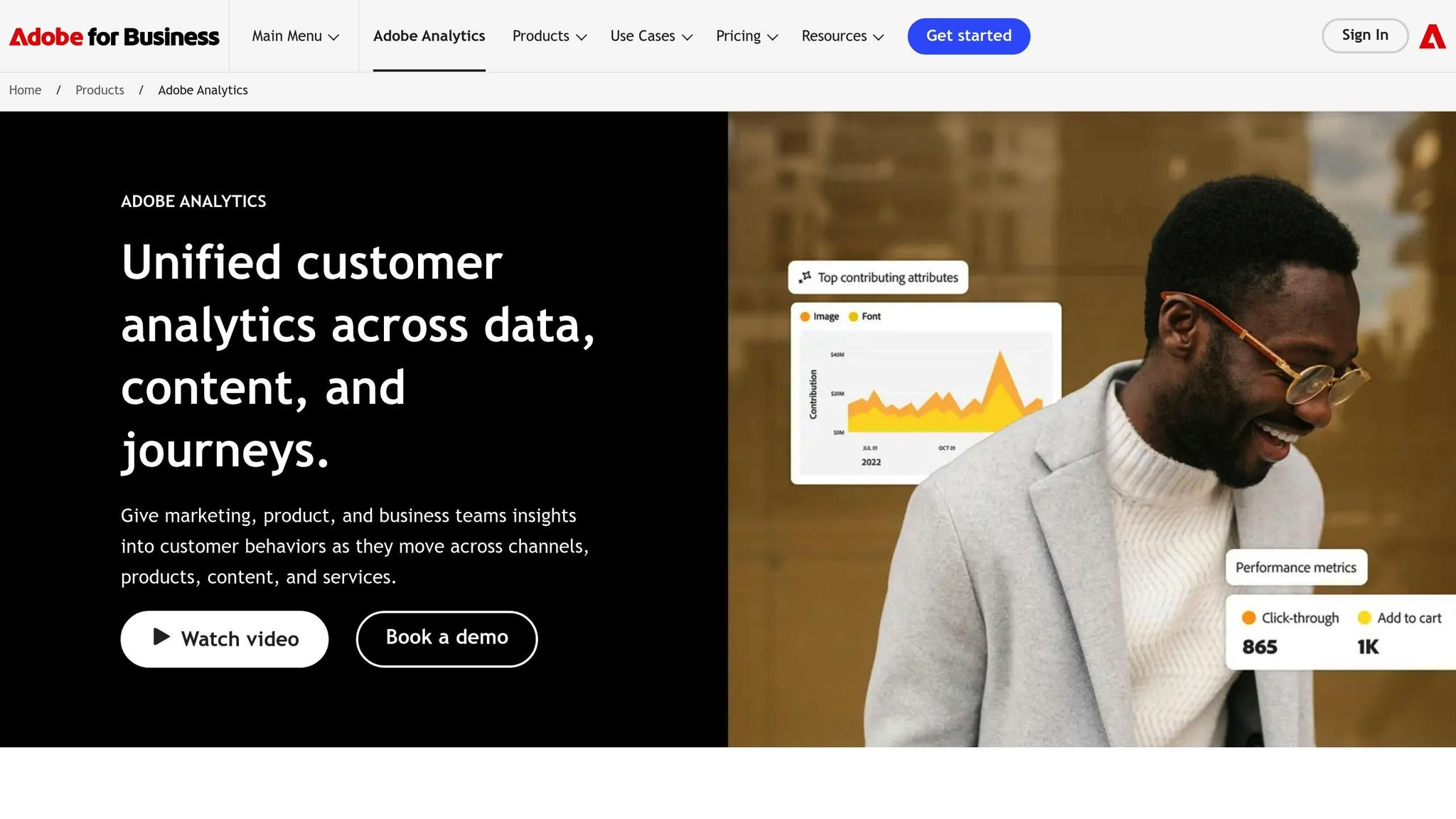
Adobe Analytics brings predictive capabilities into the Adobe Experience Cloud, enabling content teams to forecast and act on performance metrics without needing to switch between platforms. This seamless integration empowers teams to not only anticipate outcomes but also take immediate action based on those predictions.
Much like other advanced tools, Adobe Analytics merges data insights with integrated workflows to refine content strategies. By leveraging statistical modeling and machine learning, the platform predicts how content will perform even before it’s published. This allows teams to identify topics that resonate with their audience, estimate engagement levels for various formats, and project conversion rates throughout the customer journey. With this data-driven approach, teams can allocate their resources more effectively, focusing on initiatives that are most likely to deliver impactful business results.
Predictive Modeling Capabilities
Adobe Analytics excels at forecasting customer behavior, which directly informs predictions about content performance. By analyzing historical data, the platform pinpoints high-performing content types, trending topics, and key audience segments. It also predicts customer churn, allowing teams to take proactive measures. Using AI-driven insights, teams can segment audiences and forecast how different groups will engage with content before it even goes live. This includes projecting performance across different audience personas and lifecycle stages, helping teams identify which content pieces are likely to drive conversions and foster long-term customer retention.
What makes Adobe Analytics stand out is its ability to provide insights across the entire customer journey. Instead of focusing solely on isolated metrics like page views or click-through rates, it evaluates how content influences customer behavior over time, offering a more comprehensive view of effectiveness.
Integration with Content and Marketing Tools
As part of the Adobe Experience Cloud, Adobe Analytics benefits from robust integration capabilities. It works seamlessly with tools like Adobe Experience Manager, Adobe Target, and Adobe Campaign, creating a feedback loop that improves predictions and automates content personalization.
For example, content teams can automate the delivery of tailored content based on predicted engagement levels. This eliminates the need for manual adjustments, ensuring the right content reaches the right audience at the right time. By consolidating data from website analytics, email metrics, and social media interactions, Adobe Analytics provides a unified view of content performance. This holistic approach helps teams go beyond channel-specific strategies, enabling them to develop plans that enhance the overall customer experience.
Scalability for Teams of Different Sizes
Adobe Analytics is designed with marketing professionals in mind, offering a user-friendly interface that doesn’t require deep technical expertise. Customizable dashboards allow content managers to focus on the predictions most relevant to their goals without needing to dive into complex statistical models. However, the platform does come with a steeper learning curve compared to simpler tools, so teams should allocate time for proper training and onboarding.
For larger organizations managing multi-channel operations, Adobe Analytics scales effectively. Its cloud-based infrastructure can handle massive data volumes, and the platform allows for expansion as analytics needs grow. Teams can start with basic dashboards and reporting, gradually adopting advanced features like segmentation and custom algorithms as their analytics capabilities mature.
Pricing and Accessibility
Adobe Analytics is offered through a subscription model within the Adobe Experience Cloud, with pricing details available upon consultation. The platform provides flexible configuration options, allowing organizations to tailor the setup to their specific needs and budgets. However, accessing advanced predictive features or managing larger data volumes typically requires a higher-tier subscription.
For organizations already using Adobe’s suite of marketing tools, adding Adobe Analytics enhances workflow efficiency and unifies data insights. This creates a streamlined environment where teams can create, publish, and analyze content within a single ecosystem, speeding up decision-making and reducing operational friction.
Smaller teams, however, should carefully weigh the costs against the platform's potential benefits. It’s essential to assess whether the advanced predictive features align with their analytics needs and whether they’re prepared to fully commit to Adobe’s ecosystem in the long run.
8. RapidMiner
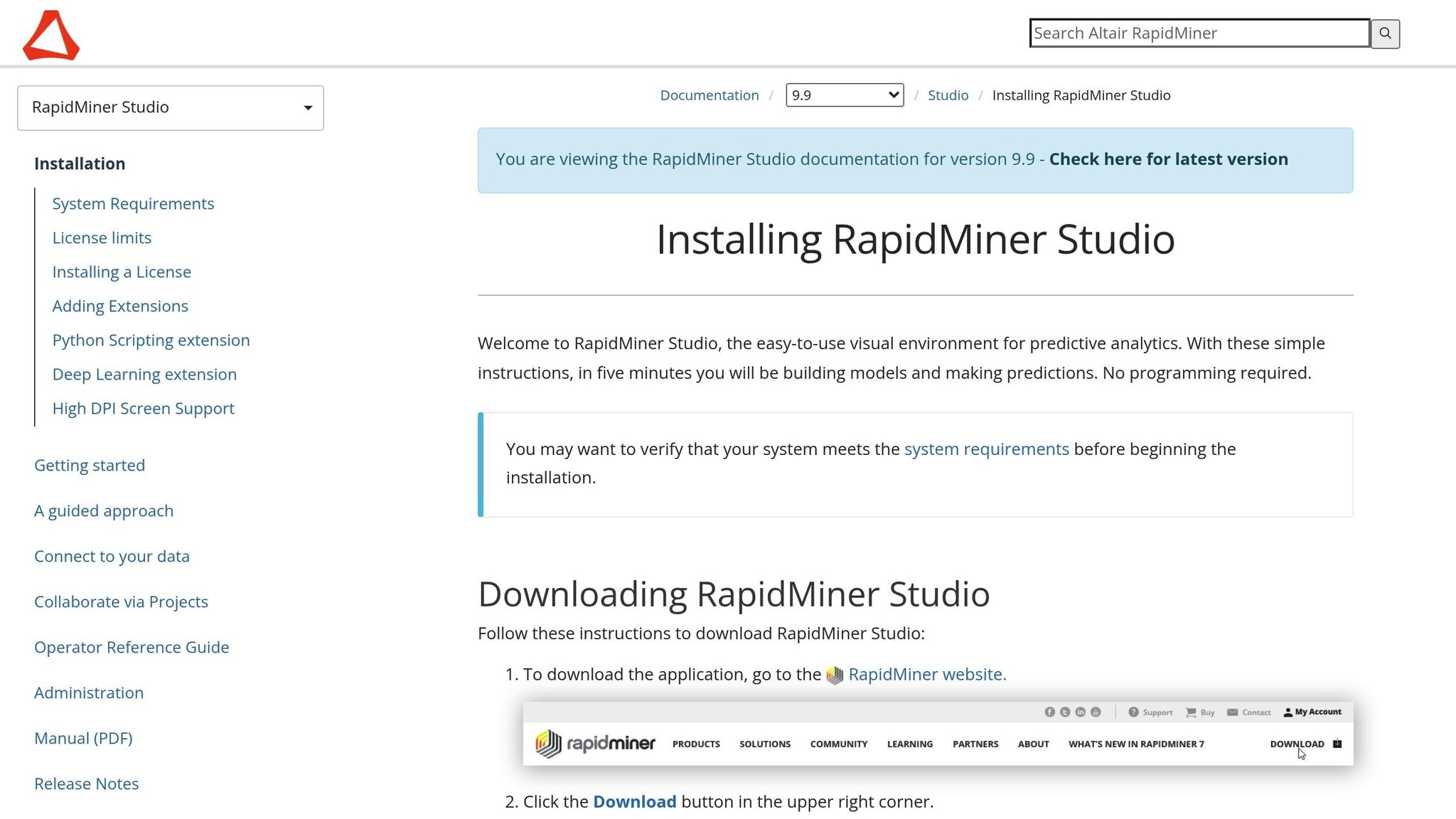
RapidMiner is a comprehensive data science platform designed for end-to-end predictive analytics. Unlike tools tailored specifically for marketing, it offers a highly customizable environment with visual workflows. This makes it accessible not just to data scientists but also to content managers, allowing them to uncover advanced insights without needing to write code.
The platform simplifies integration challenges by consolidating data from websites, social media, email campaigns, and CMS platforms. Its drag-and-drop interface makes it easy to connect various data sources, merge them into unified datasets, and develop predictive models. These models can forecast content performance, predict engagement levels, and analyze audience behavior across multiple channels.
Predictive Modeling Capabilities
RapidMiner's predictive modeling stands out with its user-friendly visual workflows, eliminating the need for extensive programming skills. It identifies performance trends, forecasts audience engagement, and provides real-time scoring to adjust predictions as content is published. The platform continuously refines its models, offering maintenance alerts to signal when content needs updates, ensuring strategies stay ahead of potential performance dips.
Content teams can use these tools to spot patterns in successful content, predict which topics will resonate with specific audience segments, and estimate engagement levels before publishing. This proactive approach helps maintain the quality and relevance of content throughout its lifecycle.
Integration with Content and Marketing Tools
RapidMiner integrates seamlessly with a variety of tools, including CMS platforms, web analytics, and marketing software, bringing together data from diverse sources into cohesive datasets. While it offers extensive customization options, this flexibility does come with a steeper setup process compared to plug-and-play marketing tools.
What sets RapidMiner apart is its ability to provide a holistic view of content performance across the customer journey. Rather than focusing on how individual pieces of content perform in isolation, it helps teams understand how content contributes to broader marketing goals. This cross-channel perspective is particularly valuable for organizations aiming to optimize their overall strategy.
Scalability for Teams of Different Sizes
RapidMiner’s low-code environment makes it accessible to teams with varying levels of technical expertise. Business analysts and content managers can use the platform’s visual interface to build predictive models, while more advanced users can dive into its deeper capabilities for complex tasks. This dual-level functionality makes it suitable for both small teams starting with predictive analytics and large enterprises with dedicated data science departments.
The visual workflow design encourages collaboration between team members with different skill sets. For instance, content managers can define prediction goals while data analysts use the drag-and-drop tools to build models. This collaborative approach reduces delays that often occur when teams rely solely on technical specialists for analysis.
Additionally, RapidMiner benefits from a strong user community where teams can share workflows, best practices, and solutions. This collective knowledge helps new users overcome challenges faster, shortening the learning curve and maximizing the platform’s value.
Pricing and Accessibility
RapidMiner offers flexible licensing options that cater to different budgets. While it’s ideal for teams with unique analytics needs, smaller teams should ensure they have at least one member familiar with basic data analysis to get the most out of the platform.
When considering RapidMiner, teams should evaluate whether they need a customizable, general-purpose analytics platform or a marketing-specific tool with pre-built features. RapidMiner is particularly well-suited for organizations looking to spend less time on data preparation and more on developing models and extracting insights. Teams willing to invest in the initial configuration process will find its flexibility and advanced features rewarding in the long run.
9. H2O.ai

H2O.ai stands out as a robust predictive content analytics tool, rooted in open-source technology. It’s designed to simplify complex machine learning tasks, making it a go-to solution for teams of all sizes looking to build predictive models efficiently.
Predictive Modeling Capabilities
H2O.ai takes the heavy lifting out of machine learning by automating tasks like feature engineering, model selection, and hyperparameter tuning. Whether you're working on classification, regression, or time series forecasting, this platform delivers. Plus, it provides insights into key input factors, helping users understand what drives the predictions. The result? A strong foundation for predictive modeling that’s both efficient and transparent.
Integration and Flexibility
One of H2O.ai's strengths is its ability to integrate seamlessly with other systems. Thanks to APIs and data connectors, users can analyze data from multiple sources without a hitch. This flexibility makes it suitable for a wide range of predictive analytics applications, no matter the industry or use case.
Scalability
Whether you’re part of a small team or a large organization, H2O.ai can scale to meet your needs. While the initial setup might require some technical know-how, the platform’s architecture is built to handle growing data demands without requiring major overhauls.
Pricing and Accessibility
The platform’s core version is free and open-source, making it accessible to a broad audience. For those who need additional features like enhanced security, dedicated support, and easier deployment options, the enterprise version is available with custom pricing tailored to specific needs.
10. IBM SPSS Statistics
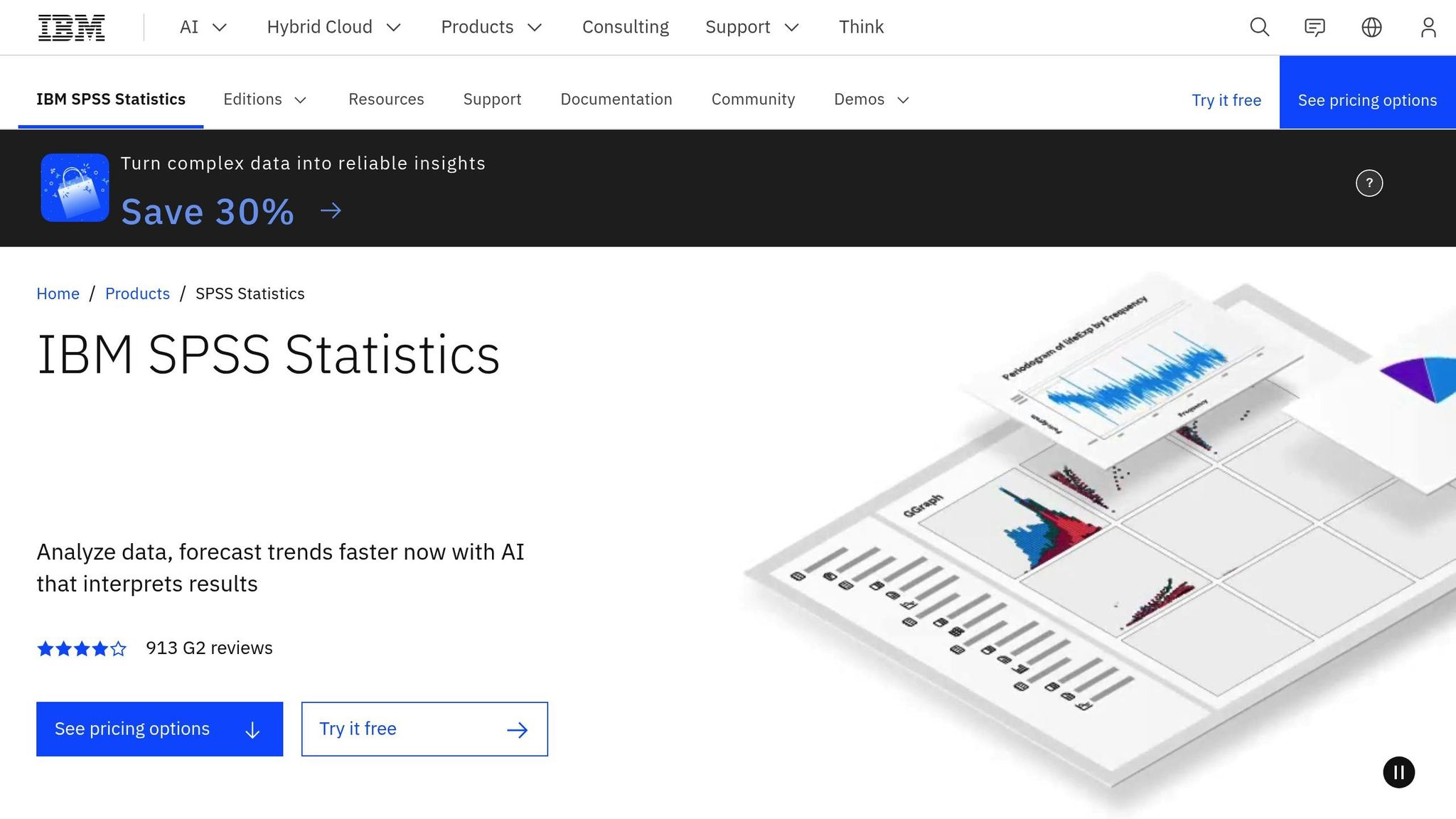
IBM SPSS Statistics is a well-established tool for statistical analysis, offering decades of expertise in helping organizations predict content performance. It's designed for teams that require precise insights to boost audience engagement and conversions, making it a go-to platform for those who prioritize accurate forecasting.
Predictive Modeling Capabilities
One of the platform's standout features is its ability to create detailed predictive models. Using techniques like regression, segmentation, and time-series forecasting, teams can analyze past performance data and key content attributes to predict future engagement, clicks, and conversions.
What makes SPSS Statistics unique is its strong statistical foundation. Unlike tools that rely on basic algorithms, SPSS employs proven methodologies, ensuring that predictions are grounded in reliable statistical principles. This level of rigor is particularly useful when making critical decisions about where to allocate resources or which content strategies to pursue. By factoring in audience behavior, seasonal trends, and other external variables, SPSS can pinpoint the characteristics that drive content success and forecast future outcomes with confidence. This precision supports smarter, data-driven decision-making for content teams.
Integration with Content and Marketing Tools
While SPSS Statistics shines in its analytical capabilities, it operates more as a backend tool rather than offering native integrations with other platforms. Typically, teams export data from tools like Google Analytics, Adobe Analytics, Salesforce, or HubSpot and then import it into SPSS for advanced analysis.
This approach allows SPSS to focus on its strength: processing and analyzing data in-depth. Many organizations use it alongside their existing marketing stack, leveraging SPSS to dig deeper into performance metrics and then applying those insights to refine their content strategies. While it doesn't offer real-time connections, its ability to handle complex data sets makes it a valuable complement to other analytics tools.
Scalability for Teams of Different Sizes
IBM SPSS Statistics is built to accommodate teams of various sizes, offering flexible deployment options. Smaller teams can opt for desktop applications with individual licenses, allowing analysts to work independently. Larger organizations, on the other hand, can deploy it on servers or in cloud environments, enabling collaboration across teams and centralized access to data.
The platform's architecture is designed to handle large volumes of data, making it ideal for enterprises managing millions of content records across multiple channels. However, this level of scalability comes with added infrastructure and management costs, making it better suited for mid-to-large organizations with dedicated analytics teams. Smaller teams or startups may find the investment challenging unless they're ready to commit significant resources to predictive analytics.
Pricing and Accessibility
As with many enterprise-grade tools, SPSS Statistics operates on a subscription model, requiring annual or multi-year commitments. Pricing starts at several thousand dollars for small teams and scales up significantly for enterprise-wide implementations.
The platform does have a learning curve, and organizations should plan for dedicated training and resources. IBM offers extensive support, including online tutorials, documentation, certification programs, and professional services to help teams get up to speed.
Implementation typically takes 8-16 weeks, covering infrastructure setup, data integration, training, and initial model development. Once operational, organizations should budget for 1-2 full-time staff members to manage the platform and maintain models. While the upfront investment is substantial, the platform's advanced capabilities make it a strong choice for established organizations with the resources to fully utilize its potential. For smaller teams or startups, however, the cost and complexity may pose a barrier.
Tool Comparison Table
Selecting the right predictive content analytics tool involves balancing your team's technical skills, budget, current infrastructure, and overall business goals. Below is a breakdown of how various platforms perform across critical factors, helping you make an informed decision.
| Tool | Best For | Predictive Capabilities | Integration Approach | Scalability | Pricing Model | Learning Curve |
|---|---|---|---|---|---|---|
| Hello Operator | Marketing teams seeking tailored AI solutions | Custom AI agents for content forecasting, automated content generation, SEO/GEO optimization | Custom code and APIs integrated with existing tech stack | Flexible monthly plans, no long-term contracts | From $3,750/month (pay-as-you-go) | Low to medium with hands-on training |
| Domo | Businesses needing all-in-one cloud solutions | Pre-built forecasting models, no coding required | 1,000+ native integrations across platforms | Enterprise-grade cloud architecture | Custom pricing | Low for business users |
| Microsoft Azure Machine Learning | Data-driven organizations with technical teams | Comprehensive ML capabilities with customizable algorithms | Seamless integration within the Microsoft ecosystem (Power BI, Azure services) | Highly scalable cloud infrastructure | Pay-as-you-go with 30-day free trial | Steep for non-technical users |
| SAS Viya | Enterprises requiring in-depth data insights | Advanced statistical modeling with both code-free and code-enabled options | Supports SQL and programming languages for custom workflows | Handles large data volumes efficiently | Enterprise custom pricing | Medium with code-free options available |
| Alteryx | Data analysts and business analysts | Drag-and-drop predictive modeling without technical expertise | Wide range of data connectors for flexibility | Mid-to-large organizations | Custom pricing | Low to medium |
| ThoughtSpot | Teams preferring natural language queries | Search-driven analytics with AI-powered insights | Multiple data connectors for broad compatibility | Scales across departments | Custom pricing | Low with search interface |
| Adobe Analytics | Marketing teams focused on customer journeys | Customer behavior forecasting and churn prediction | Native integration with the Adobe marketing suite | Marketing-focused scalability | Custom pricing based on needs | Low for marketing professionals |
| RapidMiner | Data scientists and business analysts | Visual workflows with real-time scoring capabilities | Supports the entire lifecycle from preparation to deployment | Adapts to growing analytical needs | Custom pricing | Low to medium with visual interface |
| H2O.ai | Organizations prioritizing speed and automation | Automated machine learning (AutoML) for rapid model development | Open-source flexibility with various data types | High-speed processing at scale | Custom pricing | Low with AutoML features |
| IBM SPSS Statistics | Established organizations with dedicated analytics teams | Advanced statistical methods including regression and time-series forecasting | Backend tool requiring data exports from other platforms | Enterprise deployments with large data volumes | Starts at several thousand dollars annually | High with extensive training required |
This table provides an at-a-glance comparison of each tool's key features, helping you align their capabilities with your analytics goals.
Hello Operator stands out by offering custom AI solutions tailored specifically for marketing teams. Unlike platforms with pre-packaged integrations, Hello Operator focuses on creating bespoke AI agents and workflows using secure custom code and APIs. These connect seamlessly with a client’s existing tech stack and proprietary data. This tailored approach ensures deep integration into unique operational environments while avoiding the limitations of off-the-shelf solutions. With a predictable pricing model starting at $3,750 per month and no long-term commitments, it provides flexibility to adjust as your business needs evolve.
When evaluating tools, consider both your current requirements and future growth. A solution that fits a small marketing team may not scale effectively for a larger organization with multiple departments. Similarly, tools that demand significant technical expertise could become a bottleneck if your data science resources are already stretched. The ideal platform balances immediate usability with the ability to grow alongside your organization, ensuring it continues to deliver value as your analytics needs mature.
Conclusion
Selecting the best predictive content analytics tool means aligning it with your organization's specific needs, technical abilities, and budget. This guide highlights a range of platforms, from user-friendly, no-code options like Domo and Alteryx to more advanced environments like Microsoft Azure Machine Learning and SAS Viya. Each caters to different organizational profiles, so the right choice depends on your current capabilities and future goals.
Start by evaluating your team's technical expertise. If your team has limited coding skills, drag-and-drop platforms can simplify adoption and deliver faster results. For organizations with dedicated data science teams, advanced tools offer greater customization and deeper analytical capabilities. Since the learning curve varies significantly across platforms, choose one that aligns with your team's current skill set and readiness.
Budget considerations extend beyond upfront costs. While some tools start at a few hundred dollars per month with pay-as-you-go pricing, enterprise solutions can require annual investments in the thousands. Don’t forget to account for the total cost of ownership, which includes implementation, training, ongoing support, and scaling expenses. Organizations leveraging predictive analytics have reported up to 20% higher content ROI and faster decision-making, making the investment worthwhile when matched to your needs.
Seamless integration with your existing tech stack is critical. Platforms that connect easily with your current systems can reduce manual tasks, eliminate data silos, and speed up insights. Look for tools that fit well within your technology ecosystem. Some platforms boast over 1,000 integrations, offering flexibility across diverse environments. Proper integration ensures you get the most value from your investment.
Consider starting small with pilot projects. Testing a tool on specific use cases - like predicting content engagement, optimizing publishing schedules, or forecasting audience trends - can help determine its suitability before rolling it out organization-wide. Many platforms provide free trials or monthly plans, allowing you to explore their capabilities without committing to long-term contracts. This approach minimizes risk and ensures the tool addresses your operational challenges effectively.
Training and upskilling are key to successful adoption. Tools like SAS Viya and Alteryx offer free training resources, and partnering with AI marketing experts can provide tailored workshops and solutions. A tool is only as effective as the team using it, so investing in AI literacy and fostering a data-driven culture is essential for long-term success.
As predictive content analytics continues to evolve - emphasizing AutoML, natural language processing, and industry-specific applications - the right tool should meet your current needs and grow with your organization. By carefully assessing your technical resources, budget, and integration requirements, you can position your team to leverage predictive insights effectively. Aligning the right tools with your team's strengths and strategic goals sets the foundation for sustained content success.
FAQs
What should I look for when selecting a predictive content analytics tool for my team?
When selecting a predictive content analytics tool, it's important to weigh a few key factors. Start with ease of use - a tool that's straightforward ensures your team can adopt it quickly. Scalability is another critical aspect; the tool should grow with your needs. And don’t overlook integration capabilities - it should work seamlessly with your existing systems to avoid unnecessary headaches.
You’ll also want a tool that delivers clear insights, actionable recommendations, and detailed reporting. These features empower your team to make smarter, data-backed decisions. Consider how well the tool matches your specific objectives, whether that's boosting content performance, anticipating audience behavior, or optimizing workflows. If customization or AI-driven insights are part of the package, that’s a big plus, as they allow you to tailor the tool to meet your unique challenges.
How does involving humans improve the accuracy of predictive content analytics?
Hello Operator incorporates a human-in-the-loop strategy across all AI-powered workflows, blending human expertise with advanced AI tools. This approach fine-tunes predictions, minimizes errors, and ensures creative decisions remain under human guidance.
By striking the right balance between human involvement and AI automation, this method keeps predictive content analytics aligned with your specific marketing objectives while delivering reliable and meaningful insights.
Can predictive content analytics tools work with my current content management and marketing systems?
Predictive content analytics tools often work effortlessly with widely-used content management and marketing platforms. These integrations make it easier to analyze performance data, streamline workflows, and fine-tune your content strategies - all without the hassle of juggling multiple systems.
Before selecting a tool, it's a good idea to confirm its compatibility with your current setup. This ensures a smoother onboarding process and allows you to get the most out of its features. Many platforms offer detailed guides or dedicated support to help you with the integration process.
Related Blog Posts

