

Predictive analytics is transforming how brands position themselves by using AI, machine learning, and historical data to predict customer behavior. Instead of relying on outdated reports or intuition, brands can now anticipate trends, personalize messaging, and refine strategies in real-time. Key benefits include:
- Faster decision-making: Reduces analysis time by up to 88%, from 12–16 hours to 1–2 hours.
- Improved targeting: Focuses on dynamic behavior-based clusters rather than static demographics.
- Higher ROI: Boosts Positioning Fit Scores by 15–30% and competitive differentiation by 20–40%.
Techniques such as machine learning for forecasting, NLP for sentiment analysis, and data integration for trend prediction are at the core of this shift. Real-world examples show brands like Starbucks and fashion retailers leveraging predictive models to personalize experiences, optimize pricing, and increase revenue.
However, challenges like data quality, ethical concerns, and balancing automation with human oversight remain. To succeed, companies need to combine AI precision with human insight, ensuring their strategies align with their core values while staying ahead of market changes.
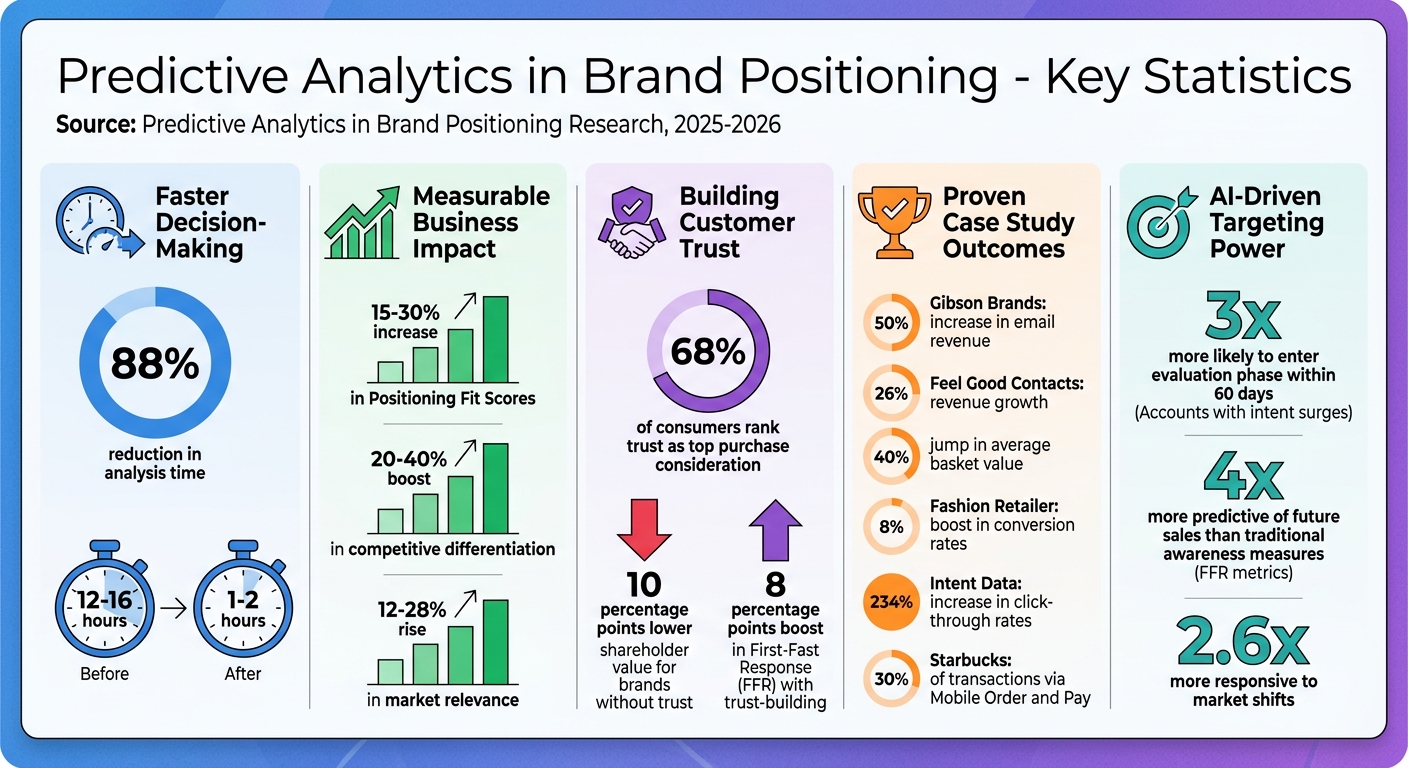
Predictive Analytics Impact on Brand Positioning: Key Statistics and Benefits
The Rise of Predictive Analytics in Marketing Strategy
sbb-itb-daf5303
Core Techniques in Predictive Analytics for Brand Positioning
Predictive analytics takes brands from reacting to consumer behavior to proactively shaping their strategies. By leveraging advanced techniques, companies can uncover insights that refine their brand positioning and resonate with their target audiences.
Machine Learning Models for Consumer Forecasting
Machine learning (ML) algorithms are powerful tools for identifying patterns in consumer demographics, behaviors, and engagement. Instead of just analyzing past performance, these models predict future trends, allowing brands to fine-tune their messaging for specific audiences without losing their core identity.
What makes ML stand out is its ability to pick up on subtle shifts - like drops in engagement or changes in purchasing habits - before they become widespread. By studying historical campaign data, ML pinpoints the messaging styles, themes, and tones that are likely to connect with future audiences. This reduces wasted marketing efforts and optimizes budgets. Additionally, ML estimates metrics like customer lifetime value (CLV) and churn risk, helping brands focus on building long-term loyalty rather than just chasing new customers. It also provides insights into competitor behavior, market share changes, and pricing trends, uncovering fresh opportunities for strategic growth.
Natural Language Processing in Brand Sentiment Analysis
Natural Language Processing (NLP) dives deeper than simple keyword tracking. It interprets the emotional tone behind online conversations, offering insights into how consumers feel - whether they're excited, dissatisfied, or disengaged. By analyzing unstructured data from sources like social media and reviews, NLP converts these sentiments into actionable strategies. This real-time feedback helps brands tweak their messaging before negative perceptions impact their bottom line.
NLP also scans massive datasets across different industries and regions, identifying early signs of societal shifts or emerging trends. It reveals the emotional and behavioral drivers behind changes in demand. As Mark Ghermezian, Co-founder and CEO of Appboy, aptly put it:
"Predictive analysis can't always accurately forecast what customers will do or want... But using it provides a far better perspective into our customers' personalities, and how they might respond to certain types of messaging than simply guessing".
Data Integration and Trend Prediction
For predictive models to be effective, they must merge structured data (like purchase histories and CRM records) with unstructured data (such as social media sentiment and customer reviews). Marketing analytics platforms bring together data from multiple channels, ensuring consistency and minimizing bias in predictions.
Real-time analysis capabilities allow brands to keep pace with fast-changing market conditions and adjust their strategies promptly. Feedback from post-purchase data and social interactions further refines these models, enabling brands to go beyond basic demographic segmentation. For example, they can identify niche groups like "bargain hunters" or "premium seasonal shoppers". This comprehensive data integration transforms trend prediction into a precise, data-driven approach that supports smarter decision-making.
Research-Backed Benefits of Predictive Analytics in Branding
Predictive analytics is reshaping how brands connect with their audience, strengthening relationships, and driving real marketing ROI. Research highlights its transformative impact on customer trust, loyalty, and overall brand positioning.
Better Consumer Personalization
Predictive analytics takes brands beyond traditional market segmentation, enabling dynamic, behavior-based targeting. A 2025 study of 371 B2B clients in retail and agriculture revealed that AI-driven machine learning and recommendation quality are key to boosting brand awareness. The study identified six dimensions of AI-powered personalization, with machine learning and recommendation quality leading the charge.
Using tools like churn modeling and propensity scoring, brands can pinpoint customers at risk of leaving and take proactive steps to retain them. Tornike Khoshtaria, a professor at FIIB Business Review, emphasizes:
"AI-driven factors such as customer service, information and recommendation, machine learning, information and satisfaction quality significantly boost brand awareness."
These technologies enable tailored messaging at scale across platforms, leveraging methods like collaborative filtering and decision trees. This approach shifts marketing from generic campaigns to predictive loyalty management, aligning with individual preferences.
This level of personalization naturally fosters stronger consumer trust.
Increased Brand Loyalty and Trust
Beyond personalization, trust is a cornerstone of brand strength. It’s no small matter - 68% of consumers rank trust as their top consideration when making purchases. Predictive analytics helps brands avoid impersonal "batch-and-blast" marketing, which damages loyalty. In fact, 23% of consumers say this type of marketing harms their brand relationships, while 28% report switching brands due to repetitive messaging.
The financial impact of trust is undeniable. Brands that fail to build trust experience 10 percentage points lower total shareholder value, while trust-building efforts correlate with an 8-percentage-point boost in First-Fast Response (FFR), a predictive metric for future sales.
Real-world examples show how this works. In 2025, Gibson Brands used SAP Engagement Cloud to unify customer profiles across online and in-store touchpoints. By adopting predictive marketing automation, Gibson achieved a 50% increase in email revenue and doubled their email engagement rates in just one year. Similarly, Feel Good Contacts, a leading UK online retailer, used predictive analytics to upsell products like eyeglasses to contact lens buyers, resulting in a 26% revenue growth and a 40% jump in average basket value.
Ellie Quacquarelli, Strategic Consultant at SAP Engagement Cloud, sums it up perfectly:
"Predictive analytics transforms raw data into forward-looking insights you can act on before customers drift away."
Improved Marketing ROI
Predictive analytics doesn’t just deepen customer relationships - it also makes marketing dollars work smarter. Cutting back on brand spending often backfires, costing $1.92 in future investment to recover every $1 saved.
Marketers who lean on predictive signals like First-Fast Response (FFR) see metrics that are 4 times more predictive of future sales than traditional awareness measures. These signals are also 2.6 times more responsive to market shifts, with AI-enhanced positioning speeding up analysis and decision-making. High-maturity marketers using AI are 1.2 times more likely to reinvest efficiency savings into marketing rather than cutting budgets.
Peter Dewey, Managing Director & Partner at BCG, highlights the strategic edge this provides:
"With AI democratizing creativity, brand distinctiveness has become the last true competitive moat."
The numbers make it clear: predictive analytics isn’t just a tool - it’s a game-changer for how brands engage customers, maintain loyalty, and allocate resources for maximum impact.
Case Studies: Successful Applications of Predictive Analytics
Some of the biggest names in business are showcasing how predictive analytics can reshape industries. Two sectors that stand out for their inventive use of this technology are coffee retail and fashion.
Starbucks: Personalization Through Machine Learning
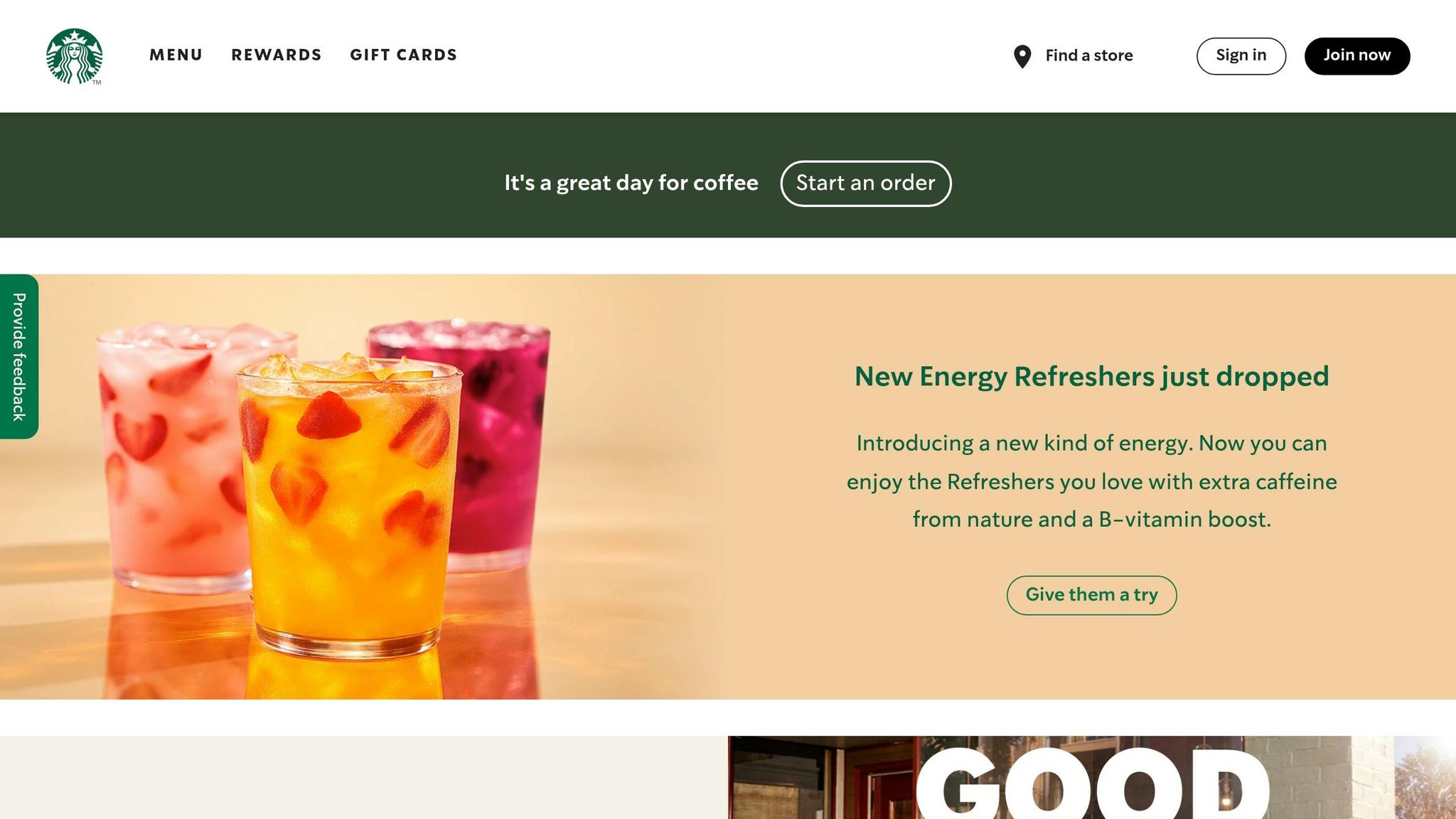
Starbucks is using its loyalty program as a goldmine for predictive analytics. By February 2026, its Deep Brew AI system had tapped into data from 34 million U.S. Rewards members to craft hyper-personalized mobile offers. This system doesn’t just stop at basic preferences - it factors in things like the time of day and even the weather to suggest the perfect drink at the perfect moment.
The impact? Mobile Order and Pay now makes up about 30% of all U.S. transactions. But Starbucks isn’t limiting predictive analytics to marketing. It’s also using it to manage labor more efficiently. By aligning staffing levels with expected order volumes, the company is on track to cut labor costs by 100 to 200 basis points.
Luciano Colos, who has extensively studied Starbucks' AI strategy, highlights the competitive edge this gives the company:
"The loyalty program's 34 million active U.S. members represent a dataset that gives Starbucks an AI training advantage that no new entrant can replicate quickly".
With its ever-expanding dataset, Starbucks continues to sharpen its predictions, maintaining a lead that’s tough for competitors to match.
Retail and Fashion: Agile Adaptation
Fashion retailers face a unique challenge: trends change fast, making traditional inventory planning a gamble. Predictive analytics is helping these brands stay ahead. For instance, in January 2026, a global fashion retailer teamed up with Itransition to create a business intelligence system that analyzed near-real-time data - like clickstream activity and email engagement. This allowed the retailer to predict which products would appeal to specific customer groups before launching full campaigns.
The results were impressive, with an 8% boost in conversion rates from visitors to buyers. The retailer also used AI-powered recommendation tools to suggest products based on browsing habits, demographics, and purchase history, offering shoppers a highly tailored experience.
Predictive analytics isn’t just about product recommendations, though. Fashion brands are also using it for dynamic pricing - adjusting prices in real time based on demand, competitor pricing, and past sales data. This approach helps maximize revenue while fine-tuning when and how discounts are applied.
Challenges and Limitations of Predictive Analytics
Predictive analytics offers exciting possibilities, but it’s far from a simple solution. Companies often encounter significant hurdles when trying to implement these systems, and being aware of these challenges ahead of time can help avoid costly missteps.
Data Quality and Availability
One of the biggest obstacles is the quality and consistency of data. Real-world datasets frequently have missing values, inconsistent formats, or mismatched schemas, which can severely impact model training. When pulling data from multiple sources - like CRM systems, billing logs, APIs, and databases - important metrics, such as user behavior patterns, are often tracked inconsistently or overlooked altogether.
Additionally, subjective terms used in brand strategy, like "premium" or "authentic", can confuse AI systems unless clearly defined. Without precise parameters, these terms can dilute a brand’s message. As Mike Maio from Monigle explains:
"AI doesn't defend your brand, it just amplifies what you give it. A poorly fed AI system scales your brand's weakest interpretations".
Another challenge is data drift. Over time, shifts in consumer behavior or seasonal trends can render earlier predictions irrelevant, reducing the accuracy of models. Ethical concerns also arise when models unintentionally reflect biases present in their training data, leading to unfair practices. On top of this, regulations like GDPR demand transparency in how predictions are made, which can be especially tricky when using complex "black-box" neural networks.
These technical issues are only one side of the equation. Companies must also navigate the delicate balance between automation and human creativity.
Balancing Automation with Human Creativity
Even with perfect data, predictive analytics is not a replacement for human insight. While AI excels at processing vast amounts of data quickly, it lacks the strategic vision and creativity needed for strong brand differentiation. Predictive analytics can identify patterns and market gaps with AI-driven insights, but relying too heavily on automation can lead to generic strategies. This happens because algorithms often focus on optimizing for established trends rather than taking bold, unconventional approaches. As Spellbrand puts it:
"AI can show you the map. It cannot tell you where to plant your flag".
The most effective approach combines AI’s strengths with human expertise. AI can handle large-scale market analysis, but human strategists are essential for interpreting consumer behavior and ensuring that insights align with a brand’s values. A hybrid workflow - where low-confidence AI outputs are reviewed by experts and decision-making roles are clearly defined - often yields the best results.
In 2026, 84% of marketers reported that their campaigns felt generic due to a lack of strategic clarity. Alana Sorrentino captured the importance of getting this balance right when she said:
"In 2026, creativity has never been cheaper to produce. Strategy has never been more expensive to get wrong".
To achieve dynamic brand positioning, companies must address both the technical challenges in data and the limitations of relying solely on automation. Combining the precision of AI with human creativity is vital for success.
Future Opportunities in Predictive Analytics and Brand Positioning
Advances in machine learning and natural language processing (NLP) are setting the stage for the next big leap in brand positioning. Emerging technologies are focusing on creating immersive experiences and gaining a sharper understanding of consumer intent.
AR/VR Integration with Predictive Analytics
Augmented reality (AR) and virtual reality (VR) are introducing new ways to gather data for predictive models. When customers interact with virtual showrooms or use AR to try on products, these platforms collect detailed insights into consumer behavior - tracking how users navigate, what products they focus on, and how long they engage. Unlike traditional click-through metrics, this real-time data provides a deeper look into spatial preferences and interaction habits. Feeding this information into predictive models allows brands to refine their strategies and create personalized, AR-guided shopping experiences tailored to consumers' likely preferences. This immersive layer of data collection is paving the way for even more precise consumer targeting, which is further enhanced by AI-driven intent analysis.
AI-Driven Intent Analysis for Better Targeting
Targeting strategies are moving beyond static demographic profiles to focus on real-time behavioral signals that reveal active research and purchasing intent. AI models now analyze up to 30 categories of signals, including technology adoption, funding events, leadership changes, and hiring trends, to identify early buying indicators. For instance, repeated visits to pricing or case study pages can help AI distinguish casual browsers from serious buyers. Additionally, when multiple individuals from the same company research a topic, AI can recognize the formation of "buying committees".
Research highlights the effectiveness of this approach: accounts showing a surge in intent - marked by spikes in research activity - are three times more likely to enter an active evaluation phase within 60 days. Furthermore, leveraging intent data has been shown to boost click-through rates by up to 234%. Jared Levy, Growth Marketing Manager at League, shared his experience with this method:
"With Demandbase, we effectively transformed advertising spend into qualified opportunities. Through precision targeting and actionable insights, we've strengthened cross-functional alignment [and] accelerated pipeline growth".
Conclusion: Key Takeaways for Businesses
Predictive analytics has reshaped how brands approach positioning. Instead of looking back at past trends, businesses can now anticipate what consumers want and adapt to cultural changes as they unfold. With AI in the mix, the time spent on analysis drops dramatically - from 12–16 hours to just 1–2 hours, saving 88% of the effort.
The results speak volumes. Brands leveraging AI-driven positioning report a 15–30% increase in Positioning Fit Scores, a 20–40% boost in competitive differentiation, and a 12–28% rise in market relevance. These shifts highlight how brands can forge stronger connections with their audiences by staying ahead of the curve.
To make the most of predictive analytics, businesses need to move past traditional demographics and focus on dynamic, real-time clusters built from behavioral and intent data. Regular reviews - monthly for positioning fit and quarterly for recalibrations - help ensure alignment. Setting clear metrics, like monitoring dips in branded search click-through rates, can signal when updates are needed, avoiding changes based purely on subjective judgment.
That said, human insight remains irreplaceable. As Mash Bonigala, Creative Director & Brand Strategist at Spellbrand, aptly puts it:
"AI can show you the map. It cannot tell you where to plant your flag."
While AI efficiently handles research and analysis, the emotional and strategic layers of brand storytelling should stay in human hands. For businesses looking to integrate AI without losing their brand's authenticity, working with experts like Hello Operator can be a smart move. Combining technology with human creativity ensures both efficiency and a genuine connection with audiences.
FAQs
What data do I need to start predictive analytics for brand positioning?
To kick off predictive analytics for brand positioning, start by collecting data on market trends, consumer behavior, and your competitors. Key information sources include customer feedback, search intent data, and competitor claims. Pair this with historical and real-time data about messaging, pricing strategies, and distribution channels.
You can also enhance your analysis with insights from sentiment analysis, social media activity, customer reviews, and surveys. This combination helps fine-tune strategies and predict trends, allowing for data-driven recommendations that keep your brand ahead in the market.
How do I measure whether predictive analytics improved my brand positioning?
To determine whether predictive analytics has strengthened your brand positioning, focus on analyzing its impact through measurable, data-driven metrics. Start by evaluating how well your models predict consumer preferences and market trends - accuracy here is key. Next, keep an eye on shifts in how consumers connect with your brand by monitoring resonance metrics.
You can also leverage tools like real-time market intelligence and sentiment analysis to gauge improvements in your brand's relevance and how it stands out against competitors. These insights offer a clear picture of how predictive analytics is shaping your position in the market.
How can my team use AI without making our brand feel generic?
Use AI thoughtfully to boost personalization and genuine connections rather than leaning entirely on automation. By analyzing consumer data, AI can craft tailored messages and experiences that resonate with your audience on a deeper level. Prioritize transparency and ethical practices to ensure these efforts come across as sincere. Additionally, predictive analytics can help you stay ahead of trends, giving your brand a chance to stand out and build a strong, forward-thinking identity.
Related Blog Posts

