

Predictive analytics can transform your sales funnel by using data and machine learning to predict lead behavior, identify bottlenecks, and improve conversions. This approach allows you to replace guesswork with data-backed decisions, leading to better lead prioritization, reduced churn, and more efficient planning. Here are the key steps:
- Map Your Funnel: Break down your funnel into clear stages (Awareness, Interest, Consideration, etc.) and assign metrics to track performance at each stage.
- Analyze Bottlenecks: Use tools like CRM and heatmaps to identify where leads drop off and why.
- Leverage Predictive Models: Build AI-powered models to score leads based on their likelihood to convert, improving efficiency by 20–40%.
- Focus on Key Stages: Prioritize high-impact stages where small improvements can yield significant results.
- Automate Actions: Use AI workflow tools for lead generation to automate lead nurturing, scoring, and routing for faster follow-ups and better personalization.
- Test and Refine: Continuously validate and update models to maintain accuracy as market conditions change.
- Scale Insights: Expand predictive analytics across all funnel stages and monitor KPIs like CAC, LTV, and sales velocity.
Companies using predictive analytics have seen conversion rates increase by 73% and sales cycles reduced by up to 50%. This method is a game-changer for businesses aiming to optimize their sales strategy and drive measurable growth.
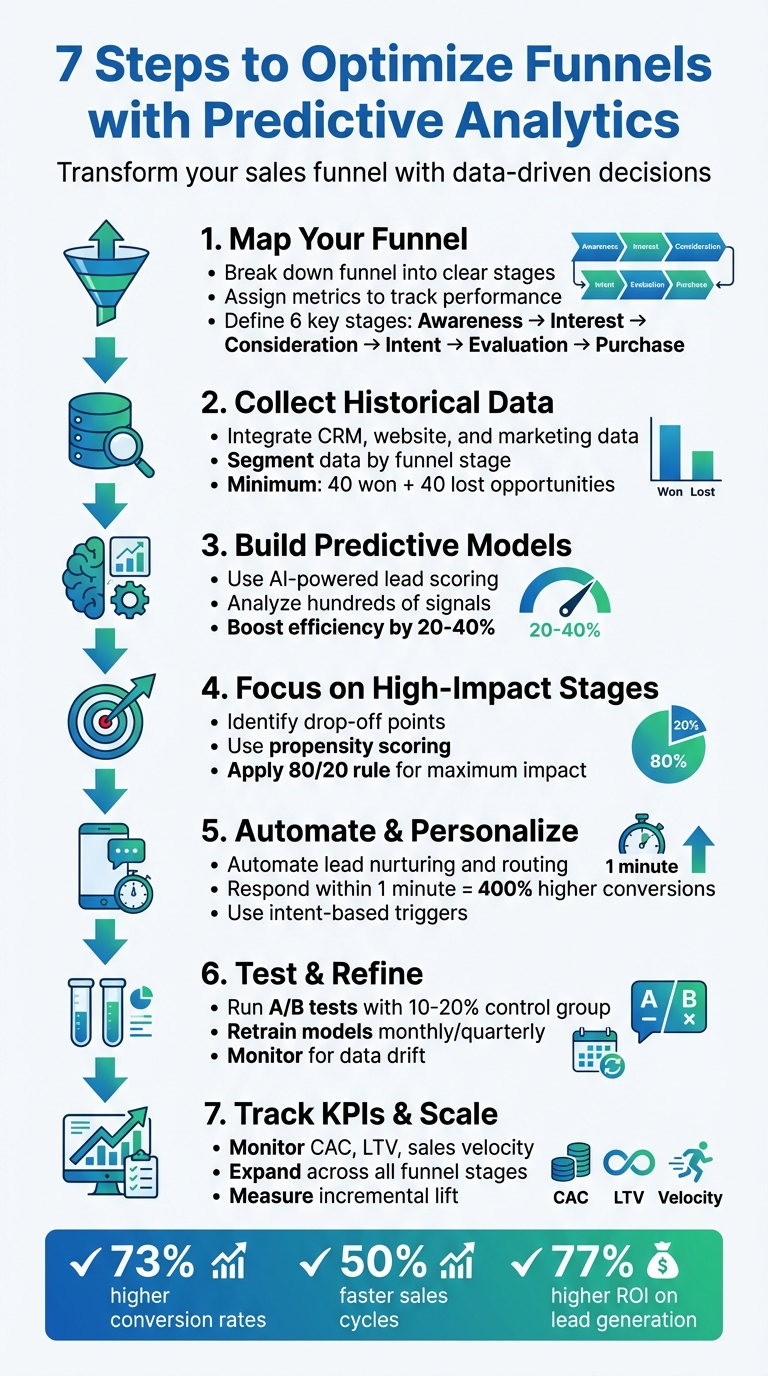
7 Steps to Optimize Sales Funnels with Predictive Analytics
Sales Funnel Analysis - Excel Template and Metrics [Free Analytics Tool]
sbb-itb-daf5303
Step 1: Map Your Current Sales Funnel
To effectively use predictive analytics, you need a clear understanding of your sales funnel. Start by outlining each stage, from the first moment a prospect becomes aware of your brand to the point they make a purchase. In B2B sales, this typically breaks down into six key stages: Awareness, Interest, Consideration, Intent, Evaluation, and Purchase. Each stage reflects a specific mindset of the buyer and requires tailored actions to guide them forward.
Define Funnel Stages and Metrics
To measure success at each stage, assign relevant KPIs that align with the buyer's mindset and the actions your team takes. Here's how these elements connect:
| Funnel Stage | Buyer Mindset | Sales Action | Key Metrics |
|---|---|---|---|
| Awareness | Problem recognition | Educational content, social selling | Website visits, content downloads |
| Interest | Solution research | Nurture campaigns, webinars | Email opens, event registrations |
| Consideration | Vendor comparison | Product demos, case studies | Demo requests, pricing page views |
| Intent | Shortlist creation | Personalized proposals, ROI analysis | Proposal opens, stakeholder meetings |
| Evaluation | Final decision-making | Contract negotiation, alignment | Contract reviews, legal discussions |
| Purchase | Commitment ready | Close deal, onboarding kickoff | Signed contracts, activation rate |
This table helps you set clear benchmarks for when leads transition from Marketing Qualified Leads (MQL) to Sales Qualified Leads (SQL). Research shows that companies with structured lead scoring can achieve up to 77% higher ROI on lead generation. Typically, MQLs should account for 3–8% of your total known contacts, with a conversion rate from MQL to SQL ranging between 20–40%.
Once your funnel is outlined and metrics are in place, focus on identifying where leads are getting stuck.
Find Bottlenecks and Drop-Off Points
Your CRM and analytics tools can reveal where leads are stalling or dropping off entirely. Look for sharp declines between stages - these are clear indicators of friction. Refine your segmentation based on the earlier funnel stages to uncover issues that might not be obvious in aggregated data. For example, if mobile users are abandoning forms more frequently than desktop users, this could signal a device-specific problem.
Another critical metric to track is sales velocity, which measures how long it takes for leads to move from their first interaction to a closed deal. If you notice leads consistently stalling between Consideration and Intent, you might need to improve your ROI calculators or provide more personalized proposals. Research shows that following up within five minutes of an MQL trigger can be 100 times more effective than delayed responses, highlighting the importance of a well-monitored funnel.
Use tools like heatmaps and session recordings to dig deeper into why drop-offs occur. Are users missing key information, or are technical issues causing frustration? These insights can help you make targeted improvements.
Remember, the modern B2B buyer interacts with an average of 10 channels during their journey, compared to just five in 2016. Your funnel mapping must account for this omnichannel complexity, tracking touchpoints across email, social media, webinars, and direct sales. This comprehensive mapping lays the groundwork for the predictive analytics strategies covered in the next steps.
With your funnel fully mapped and bottlenecks identified, you’re ready to gather the historical data needed for predictive modeling.
Step 2: Collect and Organize Historical Data
Predictive analytics thrives on accurate and relevant information. By integrating CRM, website, and marketing data, you can uncover the factors that drive conversions. Companies that incorporate predictive analytics into their sales process report conversion rates that are 73% higher than those relying solely on intuition.
Data Sources for Funnel Analysis
To analyze your funnel effectively, pull data from every system that interacts with it. Your CRM (such as Salesforce or HubSpot) provides insights like lead sources, industries, job titles, engagement levels, pipeline stages, deal sizes, and expected close dates. Sales engagement tools track the effort behind each opportunity, including emails, calls, demos, and meetings. Web and product analytics offer data on click behavior, product views, feature adoption, and drop-off points. Email platforms contribute metrics like deliverability, open rates, and click-through rates, while ad platforms provide UTM tag data and campaign performance.
Here are the key data categories to gather:
- Lead and contact data: Source, industry, job title, and location.
- Opportunity and deal data: Pipeline stages, deal size, and forecast categories.
- Sales activity data: Emails, calls, meetings, and demos.
- Behavioral data: Website visits, email engagement, and social media sentiment.
- Product usage data: Feature adoption and usage frequency.
High-performing sales teams are 1.5 times more likely to use data-driven forecasting than their underperforming counterparts. Advanced analytics can boost sales productivity by up to 20% and increase revenue by 10% or more.
To ensure accuracy, use UTM parameters and automated integrations to track first-touch attribution and reduce manual data entry errors. However, be aware that about 30% of CRM data is often inaccurate, incomplete, or outdated. To address this, set up automated processes to flag duplicate entries, archive outdated contacts, and enrich missing information.
Segment Data by Funnel Stage
Once your data is centralized, organize it according to the funnel stages you defined earlier - Awareness, Interest, Consideration, Intent, Evaluation, and Purchase. This segmentation helps identify where prospects drop off and highlights opportunities to refine your approach.
Breaking data into stages also minimizes selection bias. Historical data often reflects the leads your sales team chose to prioritize, not necessarily the ones with the most inherent value. For example, if a single segment accounts for 80% of your wins, your predictive model might be skewed toward that group. In such cases, creating separate models for underrepresented groups can balance the analysis. Tracking "unqualified reasons" in your CRM further sharpens lead scoring by identifying why certain leads didn’t progress through the funnel.
"A model trained on leads your sales team previously chose to pursue doesn't learn which prospects are inherently valuable - it learns which types of prospects your reps paid attention to." - AI Personalization
To train machine learning models effectively, you’ll need a minimum of 40 won and 40 lost opportunities from a historical period, typically spanning three months to two years. Use point-in-time snapshots to prevent information leakage - train your models using only the data that was available at the time of the scoring decision, rather than the final CRM snapshot. With this structured and segmented data, you’re now ready to move on to building predictive models in the next step.
Step 3: Use Predictive Models for Lead Scoring
Predictive lead scoring takes your structured funnel data to the next level by turning it into actionable insights for sales. By analyzing data segmented by funnel stage, these models calculate conversion probabilities, offering a more dynamic approach than traditional point-based systems. Instead of assigning static values (like +10 points for opening an email), predictive models evaluate hundreds - or even thousands - of signals to determine the likelihood of conversion. Studies show that leveraging AI-powered lead scoring can boost sales efficiency by up to 30% and improve conversion rates by 20% to 40%.
Build Lead Scoring Models
Before diving into model creation, ensure your sales and marketing teams agree on what defines a "sales-ready" lead. This shared definition should consider three key factors: timing (when the lead is ready to buy), intent (their actions and engagement), and fit (alignment with your ideal customer profile). Standardize data across platforms like CRM, email, and web analytics to avoid inconsistencies (e.g., unifying "VP" and "Vice President" into a single term).
Feature engineering is the next step. For example, calculate engagement velocity by tracking actions over time (such as downloads per week) or create interaction features by combining data points (like multiplying job level by company size). When selecting a model, consider your dataset size: Logistic Regression works well for small datasets, Random Forests for medium-sized ones, and Gradient Boosting (or XGBoost) for larger datasets. Asana, for instance, saw its win rates jump from 39% to 70% by using the 6sense intent platform to identify anonymous in-market accounts instead of relying solely on known CRM leads.
To train your model, you'll need at least 40 won and 40 lost opportunities, but for better accuracy, aim for a dataset of 1,000 closed leads and 100 converted leads. Use time-based splitting for training - this means dividing your data by time periods rather than randomly. This approach prevents data leakage and ensures the model can predict future outcomes. Finally, calibrate your scores with techniques like Platt scaling or isotonic regression to make sure a score of 80% reflects an actual 80% chance of conversion.
Once your model is calibrated and trained, it's time to integrate it into your operations for real-time use.
Apply AI Tools for Real-Time Scoring
Modern lead scoring systems go beyond batch processing by updating scores instantly as new data comes in. To enable this, synchronize your web analytics, CRM, and marketing automation tools in real time. For example, actions like visiting a pricing page or requesting a demo can trigger immediate score updates. Grammarly implemented Salesforce Einstein’s predictive modeling and cut its sales cycle from 60–90 days to just 30, while also increasing upgrade conversions by 80%.
Set up tiered notifications to keep your sales team focused. For instance:
- Send SMS alerts for "hot" leads scoring 90 or above.
- Use Slack notifications for Sales Qualified Leads (SQLs) scoring 70 or higher.
- Provide daily email summaries for Marketing Qualified Leads (MQLs).
Incorporate score decay mechanisms to lower scores over time if leads become inactive, ensuring the team prioritizes engaged prospects. To build trust in the system, include explainability features that show why a lead received its score. For example, a lead might be flagged as high-priority because they "visited the pricing page three times in 48 hours." Interestingly, research shows that a model with moderate accuracy but high adoption by sales teams can outperform a more accurate model that isn’t actively used.
Don’t forget to retrain your models regularly to account for changes in buyer behavior and market conditions. Salesforce Einstein, for example, retrains its models every 10 days, while Oracle suggests monthly updates. Establish a feedback loop where sales teams rate lead quality on a 1–5 scale, providing qualitative input to complement the AI’s quantitative analysis. Schedule regular reviews - at 30, 60, and 90 days - to fine-tune your scoring system based on actual outcomes.
Step 4: Apply Predictive Insights to High-Impact Stages
Once your lead scoring models are up and running, the next step is to zero in on the funnel stages that matter most. Not all stages are created equal - some are smooth sailing, while others are full of roadblocks that slow conversions. By focusing on the stages with the highest drop-off rates, you can make the most of your predictive analytics efforts.
Forecast Drop-Off Points
Predictive models are incredibly effective at identifying where leads lose steam in your funnel. By analyzing each stage individually, these models evaluate attributes like estimated close dates or engagement frequency to predict conversion outcomes. This detailed analysis can uncover patterns that broader data might overlook.
Propensity scoring is a key tool here. It measures how likely a lead is to convert, helping you quickly spot segments that are struggling to move forward. To create accurate per-stage models, ensure you have data from at least 40 closed opportunities (both wins and losses) for each stage you’re examining.
Behavioral shifts - like a drop in product usage or email engagement - can signal early warning signs of drop-offs. For example, one enterprise B2B team combined propensity and uplift models to identify "true persuadables", leads who would only convert with specific efforts. The result? A 19% boost in win rates and a 14% reduction in customer acquisition costs in just 12 weeks. The trick is to segment your data by traffic source, campaign, and customer traits, as drop-off issues often vary by channel.
"Data tells you what is happening, but you need to understand why." - Customer.io
To make the biggest impact, focus on the most critical drop-off points in your funnel. The 80/20 rule applies here: fixing one or two major issues can deliver bigger results than spreading your efforts thin across every stage. When you spot a drop-off, dig deeper using the "5 Whys" technique - keep asking "why" until you uncover the root cause. Combine predictive scores with tools like session recordings and surveys to better understand lead behavior.
Once you’ve identified the trouble spots, shift your attention to the stages where better decisions can drive the most conversions.
Focus on Conversion-Critical Stages
Armed with insights from drop-off analysis, prioritize the stages where small improvements can lead to big wins. Use these predictive insights to refine your funnel by targeting the moments that demand immediate action. For example, decide whether the model will guide SDR outreach or route leads into automated nurture campaigns. This clarity ensures your insights lead to real, actionable changes.
One way to prioritize is by using Expected Profit as your key metric. This balances the likelihood of conversion with the potential deal value. To streamline your process, create qualification tiers (e.g., Top, High, Medium, Low) based on KPI thresholds. Then, automate routing rules to match these tiers. Companies that implement this approach have seen conversion rates climb by as much as 73%.
Here’s a quick breakdown of predictive methods and their use cases:
| Predictive Method | Best For | Key Signals | Typical Use Case |
|---|---|---|---|
| Propensity Scoring | Purchase likelihood | Engagement, firmographics, intent | SDR routing, prioritization |
| Uplift Modeling | Targeting persuadables | Interaction history, context | Offer targeting, discount policies |
| Next-Best-Action | Sequencing touchpoints | Real-time behavior, product state | Personalized journeys, in-app prompts |
To make these insights actionable, integrate predictive scores into your CRM for sales routing and into marketing automation platforms for personalized nurturing. Real-time scoring is essential - leads should be scored as soon as new interactions occur, with updates reflected in your systems within minutes. A practical tip: freeze a lead’s score at a consistent point (like 6 hours after creation) to ensure consistent tracking and reporting.
Keep an eye out for concept drift, which happens when your model’s accuracy declines due to shifts in market conditions or lead behavior. Use drift monitors and plan for regular model retraining - monthly or quarterly - to keep your predictions sharp. For example, using propensity models for SDR routing has not only boosted win rates by 19% but also shifted 22% of the sales team’s focus toward high-fit accounts.
Step 5: Add Automation and Personalization
Once your predictive tools pinpoint the right leads at the right time, the next step is to automate actions based on those insights. The idea is simple: let AI take over repetitive tasks so your team can focus on what they do best - building relationships and closing deals. Right now, sales reps only spend about a third of their time actually selling. Automation can flip that dynamic.
Automate Lead Nurturing and Routing
Timing is everything. Responding to leads within the first minute can increase conversion rates by nearly 400%. But manually managing every lead? That’s not practical. Instead, use predictive scores to immediately assign high-priority leads to the right sales rep, complete with context about what triggered their interest. For example, if a prospect visits your pricing page three times in two days, your system can flag it, route the lead, and even draft a personalized outreach email referencing their activity.
Dynamic lead nurturing takes this a step further by adjusting content in real time based on behavior. AI tracks "digital body language" - like downloads, webinar sign-ups, or multiple visits to your site - and tailors the nurture sequence accordingly. Andrew Romanyuk, Co-Founder and SVP of Growth at Pynest, used AI to analyze company data like job postings and tech stacks, cutting lead screening time by 32% and boosting pipeline velocity by 22%.
Another game-changer? Automating post-demo follow-ups. Edward Arnold, Founding Account Executive at Flowla, used AI to analyze call transcripts and create personalized recap emails. This saved him 30 minutes per call and improved demo-to-deal conversion rates by 12%. The AI pulled direct quotes and pain points from the calls, making the follow-ups feel highly customized instead of generic.
"AI doesn't replace salespeople - it removes the repetitive grind so they can focus on building real relationships and closing deals." – Vamsi Allu, Head of Sales, Smartlead
You can also set up intent-based triggers to launch specific actions when prospects hit key milestones, like downloading a competitor comparison or revisiting your site within a short timeframe. A "Fit vs. Intent" matrix is another helpful tool: High Fit/High Intent leads go straight to sales, while High Fit/Low Intent leads enter automated nurturing. This keeps your pipeline organized and ensures no potential deal slips through the cracks.
These systems lay the groundwork for more advanced AI tools that can integrate seamlessly into your workflow.
Get Custom AI Solutions with Hello Operator
Building automation workflows from scratch can feel overwhelming. That’s where Hello Operator steps in. They offer tailored AI solutions to streamline lead management and make outreach more personalized. Their team includes on-demand AI marketing specialists who can implement AI-powered SDRs to handle prospecting, outreach, and follow-ups across email, LinkedIn, and other platforms. These tools turn predictive scores into actionable tasks - like triggering nurture emails or updating CRM records.
Hello Operator can also help you set up speed-to-lead automation. This includes analyzing visitor behavior in real time, qualifying leads through chatbots, and instantly routing high-intent prospects to the right rep. They specialize in behavioral personalization, using intent-based triggers to send tailored emails or suggest specific content based on where a lead is in their buying journey. Pricing starts at $3,750/month for ongoing support or $5,950/month for project-based work, which includes custom AI apps trained on your unique data.
What makes Hello Operator stand out is their focus on combining AI with human creativity. They don’t just hand you a tool and leave - they work with you to build systems that balance automation with human oversight. Whether you need AI agents for CRM updates, automated business case creation from call recordings, or workflows that sync predictive scores with marketing platforms, their team handles the technical details so your team can focus on strategy and execution.
Step 6: Test and Refine Your Models
Once you've integrated predictive insights into your processes, the next step is testing and refining your models to ensure their continued effectiveness. Building a predictive model is just the starting point - its true value comes from validating its impact and making adjustments as conditions evolve.
Validate Models with A/B Testing
Before rolling out a predictive model across your entire funnel, it's smart to test it against a control group. Allocate 10–20% of your leads to a control group that follows your existing workflow, while routing the rest based on predictive scores. This setup allows you to measure the incremental improvements in metrics like speed-to-lead, meeting rates, and win rates.
Start by defining what success looks like. Choose a primary outcome (e.g., Closed-Won deals) and set a clear evaluation period, such as 60 days. Then, examine how well the model distinguishes between high- and low-score cohorts - this is called discrimination. For instance, a lead with a score of "70" should convert at roughly a 70% rate, ensuring the model is calibrated.
An example of this in action comes from November 2025, when Asana tested 6sense-qualified accounts against their baseline methods. Within just eight weeks, their win rates surged from 39% to 70%. That kind of improvement provides undeniable proof that the model is driving better decisions.
"The goal isn't a perfect score - it's a score that reliably drives better decisions at scale: who to route, how fast to follow up, what motion to run, and when to nurture instead of pushing to sales." – The Pedowitz Group
Continue testing until you reach statistical significance, avoiding premature conclusions. Once the results are solid, compare key business metrics like pipeline per rep and customer acquisition cost (CAC) to calculate your return on investment (ROI). After confirming the model's impact, plan for regular updates to keep it aligned with real-world performance.
Update Models Based on Performance
Predictive models aren't a "set it and forget it" solution - they need regular updates to stay accurate. Market dynamics change, buyer behaviors shift, and data patterns evolve. Without periodic retraining, your model's accuracy could drop significantly - by as much as 27% when firmographic data becomes outdated. Top-performing teams refresh their models every few weeks or months.
Keep an eye out for signs of data drift or changes in the relationships between signals, and retrain as needed. For example, a model trained on pre-2025 data might struggle if buyer intent signals have shifted since then. Scheduling weekly or monthly reviews can help you catch these changes early.
Grammarly offers a great example of the benefits of consistent updates. In early 2025, they used Salesforce Einstein to refine their predictive model by analyzing behavioral and firmographic patterns. This approach cut their sales cycle from 60–90 days down to just 30 days and boosted paid upgrade conversions by 80%. Treating your model as a dynamic system rather than a one-time project can deliver significant gains.
When retraining, focus on comprehensive metrics like sensitivity, specificity, recall, and F1 score. These are especially important for managing imbalanced datasets where conversions are less common. If you notice model parameters consistently hitting their limits, consider expanding their ranges to improve performance. Additionally, review your training data to ensure it represents all segments. If your model only learns from leads already prioritized by your sales team, it might miss out on identifying new growth opportunities.
Step 7: Track KPIs and Scale Your Funnel
Once your models are refined, the next step is to keep a close eye on key metrics and expand your efforts strategically.
Monitor Performance Metrics
Your predictive models generate KPIs that validate the changes made to your funnel. Start by tracking forecast accuracy - compare your predicted outcomes with actual results to ensure your models stay unbiased. Keep an eye on metrics like sales velocity and lead-to-opportunity lift. These indicators show whether predictive scoring is effectively increasing conversions, often by 20–40%.
Financial metrics are equally important. Look at Customer Acquisition Cost (CAC) and Customer Lifetime Value (LTV) to gauge whether your predictive strategies are driving sustainable growth. Dive deeper into marginal ROAS to pinpoint which channels are delivering the best returns. With only 53% of decisions currently influenced by analytics, there’s a clear opportunity to rely more on data-driven insights.
Set up alerts to flag potential issues early. Define thresholds for "yellow flag" and "red flag" conditions based on your historical data, and configure automated notifications for when metrics fall outside of these ranges. Schedule monthly meetings with Marketing, Sales, and RevOps teams to ensure alignment on metric definitions and to discuss performance trends.
These metrics provide the clarity you need to confidently scale your analytics approach.
Expand Predictive Analytics Across Funnels
Once your metrics are steady and reliable, it’s time to broaden your analytics strategy. Move beyond top-of-funnel lead scoring and apply predictive insights to mid-funnel content strategies and bottom-of-funnel deal-risk assessments. Clustering models can help you uncover new market segments based on behavior and purchase history, rather than relying solely on static demographics. Additionally, analyze common traits of your best customers - such as firmographics, tech stack, or growth rate - to identify and target similar high-value prospects.
Take Rithum, for example: by reactivating its predictive infrastructure, the company influenced six quality-assured opportunities, which made up 58% of its pipeline.
Before diving into a new segment, audit your training data to ensure it accurately reflects the market you’re targeting. If certain segments are underrepresented in your historical data, your model might undervalue those prospects. Use holdout groups or geo-based experiments to measure the incremental lift in revenue and CAC impact. As you scale, retrain your models regularly - monthly or quarterly - to keep up with changing buyer behaviors and market trends.
Conclusion
Improving your sales funnel with predictive analytics isn’t a one-time effort - it’s an ongoing cycle of turning data into actionable decisions. By following the outlined seven steps, you can shift from making educated guesses to leveraging proactive insights. The process begins with mapping your funnel and analyzing historical data to spot where prospects tend to drop off. From there, predictive models can help score leads based on past success patterns, enabling you to focus efforts on critical conversion points. Automating personalized outreach at scale and consistently refining your approach ensures your funnel evolves into a system where small, data-driven tweaks lead to impressive revenue gains.
The impact of predictive analytics is clear. Companies using these tools see conversion rates jump by 73% compared to those relying on intuition. Predictive models also speed up pipeline movement by 15–35% and cut stalled deals by 20–40%. Meanwhile, sales reps spend a staggering 72% of their time on manual tasks that AI can handle, and AI-supported teams achieve 52% better quota attainment. Together, these steps create a reliable, data-focused framework that drives measurable sales success.
For organizations ready to implement this approach, expert guidance can make all the difference. Hello Operator offers tailored solutions to optimize your sales funnel. They start with a GTM workflow audit to identify bottlenecks, then develop custom AI agents and automation tools designed for your needs. Their services include everything from tool selection to delivering real-time dashboards and conducting hands-on training for your team. With flexible pricing starting at $3,750 per month and no long-term commitments, they act as an extension of your team, helping you turn AI into a repeatable advantage.
In 2026, moving from manual pipeline management to AI-driven operations is no longer optional. Begin by focusing on one high-impact stage, demonstrate the ROI, and expand from there. Use this seven-step roadmap to revolutionize your sales funnel with predictive analytics.
FAQs
What data do I need to start predictive funnel optimization?
To kick off predictive funnel optimization, start by collecting accurate and trustworthy data about your customers. This includes their behaviors, demographics, engagement stats (like open rates and click-through rates), and past sales trends. Make sure to include critical elements such as server-side events, standardized UTMs, and product usage data. Next, establish a clear business question to steer your analysis - such as predicting conversion probabilities or estimating revenue potential. With this solid data foundation, you'll be well-prepared to build models and refine your sales funnel effectively.
How many won/lost deals are needed to build a reliable lead-scoring model?
When it comes to creating a reliable lead-scoring model, there’s no magic number for how many won or lost deals you need. What truly matters is having enough historical data to properly train and validate the model. This ensures that higher lead scores consistently correlate with better conversion rates. The exact amount of data required depends on its quality and the type of model you're using, but you need enough to accurately assess its ranking power and calibration.
How often should I retrain my predictive models to stay accurate?
The timing for retraining predictive models hinges on factors like the amount of new data and how quickly the market evolves. A good rule of thumb is to retrain whenever the model's performance starts to slip - this could show up as decreased accuracy or signs of data drift. In fast-changing environments, retraining might be needed every few weeks or months. For most scenarios, keeping a close eye on performance and scheduling retraining on a monthly or quarterly basis helps ensure the model stays both accurate and useful.
Related Blog Posts

