

Backlinks are critical for SEO, but not all links are equal. High-quality backlinks from trusted, relevant sites boost rankings, while low-quality or spammy links can harm your website's performance. AI simplifies backlink evaluation by analyzing key factors like domain trust, content relevance, and spam signals at scale. Here's what you need to know:
- AI handles large backlink profiles quickly, assessing authority, relevance, and risk.
- Key metrics include domain authority, trust scores, anchor text patterns, and link placement.
- AI tools flag harmful links and prioritize valuable ones for action.
- Human oversight remains essential for strategic decisions and edge cases.
This approach saves time, ensures better link quality, and protects your site from penalties.
Key Metrics AI Uses to Evaluate Backlink Quality
Domain Authority and Trust Scores
AI systems rely on various authority metrics, including Moz Domain Authority (DA), Ahrefs Domain Rating (DR), Semrush Authority Score, and Majestic Trust Flow and Citation Flow, all scored on a scale from 0 to 100. These metrics estimate a domain's ability to rank by analyzing the quality and quantity of its backlinks. For example, a link from a major U.S. news outlet with a DA of 85 and high Trust Flow carries significantly more value than one from an obscure blog with a DA of 15.
AI doesn’t just stop at authority - it also evaluates trust. Metrics like Trust Flow and risk scores help differentiate valuable links from potentially harmful ones. Majestic's Trust Flow, for instance, is built on a manually vetted set of trusted sites, with scores propagating through the link graph. This means links closer to these trusted sources receive higher ratings. Additionally, tools like Semrush's Toxic Score and LinkResearchTools' Link Detox analyze over 25 risk factors per link to flag potential penalties. Beyond these metrics, AI assesses how well the link’s content aligns with the target topic.
Content Relevance and Context
AI systems use natural language processing (NLP) to evaluate the relevance between the linking page and your target page. By converting both pages into high-dimensional vectors, AI measures how closely their topics align. For instance, a link from a running shoe review to a marathon training guide would score high for semantic relevance. On the other hand, a casino blog linking to a B2B SaaS product would be flagged as unrelated, even if the casino site has decent authority.
The placement and context of the link also matter. Links embedded within the main body content, surrounded by relevant text, score higher than those tucked away in footers or sidebars. AI examines whether the anchor text is contextually appropriate and whether the surrounding sentences logically support the link. Patterns like repetitive exact-match anchors or irrelevant anchor text often signal manipulation. These evaluations complement AI’s ability to detect spam signals, which we’ll cover next.
Spam Detection and Risk Indicators
AI-powered tools consolidate multiple spam indicators to identify harmful backlinks. These include excessive outbound links, domains with a history of penalties or deindexation, unnatural anchor text patterns, sudden surges in low-quality links, and footprints typical of private blog networks (PBNs) like shared hosting, spun content, or repetitive layouts across multiple sites. For instance, LinkResearchTools' Link Detox evaluates over 25 risk factors to calculate a DTOXRISK score, which predicts the likelihood of a penalty.
AI models are constantly learning from established patterns of bad links, refining their algorithms to detect new threats. Sites that engage in aggressive link schemes, automated networks, or comment spam are more likely to see their backlinks flagged as toxic. These flagged links are often recommended for disavowal. By identifying these issues early, AI helps safeguard rankings before harmful backlinks can cause significant damage.
How I Build Unlimited Backlinks with AI (for Free)
Step-by-Step Process for AI Backlink Assessment
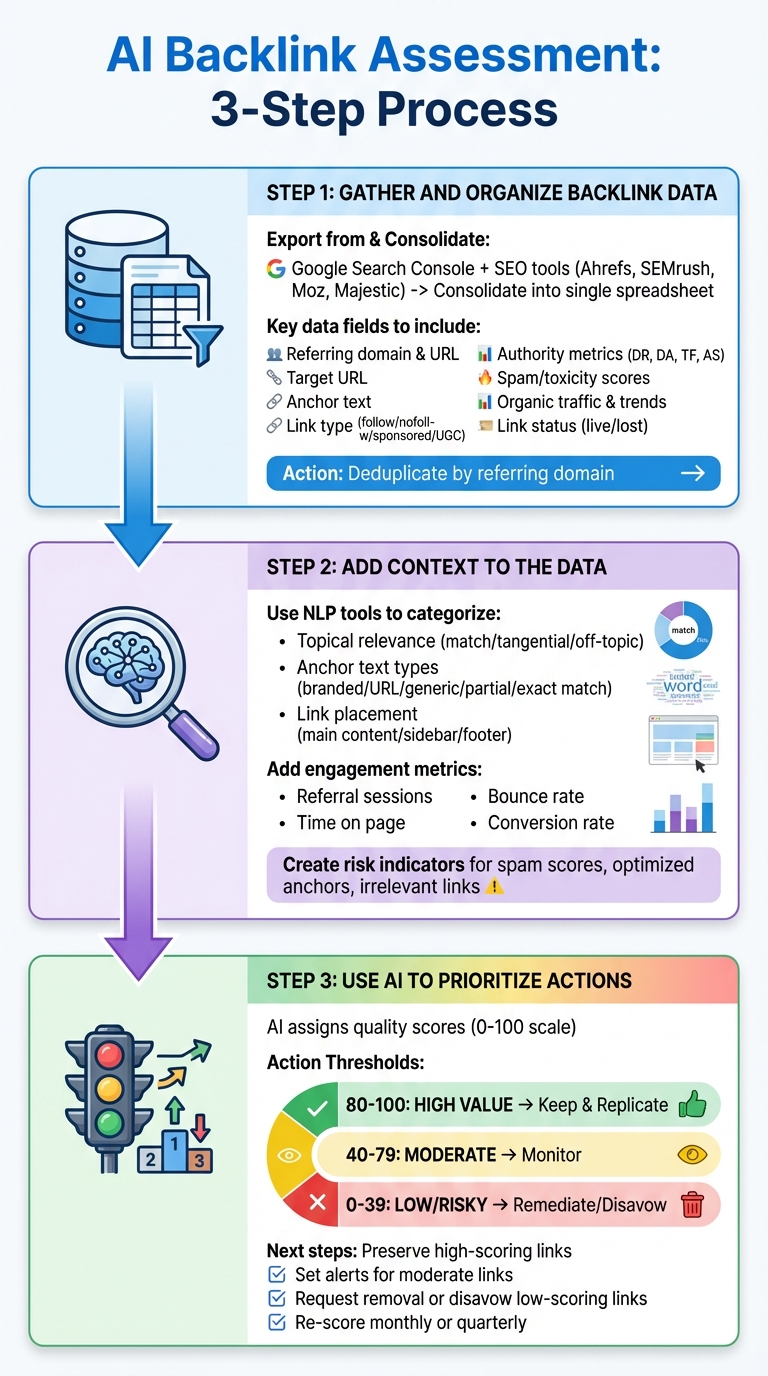
3-Step AI Backlink Assessment Process for SEO Teams
Step 1: Gather and Organize Backlink Data
Begin by exporting backlink data from Google Search Console and at least one major SEO tool, such as Ahrefs, SEMrush, Moz, or Majestic. Each platform offers unique insights, so combining data from multiple sources helps cover more ground and minimizes gaps in your backlink profile.
Next, standardize all the data into a single spreadsheet or data warehouse. Include key details like the referring domain, referring URL, target URL, anchor text, link type (e.g., follow, nofollow, sponsored, or UGC), first and last seen dates, authority metrics (such as DR, DA, TF, or AS), spam or toxicity scores, organic traffic, traffic trends, and the link’s current status (live or lost). Deduplicate entries by referring domain to streamline your analysis. For U.S.-based teams, remember to use proper formatting, such as commas for thousands (e.g., 12,500 sessions), dates in the MM/DD/YYYY format, and currency in dollars (e.g., $1,500).
Once your data is consolidated and cleaned up, you’re ready to enrich it with additional context.
Step 2: Add Context to the Data
Use natural language processing (NLP) tools or SEO platforms to add layers of context to your backlink data. Start by categorizing links based on topical relevance - whether they match your content’s theme, are tangentially related, or completely off-topic. Break down anchor texts into categories like branded, URL, generic, partial match, or exact match. Pay attention to where the links appear on the page (main content, sidebar, or footer), as links placed within natural, editorial content tend to carry more weight.
Flag any patterns that could indicate overuse of exact-match anchors, especially if they come from low-quality domains. It’s also helpful to identify whether links are editorially placed or user-generated and whether they’re surrounded by relevant keywords, which can enhance their value.
Add engagement metrics to your dataset, such as referral sessions, bounce rate, average time on page, and conversion rate, to gauge the actual impact of each link. Look at traffic data from referring domains, including total organic traffic, growth or decline trends, and whether traffic is overly concentrated on a few pages - this could signal a risky or thin site. Finally, create risk indicators for factors like high spam scores, overly optimized anchors, irrelevant links, or connections to deindexed or suspicious sites.
With this enriched dataset, you can now use AI to determine which links to keep, monitor, or address.
Step 3: Use AI to Prioritize Actions
With your enriched data in hand, apply AI to prioritize actions based on link quality and risk. Use an AI model to assign a quality score (on a scale of 0–100) to each link, and optionally add separate scores for value and risk. Define clear thresholds for action:
- Links scoring 80 or higher are high-value and low-risk, making them ideal for a "keep and replicate" strategy.
- Links scoring between 40 and 79 may have moderate value or slight risks and should fall into a "monitor" category.
- Links with scores of 39 or below, especially those flagged for spam or irrelevant network signals, should be marked for "remediation" or disavowal.
Manually review any high-risk links flagged by the AI, as well as sudden spikes in backlinks, which might indicate negative SEO efforts. For high-scoring links, preserve them and analyze their characteristics for potential replication. For links in the "monitor" category, set up automated alerts to track changes in authority, deindexing, or traffic drops from the referring domains. For links marked for "remediation", reach out to webmasters to request removal or update your Google disavow file to neutralize their impact.
Finally, make it a habit to re-score your backlink dataset regularly - monthly or quarterly - to account for algorithm changes, shifts in domain metrics, and new or lost links. This ongoing process ensures your backlink profile stays optimized and aligned with your SEO goals.
sbb-itb-daf5303
Building a Scalable AI-Driven Backlink Workflow
Set Quality Thresholds
Start by defining what "good" looks like for your website and industry. These benchmarks should align with your current backlink profile and competitive environment, rather than relying solely on generic data thresholds. To set these standards, evaluate your backlink data using metrics like DA (Domain Authority), DR (Domain Rating), Trust Flow, organic traffic, and toxicity scores. Establish your site's median and top quartile performance, then compare these figures against three to five competitors.
Create tiered action levels based on the scores you’ve identified. For instance:
- Tier A (High Priority): DR ≥ 60
- Tier B (Moderate Value): DR 40–59
- Tier C (Lower Priority): DR 20–39
Accept links below DR 20 only if they are highly relevant or come from trusted local sources. Ensure relevance by requiring topical similarity and placement within the main content, avoiding footers or sidebars. For risk management, define "red zones" using toxicity scores. For example, flag links with a toxicity score above 70/100 for disavowal, especially if they show other warning signs like link networks or spun content. Remember to format thresholds using U.S. conventions - use commas for large numbers (e.g., 50,000 backlinks) and date reviews in MM/DD/YYYY format.
Once your thresholds are in place, the next step is to automate your monitoring processes.
Automate Monitoring and Alerts
With quality tiers established, automate your tracking systems to catch deviations quickly. Use tools like Google Search Console, Ahrefs, or SEMrush, and connect them via APIs to a centralized data warehouse. Regularly re-score your entire backlink dataset based on your site’s risk profile. For high-traffic or competitive sites, this might mean daily or near-real-time updates, while smaller sites may need checks two to three times a week.
Set up alerts for key events, such as:
- Sudden increases in low-authority or high-toxicity links
- Loss of high-authority or high-traffic backlinks
- Unusual changes in anchor text ratios (e.g., spikes in exact-match money terms)
- Negative traffic trends from referring domains, which could signal penalties
Integrate these alerts into tools your team already uses, like Slack, email, or Jira, to streamline workflows. Prioritize alerts by impact, combining metrics like domain authority, traffic potential, and the importance of the target page (e.g., revenue per session in U.S. dollars). Start with conservative triggers and fine-tune over two to four weeks of testing. Aim for a manageable volume of five to twenty high-priority notifications per day. Group lower-priority alerts into daily or weekly digests to prevent overwhelming your team. Separate alerts into categories like "critical risk", "lost high-value link", or "new opportunity", so team members can focus on their specific responsibilities.
Keep Humans in the Loop
Even with automated systems, human oversight is essential for managing exceptions and making strategic decisions. While AI excels at processing large datasets, human judgment is necessary for high-stakes or ambiguous cases. Always route specific situations to manual review, such as:
- Links affecting core revenue pages (e.g., pricing, product, or lead-gen pages)
- Links from major U.S. publishers or .gov/.edu domains
- Cases with conflicting authority and risk scores
- Potential link schemes or networks where intent needs evaluation
- Brand-sensitive contexts, particularly involving political, medical, or controversial sites
"Never let AI fool you. We're obsessed with quality and keep humans-in-the-loop for all AI-assisted workflows." – Hello Operator
Configure your AI system to flag these cases with a "requires manual review" tag. For example, this might happen when risk and authority scores conflict, sensitive topics are detected, or strategic pages are involved.
Clearly divide responsibilities: let AI handle data collection, initial scoring, continuous monitoring, and pattern recognition, while human specialists focus on strategy, reviewing edge cases, finalizing disavow files, conducting outreach, and interpreting results in the context of algorithm updates or manual actions. Companies like Hello Operator can assist U.S. marketing teams in designing custom AI workflows, integrating them into existing tech stacks, and training in-house SEOs to manage and refine these systems - blending automation with human expertise and brand insights.
How Hello Operator Can Support AI-Driven Backlink Management
With a streamlined workflow in place, Hello Operator can take your backlink strategy to the next level by offering tailored support and solutions that fit your specific needs.
Tailored AI Solutions for Backlink Analysis
Hello Operator specializes in creating custom AI tools that align with your backlink data and technical setup. Instead of relying on generic software, they train AI agents using your proprietary data - this includes your historical link profile, competitive benchmarks, and industry-specific quality indicators. The goal? To define what a "quality backlink" means specifically for your business.
Their solutions integrate seamlessly into your SEO infrastructure through secure code and APIs. For instance, they've developed SEO content publishing tools that can be adapted to automate tasks like backlink scoring, classification, and prioritization. These tools are fine-tuned to match your risk tolerance and growth objectives. The best part? You retain full ownership of these AI solutions, giving you complete control over your backlink processes. Their Custom Assets & AI Advising plan, starting at $5,950/month, includes everything from strategic planning and app development to AI agent training and dedicated project management.
Hands-On Workshops and Team Training
In addition to building custom tools, Hello Operator offers workshops designed to help your team harness AI-driven backlink insights effectively. These sessions - available both in person and remotely - equip your SEO team with practical skills to streamline their workflows. Whether it's automating tasks with platforms like n8n, conducting in-depth research using NotebookLM, or creating custom workflows with MCP, these workshops are tailored to solve real-world challenges.
For example, your team can learn how to interpret toxicity scores, prioritize outreach targets based on AI recommendations, or set up feedback loops where human input refines AI performance over time. This training ensures your team doesn’t just rely on AI outputs but also understands how to validate and act on them. By combining hands-on learning with expert guidance, your team will be better prepared to integrate AI into their link-building strategies.
Blending AI with Human Expertise
Hello Operator doesn’t just stop at automation - they emphasize the importance of human oversight in critical decision-making. Their AI marketing team works closely with your team via tools like Slack, offering expert advice during implementation. You’ll have access to specialists in LLMs, APIs, and SEO who can help interpret AI results and guide decisions, whether it’s disavowing a flagged link or assessing a high-authority yet contextually tricky opportunity.
This hybrid approach shifts routine tasks to AI while reserving strategic and high-stakes decisions for human experts. Their Ongoing & On-Demand plan, starting at $3,750/month, includes access to custom GPTs, AI agents, and combined human-AI content creation services. With no long-term contracts, U.S.-based marketing teams can scale their AI adoption at a pace that works for them.
Conclusion and Key Takeaways
Recap of AI Metrics and Workflow
Let’s quickly revisit the essentials of AI-driven backlink assessment. The entire process revolves around three key metrics: authority, relevance, and risk. These elements work together to help you evaluate the quality of your backlinks. For a deeper dive into how each metric functions, refer back to the earlier sections.
The workflow itself is simple yet effective: start by gathering backlink data from your SEO tools and analytics platforms. Then, enhance each link with AI-powered contextual insights. Finally, prioritize your actions based on composite scores. This approach transforms a mountain of raw backlink data into a clear action plan, making it easier to conduct regular reviews - whether monthly or quarterly - to keep your link profile in top shape.
Action Plan for Your Team
To truly harness the power of AI in backlink management, combine its speed and precision with your team’s expertise. Here’s how you can roll out this strategy step by step:
- First 30 days: Activate AI features, define quality benchmarks (e.g., Domain Authority above 40, toxicity below 60), and set up dashboards to categorize links by authority, relevance, and risk.
- Next 60 days: Apply the workflow to a single domain. Use AI to pinpoint high-value referring sites for potential partnerships and flag toxic clusters that may require disavowal.
- By 90 days: Incorporate AI scoring into your regular SEO reviews and fine-tune thresholds based on the results you observe.
By following this phased approach, you’ll establish a solid foundation for ongoing improvements to your SEO strategy.
AI isn’t here to replace your strategy - it’s here to enhance it. With AI handling the repetitive and time-consuming aspects of backlink evaluation, your team can shift focus to the tasks that require human creativity and judgment, like building relationships, collaborating on content, and making strategic decisions. This allows for a more thorough and consistent approach to managing your backlink profile without increasing your team’s workload.
For those ready to take their efforts to the next level, partners like Hello Operator can help you design custom AI workflows that integrate backlink, analytics, and CRM data. They can also automate tasks like generating prospect lists and setting up alert triggers, while offering hands-on workshops to upskill your team. This bridges the gap between standard tools and a fully integrated, AI-powered link management system.
FAQs
How does AI evaluate the quality of a backlink?
AI assesses backlink quality by focusing on several critical factors, including domain authority, content relevance, and spam signals. It examines the linking website's reputation and trustworthiness, ensuring it matches the topic or focus of your content.
On top of that, AI identifies potential spam or low-quality links, weeding out those that might negatively impact your site's performance. This ensures that your backlink profile is built on reliable and relevant connections, strengthening your overall digital marketing efforts.
Why is human oversight important in AI-based backlink evaluations?
Human involvement plays a key role in ensuring accuracy, context, and fairness when evaluating backlinks with AI tools. While AI excels at crunching numbers and analyzing metrics such as domain authority, relevance, and spam scores, it’s the human touch that adds essential judgment to validate these results, spot subtle nuances, and address potential biases.
By combining the efficiency of AI with human expertise, this partnership upholds ethical standards, enhances decision-making, and minimizes the chances of errors in automated processes.
How do AI tools detect and flag harmful backlinks?
AI tools assess backlinks by looking at important factors like domain authority, relevance, and spam scores. They help pinpoint harmful backlinks by detecting issues such as unnatural link patterns, connections to unrelated domains, or elevated spam signals. After identifying these problematic links, you can review them and take action, like disavowing, to safeguard your website’s SEO health.
Related Blog Posts

