

AI-powered competitor analysis is reshaping how businesses approach SWOT analysis, turning a traditionally slow and subjective process into one that's efficient and data-driven. Here's what you need to know:
- AI automates 80% of tasks like data collection and pattern detection, reducing research time from days to hours.
- Tools like NLP analyze customer reviews, while machine learning monitors competitor activity in real time.
- By 2025, 56% of marketers are expected to integrate generative AI into their workflows.
Key applications include:
- Competitor Landscape Mapping: Identify direct, indirect, and emerging competitors.
- Feature Benchmarking: Use AI to analyze product gaps and competitor strategies.
- Real-Time Monitoring: Track competitor moves 2–3 weeks faster than manual methods.
- Sentiment Analysis: Extract insights from competitor reviews for better positioning.
- Pricing Intelligence: Detect pricing shifts and adjust strategies instantly.
- Predictive Modeling: Anticipate market trends and competitor actions.
- Scenario Planning: Stress-test strategies using AI simulations.
- Agentic Workflows: Autonomous AI systems provide continuous competitive insights.
AI doesn't replace human expertise but enhances it by delivering actionable insights faster and at a lower cost. Whether you're tracking pricing changes, analyzing sentiment, or predicting trends, AI ensures you're always one step ahead.
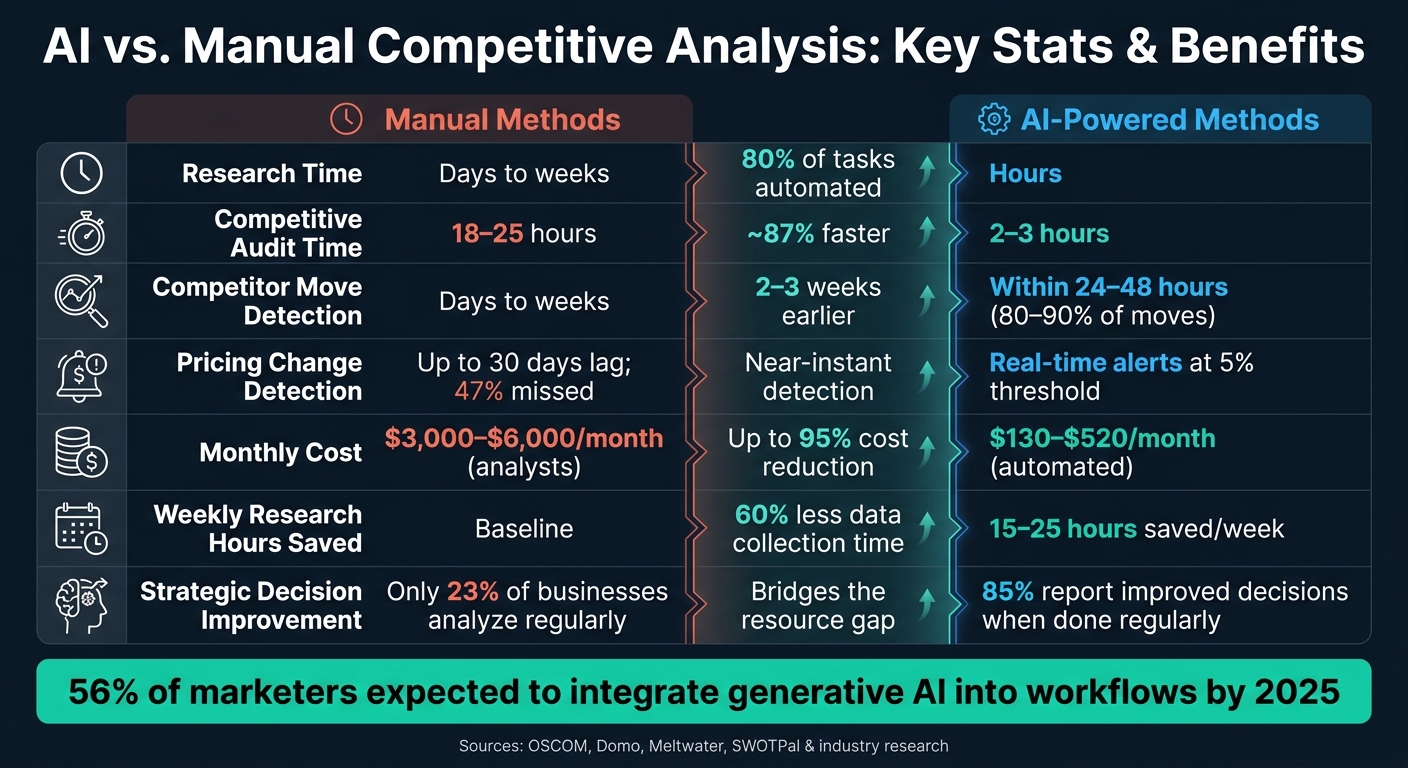
AI vs. Manual Competitive Analysis: Key Stats & Benefits
SWOT Analysis With AI: The New Way to Find Strengths, Weaknesses & Market Opportunities (Dapta)
sbb-itb-daf5303
1. Competitor Landscape Mapping
AI-powered discovery tools can reveal competitors you might not have noticed by analyzing factors like audience overlap, keyword trends, and digital behavior. This is especially crucial when it comes to indirect competitors - those addressing the same customer problem but with a different product. These are often the ones that catch businesses off guard.
To make sense of your competitive landscape, organize competitors into three categories: Direct (offering the same product in the same market), Indirect (different product, solving the same problem), and Emerging (new players or companies branching into your space). A good rule of thumb is to focus on 5–8 direct competitors and 10–12 indirect ones. This keeps things manageable while still allowing you to spot potential threats early on. This structured approach helps you stay alert to subtle changes in the competitive environment.
One often-overlooked signal is competitor job postings. For example, if a company begins hiring machine learning engineers, it could indicate they’re planning a pivot into AI - a development that might materialize 6–12 months later.
"Companies hire for what they plan to build, not what they have already built." - OSCOM
Another tactic is LLM brand monitoring, which involves using AI tools like ChatGPT or Claude to compare how they describe your brand versus competitors. As AI-generated answers increasingly shape buyer decisions, ensuring your brand is well-represented in these responses is becoming just as critical as maintaining strong search rankings.
2. Feature and Positioning Benchmarking
Feature and positioning benchmarking takes competitor analysis a step further by focusing on product details and market strategies. One standout tool in this process is AI-driven feature gap analysis, which significantly cuts down the time needed for a full competitive audit. Instead of spending 18–25 hours manually comparing products, AI can scan competitor product pages, customer reviews, and technical documents to deliver structured insights in just 2–3 hours.
Natural Language Processing (NLP) tools also play a key role by sifting through hundreds of reviews on platforms like G2 or Capterra. These tools uncover specific strengths and weaknesses of competitors. For example, AI analysis of competitor reviews found that 41% of negative feedback related to a single feature - reporting customization. This gave a rival company a clear opportunity to position their product as a solution to that issue. Beyond features, AI also tracks broader strategic changes, such as shifts in competitor messaging. If a competitor updates their homepage headlines or value propositions to target new buyer personas using AI psychographics, AI can detect these subtle yet significant moves - something many teams might overlook.
"AI identifies language patterns that reveal strategic priorities. When a competitor repeats certain phrases across channels, that's not accident. That's positioning." - Rodney Warner, Strategist
The real advantage of AI-driven benchmarking lies in connecting these insights to actionable business outcomes. By tying each feature gap to potential revenue opportunities and estimating the time-to-value, teams can better prioritize their product and marketing strategies. This approach ensures that every insight translates into meaningful impact.
3. Real-Time Market Monitoring
Always-On Competitive Intelligence
Real-time market monitoring takes competitor analysis to the next level by making it a continuous process instead of relying on static quarterly reports. Why does this matter? Because by the time traditional reports are compiled, the market may have already shifted. AI changes the game by keeping your strategy nimble and responsive.
"Most companies don't have a data problem; they have a 'speed of insight' problem. By the time a human analyst manually compiles a competitor report, the market has already moved." - Domo
AI tools work around the clock, tracking competitor websites, social media platforms, job postings, news updates, and even patent filings. These systems are incredibly efficient: mature AI programs can detect 80–90% of significant competitor moves within 24–48 hours. Compare that to manual methods, which might take days or even weeks to gather the same insights. Businesses leveraging AI often identify market opportunities 2–3 weeks earlier than those relying on traditional research methods. This speed gives companies a clear edge in adapting their strategies.
To keep the flood of data manageable, focus on monitoring 5–8 key competitors and use threshold-based alerts. For instance, you can set notifications to trigger only when price changes exceed 5%. This approach helps your team focus on meaningful developments while filtering out less relevant noise. With this real-time intelligence, AI becomes an even more powerful tool for sharpening your competitive strategies.
4. Sentiment and Customer Feedback Analysis
Mining Competitor Reviews for Strategic Positioning
Competitor reviews are a treasure trove of insights that often go untapped. With the help of AI tools and Natural Language Processing (NLP), businesses can now analyze thousands of unstructured reviews from platforms like G2, Capterra, Trustpilot, and Reddit in record time. What used to take 45–60 minutes can now reveal patterns within minutes. These tools categorize feedback into themes, offering a clear picture of where competitors frequently fall short - and where your business can step in. This method provides a fast, structured way to analyze feedback on a large scale.
"AI helps teams track competitor activity continuously and at scale. Advanced AI models can pick up on subtle shifts in language, product focus, hiring priorities, and customer sentiment." - Chris Hanson, Meltwater
Recurring issues like "confusing setup" or "slow support response" can be turned into actionable opportunities for your team. Using this insight, your marketing team can craft messaging that directly addresses these competitor weaknesses, using language that resonates with customer concerns.
A smart move: set up AI tools to send alerts when a competitor's sentiment score takes a sudden dive. A sharp drop could indicate a failed product launch or a pricing error - giving your team a chance to act before the market fully absorbs the impact. This kind of real-time monitoring turns shifts in customer sentiment into strategic opportunities for your business.
5. Pricing and Promotion Intelligence
Decoding Competitor Pricing Before It Costs You
In an AI-driven SWOT framework, pricing signals provide quick, actionable insights that can make a big difference. Pricing is a fast-moving competitive factor, and relying on manual monitoring often means falling behind - up to 30 days, in fact. Even more concerning, 47% of pricing changes can go unnoticed with manual methods. By the time your AI marketing team spots a competitor's pricing adjustment, customers might have already made the switch. This is where AI's real-time monitoring shines, complementing its broader ability to track competitive changes.
AI tools constantly scan competitor pricing pages, instantly flagging any updates. They also dig deeper, analyzing packaging structures - like a switch from per-seat pricing to usage-based billing or moving a feature from an enterprise plan to a mid-tier option. These shifts often signal deliberate growth strategies rather than simple price adjustments.
"Pricing is the competitive signal with the most immediate impact on revenue." - Seeto
To stay ahead, set AI alerts to trigger at a 5% pricing change threshold - or even 2–3% in markets where price sensitivity is high. If a competitor moves an enterprise feature to a lower-tier plan, that’s likely a push to broaden adoption. In such cases, your team should act fast, updating your positioning to counter the move before customers notice.
Here’s a quick breakdown of common pricing signals and how to respond strategically:
| Pricing Signal | Strategic Interpretation | Recommended Action |
|---|---|---|
| Launching a free tier | Focus on product-led growth | Assess how this impacts entry-level customer acquisition |
| Moving features to higher tiers | Monetizing existing users | Emphasize your inclusion of those features in marketing |
| Increasing annual discounts | Addressing cash flow or churn concerns | Counter with "no-contract" or flexible payment messaging |
| Removing a plan | Simplifying or abandoning a segment | Target displaced users with tailored campaigns |
AI doesn’t just flag changes; it creates a searchable pricing history, helping you distinguish between short-term experiments and long-term strategic shifts. Combined with the continuous market monitoring discussed earlier, this data provides the context needed to craft timely and effective responses.
6. Predictive Trend and Risk Modeling
Spotting What's Coming Before It Arrives
Building on real-time monitoring, predictive trend modeling gives teams the ability to anticipate market changes before they happen. AI takes SWOT analysis beyond a historical perspective, turning it into a forward-focused strategy tool. Instead of just analyzing past performance, predictive modeling helps pinpoint opportunities and threats early - providing a competitive edge.
For example, competitor job postings can signal upcoming strategic moves. A noticeable increase in job listings for machine learning (ML) or natural language processing (NLP) roles - previously flagged during competitor landscape mapping - often hints at a focus on advanced technologies. Similarly, a rise in regional manager hires can suggest plans for geographic expansion. AI also tracks sentiment trends on platforms like G2, Capterra, and Trustpilot. A steady decline in competitor reviews over 3 to 6 months might forecast customer churn or a potential pricing adjustment, giving your team time to act. Companies using AI tools for automated marketing reports often detect these trends 2–3 weeks earlier than those relying on manual methods. By combining these signals with cross-industry hiring trends, businesses can uncover broader market patterns.
Another effective approach is correlating data across multiple competitors. For instance, if three competitors simultaneously hire AI specialists, it could indicate a larger industry-wide shift in technology - helping you determine whether you're seeing an isolated strategy or a broader trend.
Looking ahead to 2026, monitoring mentions of AI assistants in brand discussions will enhance predictive capabilities. These insights will reveal how such platforms influence buyer decisions, adding another layer to market analysis.
7. Scenario Planning and Strategy Stress Testing
Simulating the Future Before It Happens
Building on predictive trend modeling, scenario planning takes things a step further by stress-testing strategies against possible future disruptions. With AI-powered scenario planning, businesses can simulate market conditions to evaluate strategic decisions.
Instead of focusing solely on strengths, consider this: "How will our strengths hold up if a competitor rolls out a similar feature next quarter?" AI can model this exact scenario, pinpointing vulnerabilities in your strategy. This approach doesn’t just save time - it reduces strategic analysis efforts by 60% while delivering deeper insights. Such simulations pave the way for tools like pre-mortem analysis.
One effective tool is pre-mortem analysis, where AI creates a hypothetical future failure and identifies the weaknesses or threats that led to it. This method uncovers blind spots that traditional SWOT analyses often overlook.
"In 2026, strategic planning isn't about remembering what your strengths are - it's about using Artificial Intelligence to simulate market conditions and stress-test your assumptions." - Mark King, Strategy Analyst, SWOTPal
AI doesn’t stop at simulations. It sharpens strategic focus by assigning materiality scores to risks and opportunities. These scores, ranging from 1 to 10, are based on revenue impact and likelihood. This allows leadership to prioritize the most critical risks instead of spreading resources thin. For example, a looming price war might pose a revenue risk of $8M–$12M, while a vertical expansion opportunity could offer potential gains of $5M–$15M.
8. Agentic AI Workflows
Your Competitive Intelligence That Never Clocks Out
Traditional methods like trend modeling, scenario planning, and sentiment tracking all require human input to get started. Agentic AI workflows, on the other hand, take a completely different approach. These systems operate autonomously, working 24/7 to monitor competitor websites, social media channels, job boards, and review platforms. Imagine the difference between taking a single photograph and streaming live video: traditional SWOT analysis gives you a one-time snapshot, while agentic AI provides a constant stream of real-time updates. This uninterrupted flow of intelligence can lead to measurable performance improvements.
From 103 Days to 23 Days
Here’s a real-world example: between July 2025 and February 2026, the voice-AI platform Anyreach implemented an agentic system called AR007 in a competitive market with over 50 vendors. AR007 analyzed 12 GB of competitor data daily from platforms like Discord and GitHub, using LLM ensembles to achieve an impressive 92% precision in signal classification. The results were striking - Anyreach reduced its average feature parity timeline from 103 days to just 23 days, a 77% reduction. Additionally, the system helped reclaim 18% of at-risk customers.
"AR007 detects competitor moves within 24 hours and ships matching features in one sprint - outnumbered 5-to-1." - Anyreach
Agentic orchestration doesn’t just boost performance - it’s also cost-effective. Running such a system costs around $1,700 per month, significantly less than the $3,000–$6,000 monthly expense of manual competitive analysis. Plus, these systems save 15–25 hours of manual research every week and reduce data collection time by 60% . These efficiency gains highlight how agentic AI can streamline workflows, reduce costs, and deliver actionable insights faster.
"Think of an AI agent as a junior competitive analyst that never sleeps." - Ulriikka Järvinen, Tech CMO
To get started, deploy a single agent with a focused goal, such as tracking competitor pricing. Once you see the benefits, you can scale to a multi-agent system. The key is ensuring the agent integrates with tools your team already uses, like Slack or Notion, so insights are immediately actionable rather than buried in reports.
For marketing teams looking to integrate continuous, actionable competitive intelligence, platforms like Hello Operator use similar agentic AI workflows to seamlessly feed strategic insights into existing processes.
Conclusion
AI has transformed tasks that once took weeks into processes completed in minutes - and at a fraction of the cost. Whether it's mapping out competitor landscapes, benchmarking product features, analyzing real-time sentiment, or stress-testing strategic scenarios, AI tackles the bottlenecks that often slow down how organizations understand and react to their competitive environments.
While AI excels at gathering and organizing data, human expertise remains essential for turning those insights into meaningful action. As OSCOM aptly states:
"The companies with the best competitive intelligence are not the ones that know the most about their competitors. They are the ones that know the right things at the right time and have systems that translate observations into actions."
For instance, AI might alert you to a competitor restructuring its pricing or hiring for new engineering roles. But it’s up to your team to interpret whether these changes signal a threat, an opportunity, or just noise.
Interestingly, only 23% of businesses conduct competitive analysis regularly, despite 85% of those who do reporting improved strategic decisions. This gap isn’t because of a lack of interest - it’s a matter of resources. AI helps bridge this divide, making continuous monitoring realistic and cost-effective. A fully automated competitive intelligence setup typically costs between $130 and $520 per month, compared to the $3,000–$6,000 monthly expense of employing analysts.
FAQs
What data sources should AI use for a SWOT analysis?
To create a thorough SWOT analysis, it's crucial to blend internal data - like customer feedback, financial reports, and performance metrics - with external sources such as competitor websites, social media trends, industry news, and trade publications. Adding layers like SEO metrics, audience demographics, and real-time sentiment analysis can provide deeper insights. This combination helps ensure your analysis is grounded in data and ready to drive meaningful decisions.
How do I avoid bad or biased AI insights in competitive analysis?
To minimize biased or unreliable AI-generated insights, prioritize high-quality data. Use a mix of diverse and trustworthy sources, such as competitor websites, industry reports, and customer reviews. When working with AI, guide it by assigning specific roles (like acting as a critical analyst) and encourage contrarian reasoning to expose potential blind spots or weaknesses in its output. Always double-check the claims made by AI by reviewing its cited sources. While AI is excellent at identifying patterns, the responsibility for interpreting those patterns lies with humans.
How can I start using agentic AI for SWOT without a big budget?
You can start incorporating agentic AI into your SWOT analysis without spending much by prioritizing well-crafted prompt engineering over expensive software. Let AI help you sift through specific data sources, such as customer feedback or competitor updates, to spot trends or challenges. Take on the role of strategist while using AI for extracting data and recognizing patterns, keeping expenses minimal while still delivering professional-level insights.
Related Blog Posts

