

AI is transforming how businesses create thought leadership content. By handling tasks like research, drafting, and repurposing, AI allows experts to focus on their insights and experience. The result? Faster processes and better outcomes when humans and AI work together.
Key Takeaways:
- AI can cut research time by up to 80% and streamline content creation.
- Human oversight is essential to ensure originality, accuracy, and trust.
- Teams using AI see up to 4.1x better performance compared to fully automated efforts.
- Repurposing content with AI boosts visibility and engagement across platforms.
How AI Supports Collaborative Content Creation:
- Research Synthesis: Quickly processes large data sets and interview transcripts.
- Drafting: Turns expert input into first drafts for blogs, social posts, and more.
- Consistency: Ensures tone and messaging align across teams with shared guidelines.
- Content Repurposing: Maximizes the value of one piece by adapting it for multiple platforms.
- Internal Knowledge Sharing: Builds efficient systems for team collaboration.
AI acts as a powerful tool, but the human element - insights, creativity, and final editing - remains irreplaceable. Together, they deliver content that stands out and drives results.
How to Make Thought Leadership Content with AI
For organizations looking to implement these strategies, an AI marketing workshop can help teams master the necessary tools and workflows.
sbb-itb-daf5303
What Is Collaborative Thought Leadership?
Collaborative thought leadership happens when subject-matter experts (SMEs), marketing teams, and AI join forces to create content that balances credibility with scalability. The idea isn't to replace human expertise but to combine it with the efficiency AI offers. AI steps in as a first-draft creator and junior strategist, organizing ideas and synthesizing research, while humans provide the insights, strategy, and final polish. This partnership ensures content is both trustworthy and distinct.
Why does this shift matter? The value of thought leadership has evolved. It’s no longer about having exclusive access to information (known as information asymmetry). With AI making data more accessible than ever, the real edge comes from relationship asymmetry: building trust, shaping narratives, and fostering genuine community connections. Robert Rose, Chief Strategy Advisor at the Content Marketing Institute, explains it well:
"Leadership in this new era won't involve commanding authority. It will require leaders to earn it one community at a time. The ones who thrive won't be those who control but those who connect."
Core Principles of Collaborative Thought Leadership
For this model to work effectively, three principles are key: credibility, consistency, and human oversight.
- Credibility: Strong content is rooted in real-world experience. This includes proprietary data, customer stories, and unique perspectives - things AI alone can’t replicate.
- Consistency: A unified voice and perspective across all content are crucial. This requires giving AI clear and specific instructions, rather than vague descriptors.
- Human Oversight: Humans must remain involved to catch issues like AI hallucinations or overly generic language that could weaken the authenticity audiences rely on.
These principles explain why 86% of top Google search results and 82% of sources cited by AI tools like ChatGPT and Perplexity still come from human-created content. Search engines and AI systems prioritize material that demonstrates Experience, Expertise, Authoritativeness, and Trustworthiness - the E-E-A-T framework. Generic AI-generated content, no matter how polished, often falls short of these standards.
Why AI Improves Collaborative Processes
AI’s greatest strength in this collaboration is its ability to reduce friction. It can cut research time by up to 80%, handle formatting tasks, generate SEO metadata, and transform a single article into social media posts or email campaigns. By taking care of these time-consuming tasks, AI allows experts to focus on delivering high-value insights, making the collaborative process more efficient. Jesse Schor, Head of Growth at Webstacks, sums it up:
"The strategic question for B2B leaders isn't whether to use AI in content production - it's how to use it without becoming indistinguishable from competitors."
However, creativity remains a limitation for AI, reinforcing the importance of human control. As Sydney Scott, Editorial Strategist at Workday, puts it: "The goal for leaders isn't to see how much control they can give away, but to prove that humans still hold the wheel." AI operates by predicting the most likely outcome based on its training data - it produces what’s expected, not what’s bold or thought-provoking. This is where human input transforms AI’s output from merely adequate to truly engaging. Together, this collaboration creates content that stands out and drives meaningful business results.
AI Use Cases in Collaborative Thought Leadership
Here are five specific ways businesses are leveraging AI to enhance collaborative thought leadership - and the results they’re achieving along the way.
Research Synthesis
AI content ideation isn’t just fast - it’s great at spotting patterns that might go unnoticed by a single person. Take Elena Rodriguez, a boutique management consultant, for example. In early 2026, she created a five-step AI research chain to process interview transcripts, industry reports, and financial data. The result? She slashed her research time from 34 hours to 14 hours per engagement - a 59% time savings - while her client feedback scores jumped from 4.2 to 4.7 out of 5.0 in areas like evidence support and research depth.
One tip: record expert conversations instead of summarizing them. Full transcripts give AI the raw material it needs - detailed stories, numbers, and opinions - to produce sharper, more credible insights. This approach directly improves both the quality and impact of the research.
Expert-Led Drafting
The best drafting workflows combine human expertise with AI’s efficiency. Here’s the process: subject-matter experts (SMEs) provide the raw input (like voice notes or quick interviews), AI creates a draft, and human editors refine it into the final version. Nathan Thompson, Head of Content Strategy at Copy.ai, sums it up perfectly:
"AI replaced the ghostwriter, not the thought leader... The prose is rougher, but the thinking is sharper. And the thinking is what the reader came for."
This method works because AI-generated content with human oversight performs 4.1x better than fully automated content. The expert’s voice and insights remain front and center, while AI eliminates the dreaded blank page, making the process faster and more effective.
Multi-Stakeholder Content Development
Aligning messaging across teams - like product, sales, and customer success - is notoriously challenging in thought leadership. Many organizations are solving this by using a shared "judgment layer." This layer includes rules for audience targeting, tone, and restricted phrases, ensuring consistency across all contributors without endless rewrites.
Additionally, basing content on actual stakeholder conversations (rather than committee notes) adds authenticity and specificity that generic content often lacks. This approach strengthens the collaborative model that’s essential for scaling thought leadership efforts.
Content Repurposing and Distribution
AI doesn’t just help with drafting - it also maximizes the value of content through repurposing. A single, well-researched piece can fuel weeks of content when reused strategically. For instance, ColdIQ built a content engine using Claude Code, with 27 specialized skills, allowing 24 team members to publish in their unique voices. Over just 87 days starting in April 2026, this system turned single LinkedIn posts into X threads, newsletters, blogs, video scripts, and carousels. The payoff? $151,000 in monthly recurring revenue (MRR) and 27 new clients.
Companies that refresh and redistribute content every 90 days see up to 4.8x more AI citations than those that publish once. Plus, 59% of LinkedIn content cited in AI search results comes from individual profiles, not company pages. This makes activating real people across platforms a key strategy - not just a nice-to-have.
Internal Knowledge Activation
Strong internal systems are the backbone of consistent, high-quality content. These systems might include brand voice guides, prompt libraries, and shared content rules that anyone on the team can use. AI systems governed by these tools can boost productivity by up to six times when compared to unstructured approaches.
Here’s a practical starting point: identify three to five subject-matter experts outside the C-suite and build workflows around their expertise. Right now, only 37% of B2B companies involve non-C-suite employees in thought leadership. This means most organizations are overlooking their most credible voices - and missing out on the business impact these voices could deliver.
Measurable Results and Business Outcomes
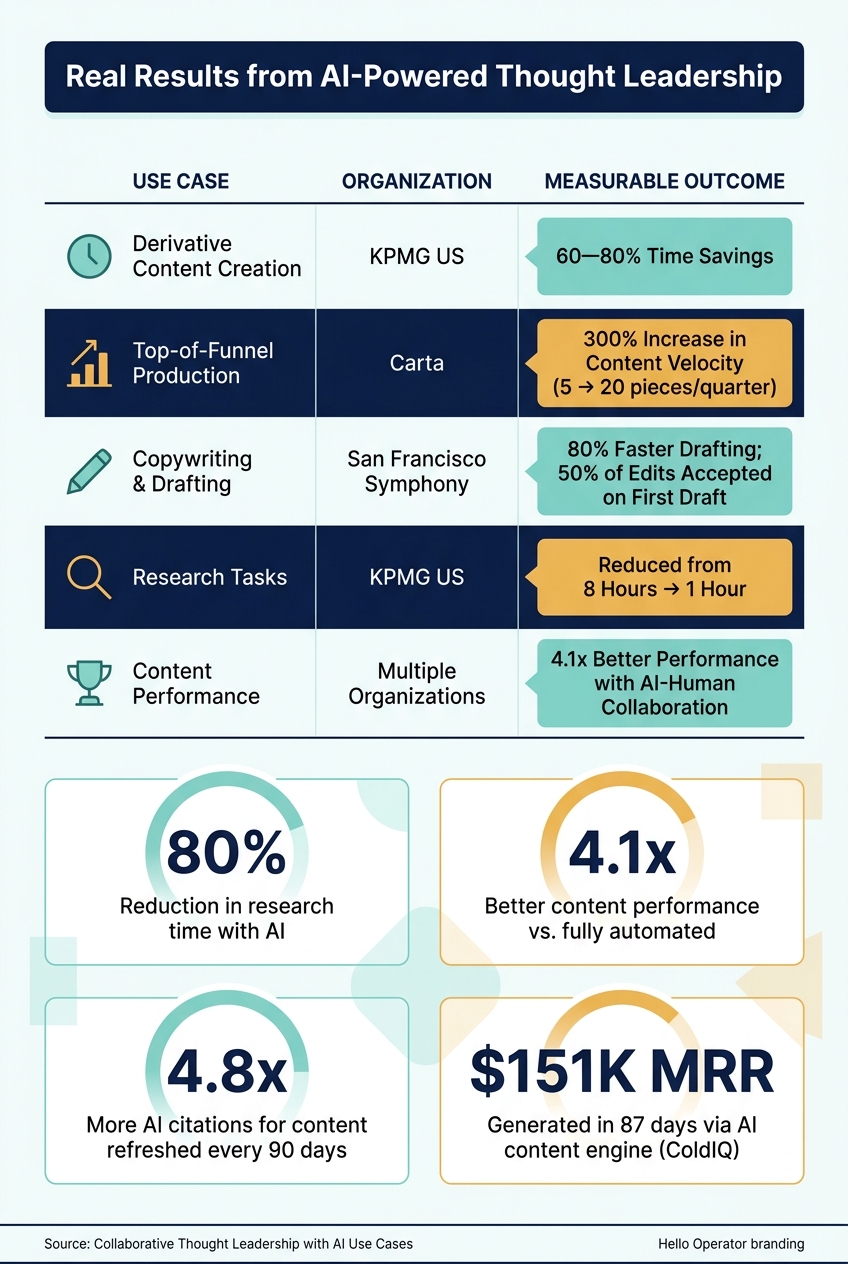
AI-Human Collaboration in Thought Leadership: Measurable Business Outcomes
The impact of AI-driven processes becomes undeniable when you look at the measurable results they deliver across industries. From professional services to fintech and even the arts, AI-powered collaboration is driving real, tangible improvements in efficiency and consistency.
Take KPMG US, for example. By implementing Writer AI agents through its "aIQ" program, the company slashed 60–80% of the time spent on derivative content creation. What used to take an entire workday now takes just an hour. As Lauren Boyman, KPMG's CMO, put it:
"We need to move fast, and Writer is one of the AI tools we identified early on that can help us increase our speed to market with high quality content."
Carta experienced a remarkable transformation as well. Their content velocity tripled, jumping from 5 to 20 organic pieces per quarter, all while maintaining quality and staying true to their brand. Lucy Hoyle, Carta's Content Marketing Manager, highlighted the importance of AI integration:
"Being able to infuse our Brand Kit into AirOps to make sure all our writing is consistent has proven to be very important, especially as our brand evolves... Now, we can add more creativity to our content."
These examples illustrate how AI tools, when aligned with brand guidelines and governance, empower teams to produce on-brand content independently. This eliminates the need for prolonged senior reviews and minimizes reliance on external agencies.
Here’s a quick summary of the outcomes:
| Use Case | Organization | Measurable Outcome |
|---|---|---|
| Derivative Content Creation | KPMG US | 60–80% time savings |
| Top-of-Funnel Production | Carta | 300% increase in velocity |
| Copywriting/Drafting | San Francisco Symphony | 80% faster drafting; 50% of edits accepted on first draft |
| Research Tasks | KPMG US | Reduced from 8 hours to 1 hour |
| Content Performance | Multiple | 4.1x better performance with AI-human collaboration |
These results show how AI's efficiency, paired with human creativity, can lead to outstanding business outcomes.
While AI excels at tasks like research, drafting, and repurposing content, the human element remains essential. Strategic oversight, original ideas, and a distinctive brand voice are what make the final product stand out. It's this partnership - AI doing the heavy lifting and humans adding the creative spark - that delivers results that are hard to beat.
What You Need to Get Started
To launch a successful AI-driven thought leadership strategy, it’s essential to lay the groundwork first. This means combining the right tools, processes, and - most importantly - people.
The key ingredient? Engaged subject-matter experts (SMEs). Kevin Thomas from Contentstack highlights why this is so important:
"AI is a synthesis engine, not an original thinker - it predicts probable text based on existing data, which means it defaults to consensus rather than new perspectives."
Your SMEs - whether they’re engineers, product managers, or executives - must actively contribute. Even a quick 30-minute briefing or a short voice memo from a senior leader can provide the unique insights AI needs to produce standout content.
Next, you’ll need an AI-ready brand voice guide. A basic style guide simply won’t cut it. To avoid AI generating bland, cookie-cutter text, you’ll need to provide specifics: vocabulary lists (including words to use and avoid), examples of sentence rhythm, and rewritten paragraphs that clearly illustrate your brand’s tone. Without this, AI-generated content risks falling into the trap of generic writing - a problem seen in 74.2% of AI-detectable web pages published in April 2025.
Finally, a three-layer workflow is essential for maintaining quality while scaling production. Here’s how it works:
- Humans generate the core ideas and direction.
- AI takes on the heavy lifting, like drafting and structuring.
- Humans step back in to refine, ensuring the final output is clear, accurate, and aligned with your brand’s voice.
This human-in-the-loop process ensures that AI remains a tool, not the sole driver, of content creation. With these elements in place, you’ll have a solid foundation to integrate AI into your thought leadership efforts effectively.
How Hello Operator Can Help
If you’re ready to put these workflows into action, Hello Operator offers the expertise to bridge strategy and execution. Their team - featuring LLM and API specialists, SEO experts, writers, and project managers - integrates directly into your existing Slack or Teams setup. Rather than replacing your team, they function as an extension of it, aligning with the collaborative human-AI workflows discussed earlier.
They offer two key options:
- Project-Based Plan ($5,950/month): This includes custom AI workflows, AI agents trained on your proprietary data, reusable templates, and standard operating procedures.
- Welcome Assessment ($3,950, one-time): A 21-day onboarding sprint that delivers a strategic roadmap, an SEO 2.0 audit, and a clear understanding of where AI can make the biggest impact before committing to a larger engagement.
As Hello Operator puts it:
"AI is our tool, not our identity. We design and create with empathy, ensuring our solutions empower people, foster connection, and remain grounded in humanity."
Conclusion: AI as a Partner in Thought Leadership
The examples shared here highlight a key point: AI isn't here to replace human expertise - it’s here to amplify it. Whether it’s synthesizing complex research or managing content across diverse teams, the companies gaining real traction are the ones that keep humans in control while letting AI handle the repetitive tasks.
As Jesse Schor, Head of Growth at Webstacks, explains:
"The brands that win will use AI to amplify their unique insights, not automate generic takes."
The real advantage lies in combining AI’s efficiency with authentic human perspectives. This partnership is what creates content that stands out.
With the rise of AI-driven customer journeys and Generative Engine Optimization (GEO), thought leadership must be both authoritative and structured in a way that AI systems can recognize. Content that lacks a genuine human voice or fresh insights risks fading into the background - both for audiences and the AI tools shaping today’s buying decisions. This shift demands a stronger focus on collaboration between humans and AI.
These insights offer a clear path forward. Ready to take action? Hello Operator provides a practical starting point. As they put it, "AI is a moving target and what's working today could be outdated tomorrow. Fractional AI marketing support keeps your team agile amid rapid changes." Whether through a one-time evaluation or a full-scale project, the goal remains the same: creating thought leadership that’s faster to produce, impossible to overlook, and unmistakably yours.
FAQs
How do you ensure AI-assisted thought leadership doesn’t feel generic?
To stand out from generic AI-generated content, ground your work in proprietary data, original viewpoints, and a tone that reflects your brand's personality. Make sure to include human oversight in the process - this helps refine the content with genuine insights, practical examples, and thoughtful editing. Combining the efficiency of AI with human creativity ensures your message stays unique and captures attention.
What human review steps prevent AI errors like hallucinations?
To ensure the quality and reliability of AI-generated content, several key steps are involved in the human review process:
- Regular Audits: Periodic checks of AI outputs help identify errors, inaccuracies, or inconsistencies in the content.
- Fact-Checking: Verifying claims for accuracy ensures that the information provided is correct and trustworthy.
- Tone and Sensitivity: Reviewing the content for consistency in tone and ensuring it aligns with cultural norms avoids unintentional insensitivity or misrepresentation.
Structured checkpoints are built into the workflow, allowing human reviewers to validate or adjust the AI-generated material before it goes live. This process reduces mistakes and ensures compliance with standards.
What’s the fastest way to turn one expert insight into multiple content formats?
The quickest method involves leveraging AI-driven workflows to transform your original content - whether it’s a blog post, podcast, or video - into multiple formats. These workflows can identify key takeaways and repurpose them into bite-sized pieces like social media posts, email snippets, or even video scripts. With pre-designed templates and automation tools, you can maintain consistent branding while streamlining the publishing process. This approach lets you efficiently create a variety of content from a single expert idea.
Related Blog Posts

