
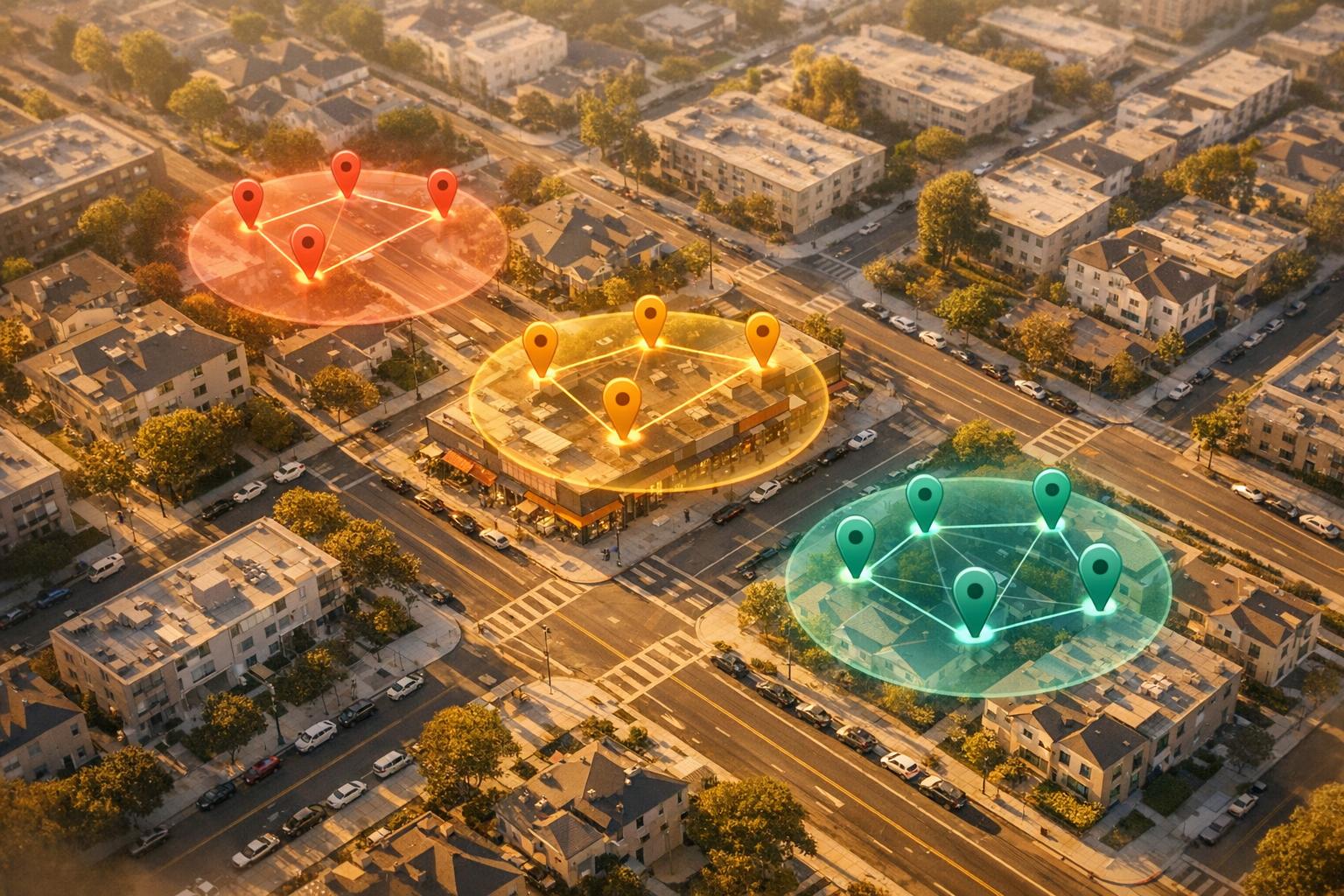
AI is transforming geographic segmentation by analyzing real-time data like GPS locations, IP addresses, and mobility trends. Unlike older methods that rely on broad ZIP codes or static demographic reports, AI enables hyper-local targeting, down to specific streets. This leads to better customer engagement, with businesses reporting up to 43% higher conversion rates and 67% improved customer interaction.
Key takeaways:
- AI vs. Traditional Methods: Traditional segmentation uses static data and broad assumptions, while AI leverages real-time, dynamic data to identify precise customer segments.
- Techniques Used: Algorithms like K-Means clustering, neural networks, and gradient boosting machines make segmentation faster and more accurate.
- Data Sources: AI combines IP/GPS data, census demographics, social media, and mobility patterns for detailed insights.
- Real-World Impact: Examples include Urban Outfitters boosting campaign performance by 25% and Starbucks achieving a 34% increase in offer redemptions through AI-driven targeting.
AI-driven segmentation is helping companies deliver highly relevant campaigns, reduce wasted resources, and adapt to changing consumer behaviors in real time. If you're not using AI for geographic targeting, you're likely missing out on better engagement and ROI.

Traditional vs AI-Powered Geographic Segmentation: Key Differences
Basics of AI-Driven Customer Segmentation | Exclusive Lesson
sbb-itb-daf5303
Traditional vs AI-Powered Geographic Segmentation
Traditional geographic segmentation operates on the assumption that everyone within a specific region shares similar characteristics. For example, marketers might treat all of California as a single audience, assuming that residents of San Francisco and Fresno have the same preferences and needs. This broad-strokes approach often results in campaigns that miss the mark, leading to wasted resources and irrelevant messaging. Adding to the challenge, traditional methods rely heavily on static data sources like ZIP codes or census reports, which can quickly become outdated. This means marketers are often working with information that no longer reflects current consumer behaviors.
As Francesco Montesanto, Content Marketing Manager at Optimizely, puts it, manual segmentation relies on "chunky demographic buckets". This method is not only slow but also reactive, focusing on historical trends rather than anticipating what’s next. It fails to capture the subtle differences that can exist between neighborhoods just a few miles apart, leaving marketers unable to deliver truly tailored campaigns.
This is where AI steps in to transform the game. By leveraging real-time behavioral data, AI can identify micro-segments that traditional methods overlook. Machine learning models analyze billions of data points - ranging from GPS data and social media activity to weather conditions and traffic patterns. This allows AI to continuously adapt and recategorize customer segments in real time as local conditions shift. Unlike static, manual approaches, this dynamic capability addresses the limitations of traditional segmentation head-on.
"AI, particularly through machine learning, analyzes vast and diverse datasets to reveal hidden patterns and more granular customer segments that would otherwise go unnoticed." - Francesco Montesanto, Content Marketing Manager, Optimizely
The impact of this precision is clear. For instance, in May 2025, Urban Outfitters used AI-powered geo-targeting to send push notifications for party dresses specifically to women who had visited nightclubs, based on their location history. The platform even adapted the language of the ads to Portuguese for users in Brazil. This approach led to a 25% boost in campaign performance. Such a level of targeting would be impossible with static ZIP code-based methods that update only once a year.
Comparison Table: Traditional vs AI Approaches
Here's a side-by-side look at the differences between these approaches:
| Feature | Traditional Geographic Segmentation | AI-Powered Geographic Segmentation |
|---|---|---|
| Accuracy | Low; relies on broad, static demographic buckets | High; identifies granular patterns and micro-segments |
| Scalability | Limited by manual analysis and human effort | Processes billions of data points across numerous variables |
| Speed | Slow; updates are based on historical data | Real-time; continuously adapts based on current behavior |
| Data Integration | Siloed and limited to isolated data sources | Unified; combines structured and unstructured data from multiple sources |
| Nature of Insights | Reactive; focuses on past behavior | Predictive; forecasts future needs and purchase intent |
AI Algorithms That Improve Geographic Segmentation
AI-powered geographic segmentation relies on several advanced algorithms to tackle challenges like grouping locations, identifying spatial patterns, and predicting market trends. Let’s dive into three key players in this space: K-Means clustering, neural networks, and gradient boosting machines - each offering unique capabilities to refine segmentation strategies.
K-Means Clustering for Grouping Locations
K-Means clustering, an unsupervised learning algorithm, groups locations based on shared behaviors - like shopping habits and commuting patterns - rather than sticking to predefined boundaries.
Here’s how it works: the algorithm assigns each location to the nearest cluster center (or "centroid") and recalculates the centroid by averaging all assigned points. This process repeats until the clusters stabilize. Advanced versions use observation-weighted centroids, which shift cluster centers toward high-density areas, creating groupings that better reflect real-world human activity.
A great example of this in action comes from Precisely, which, in June 2021, used an observation-weighted K-Means approach with PlaceIQ data to segment the U.S. They identified natural divisions - like splitting Northern and Southern California - based on movement patterns rather than arbitrary state lines. Another case is Starbucks, which applied K-Means in 2024 to analyze 76,277 marketing offers sent to 17,000 users over 30 days. This effort revealed three distinct customer segments, achieving a 98.4% offer viewing rate and a 62.6% completion rate for targeted campaigns.
"By taking a clustering approach to creating regional boundaries, we allow our data to drive the process." - Precisely Editor
For the best results with K-Means, it’s important to scale your data (using tools like StandardScaler) to ensure variables with larger numerical ranges don’t skew the clusters. Now, let’s explore how neural networks take segmentation to the next level by recognizing complex spatial patterns.
Neural Networks for Recognizing Spatial Patterns
Neural networks are masters at uncovering intricate spatial relationships in geospatial data. They analyze inputs like satellite imagery, aerial photos, and mobility patterns through multi-layered networks that mimic the way human brains process information. This allows them to automatically identify geographic features such as building footprints, water bodies, and land cover types.
What makes neural networks even more powerful is their ability to leverage transfer learning. By fine-tuning pre-trained models, businesses can adapt these networks to local markets. Combining neural networks with traditional clustering techniques has been shown to improve predictive accuracy for complex datasets by 25–40%. For instance, a neural network might analyze satellite images to detect urban sprawl, feeding these insights into a clustering algorithm to create actionable market segments when conventional data falls short.
From recognizing spatial patterns, we move to gradient boosting machines, which are essential for making highly localized predictions.
Gradient Boosting Machines for Localized Predictions
Gradient boosting machines (GBMs), along with related models like decision trees and random forests, specialize in capturing subtle regional differences that broad national averages often overlook. These algorithms are particularly effective for understanding variations in areas like channel efficiency, price sensitivity, and media saturation.
GBMs work by building sequential decision trees, each correcting the errors of the previous one. This iterative approach allows the algorithm to pinpoint the specific factors influencing behavior within each geographic segment. For marketers, this means not just identifying where to focus but also tailoring messaging, pricing, and channel strategies to fit each region’s unique dynamics. By moving away from generic strategies, businesses can adopt hyper-local approaches that align with real-time market needs.
Together, these algorithms - K-Means clustering, neural networks, and gradient boosting machines - equip marketers with the tools to achieve precise, dynamic geographic segmentation. This leads to more targeted campaigns and better overall performance.
Data Sources for AI Geographic Segmentation
AI-driven geographic segmentation relies on a variety of data streams to build accurate customer profiles. The location intelligence market is expected to grow from $18.7 billion in 2024 to over $42.7 billion by 2030, highlighting how businesses increasingly value precise geographic data. Here’s a closer look at the four main data sources that fuel AI algorithms and enhance marketing precision.
IP Geolocation and GPS Data
IP geolocation and GPS data form the backbone of real-time tracking and location-based targeting. IP geolocation analyzes internet protocol addresses to localize website content, adjust currency displays, detect ad fraud, and ensure ad budgets are spent in the right geographic markets. It can pinpoint locations down to the ZIP+4 or postal code level.
On the other hand, GPS data - collected via mobile devices and SDKs - provides precise coordinates, enabling geofencing, foot traffic analysis, and real-time location-based services. With many iPhone and iPad users opting out of tracking through Apple’s App Tracking Transparency tool, IP data has emerged as a privacy-compliant alternative to cookies.
AI geocoding tools like Geocodio can handle up to 10,000 coordinates or addresses in a single batch, converting raw GPS data into structured addresses for uses like fleet tracking or event analysis. They also offer reverse geocoding, turning GPS points into detailed addresses enriched with metadata such as school districts, time zones, or congressional districts. This added context enhances targeting by transforming raw location data into actionable insights.
Next, let’s look at how demographic data complements these precise location details.
Census Demographics and Population Data
Demographic data from sources like the American Community Survey (ACS) and the FFIEC (Federal Financial Institutions Examination Council) provides insights into factors like median family income, housing characteristics, age distribution, and minority population percentages. AI uses this information to refine neighborhood profiles.
However, census data has its challenges. There’s often a trade-off between geographic specificity and accuracy. For instance, in 72% of areas reported by the U.S. Census, the margin of error for specific estimates (like children in poverty) exceeds the estimate itself. As geographic focus narrows to block groups (typically 600 to 3,000 people), the data becomes less reliable for precise targeting.
AI mitigates this issue by combining multiple census variables into holistic neighborhood profiles. Instead of focusing on single metrics like income or race, AI employs a "contextual approach", analyzing hundreds of variables to create more reliable insights for decisions like market entry or persona development.
Beyond static demographics, behavioral data offers a dynamic layer to geographic insights.
Social Media and Mobility Patterns
Social media and mobility data capture real consumer behaviors, providing insights that go beyond stated intentions. Machine learning tools analyze geotagged posts from platforms like Instagram, Twitter, and Facebook, categorizing hashtags and text into behavioral segments. This enables businesses to target regions based on shared interests - like "Wanderlust" or "Green Thumb" - rather than just demographic traits.
For example, Spatial.ai uses 14.8 million data points from 52 million social users to create 72 distinct geographic segments. By leveraging Spatial.ai’s data, Wings Etc. achieved a 3.75x higher click-through rate and a 7.5x return on investment compared to baseline audiences.
"We're using the customer information from [Spatial.ai] to create more relevant ads for our actionable guest segments. For less money - or for the same amount of money - we're achieving higher click-through rates." - David Ponce, CMO, Wings Etc.
Similarly, Vi Acquire integrated Spatial.ai’s social-driven geographic audiences, resulting in a 53% lower cost per acquisition and 75% client membership growth, outperforming all other datasets they had previously used. These examples show how social and mobility data provide psychographic insights that traditional demographics often miss.
Comparison Table: Data Source Characteristics
| Data Source | Accuracy Level | Real-Time Applicability | CRM Integration Example |
|---|---|---|---|
| IP/GPS Data | High (Rooftop-level) | High (Live API calls) | Tars AI Agent + Geocodio |
| Census Data | Medium (High margin of error) | Low (5-year estimates) | FFIEC compliance in banking |
| Social Media | High (Behavioral) | Medium (Aggregated) | SiteZeus + Spatial.ai |
| Mobility Patterns | High (Movement tracking) | High (Live) | Fleet tracker log enrichment |
Each data source plays a specific role. IP and GPS data shine in real-time targeting and content localization. Census data offers long-term strategic insights for market planning. Social media and mobility patterns uncover behavioral trends that demographics alone cannot. The most effective AI segmentation strategies combine these sources to overcome the limitations of any single dataset.
How Businesses Use AI for Geographic Segmentation
AI-driven segmentation is transforming how businesses target customers by analyzing behavior within specific locations. Using real-time data and advanced techniques, companies can now deliver campaigns that connect with audiences on a local level. Instead of relying on broad, location-based messaging, AI can determine why a customer is in a particular area. For instance, it distinguishes between someone commuting through a business district in the morning versus someone shopping in a residential neighborhood. This shift from focusing on "where" to understanding "why" allows businesses to create real-time value and achieve measurable outcomes.
Urban vs. Rural Targeting in Retail
AI enables retailers to tailor campaigns by addressing the distinct needs of urban and rural customers. In urban areas, AI highlights speed, premium features, and products designed for compact living spaces. In rural settings, the focus changes to affordability, durability, and even local language support. For example, AI might recommend bulk packs or entry-level models to rural shoppers.
The results speak for themselves: studies show that location data influences purchasing decisions far more than static demographics. In fact, AI-based location behavior analysis can boost marketing effectiveness by 156% compared to traditional demographic methods. Predictive models also help retailers understand how far customers are willing to travel, which varies significantly between densely populated urban areas and spread-out rural regions.
"Location data isn't just geography - it's behavioral intelligence, intent prediction, and competitive intelligence combined into a single, real-time signal." - Averi Academy
Beyond product recommendations, AI automates localization efforts. It adapts marketing copy to local languages and customs, which is especially crucial in rural areas where vernacular communication builds trust. AI can even incorporate weather data to trigger timely promotions, like advertising rain gear during storms or snow tires before a blizzard.
These insights extend beyond retail, offering solutions for B2B compliance as well.
Localized Campaigns for Compliance in B2B
In B2B marketing, AI ensures that campaigns comply with regional regulations while maintaining precision. Operating across multiple jurisdictions often means navigating different data privacy laws, industry-specific rules, and local business practices. AI simplifies this by automatically adjusting messaging, data collection methods, and campaign timing to meet local requirements.
Take Swiss Life, for example. They used AI to manage 180 database servers containing over 1,800 databases and 18,000 tables, slashing deployment times from weeks to just 20 minutes. This system allows them to segment B2B audiences by region while adhering to Switzerland's strict data protection laws.
Similarly, Zyxware leveraged AI to process a database of 5,000 contacts. The technology categorized entries by region, industry, and compliance needs, ensuring their campaigns aligned with local regulations and norms. This streamlined approach saved time and resources while maintaining accuracy.
AI also adapts to dynamic global events, enhancing campaign relevance in real-time.
Event-Driven Segmentation for Global Campaigns
AI empowers brands to adjust campaigns instantly based on local events, weather changes, and cultural moments. For example, Starbucks saw a 34% increase in redemption rates for personalized location-based offers by analyzing individual location patterns and weather conditions, outperforming generic promotions.
During the Macy's Thanksgiving Day Parade, Google used AI to update out-of-home ads in real-time, showcasing how brands can respond to live events at scale. The system processed data - such as location, weather, and user history - within 500 milliseconds, ensuring offers were relevant and timely.
Micro-geofencing is another AI-powered strategy that creates temporary, precise virtual boundaries around event venues like concerts or festivals. This method has been shown to generate 89% higher engagement compared to broader radius-based targeting. AI dynamically adjusts customer segments based on live conditions, ensuring campaigns remain effective as events unfold.
| Event Type | AI-Driven Trigger | Marketing Application |
|---|---|---|
| Weather | Real-time temperature/precipitation | Adjust menus (hot vs. cold drinks), promote apparel |
| Local Events | Concerts, festivals, parades | Geofencing and event-specific creative |
| Cultural | Regional holidays (e.g., Diwali) | Tailored messaging, timing adjustments |
| Logistical | Traffic patterns, crowd density | Queue management offers, in-store navigation |
With location-based marketing projected to hit $79.6 billion by 2025 at an annual growth rate of 33.7%, and 89% of marketers reporting higher ROI than demographic targeting, event-driven segmentation is becoming a must-have for global campaigns. Predictive location marketing is expected to achieve 89% accuracy in forecasting customer movement and intent by 2026, offering businesses a powerful edge in diverse markets.
How to Integrate AI for Geographic Segmentation
Bringing AI into your geographic segmentation strategy doesn’t have to disrupt your current systems. Start by auditing the customer data in your CRM - whether it’s Salesforce, HubSpot, or another platform. Make sure you’ve got the essentials, like addresses, IP addresses, and GPS data. Then, use a geocoding API, such as Bing Maps Geocode Dataflow, to convert text-based addresses into precise geographic coordinates. This step refines your data from broad ZIP codes to street-level details, opening up opportunities to uncover untapped local markets. Once your data is optimized, you’ll be ready for seamless integration with AI-powered tools.
With your data prepared, the next move is connecting your CRM to an AI platform. Advanced AI systems, especially those using behavioral clustering or neural networks, can analyze massive datasets to identify patterns and micro-segments that manual methods often overlook. These insights go far beyond basic location tags, offering a deeper understanding of customer behaviors and preferences.
CRM Integration and Automation
Once your data is geocoded and ready, link your CRM to AI tools for automated workflows. These systems integrate directly, streamlining segmentation and targeting processes. For instance, marketing platforms like Marketo or Mailchimp can use geofencing or proximity triggers to deliver personalized content or offers. AI-powered workflows can even respond to customer behavior in real time - sometimes within 500 milliseconds - ensuring timely actions for location-based campaigns.
Privacy and compliance are key. Make sure your CRM includes transparent opt-in processes to align with regulations like GDPR and CCPA. Research shows that clear communication about privacy can boost customers’ willingness to share location data by 67%. To maximize ROI, use performance monitoring tools to track engagement and refine your strategies. Businesses leveraging advanced location intelligence have reported up to 43% higher conversion rates.
Custom AI Solutions from Hello Operator
For companies with unique needs, Hello Operator offers custom AI solutions that go beyond off-the-shelf tools. Their project-based service, starting at $5,950 per month, includes tailored AI applications, strategic planning, and AI agents trained on proprietary data. A dedicated project manager ensures smooth integration with your existing systems, making this an ideal option for teams looking to automate complex workflows.
For ongoing support, Hello Operator also provides an on-demand service starting at $3,750 per month. This package includes access to a full-stack AI marketing team capable of managing human-in-the-loop content systems and optimizing SEO strategies for location-based searches. To further empower teams, they offer hands-on workshops and training sessions, equipping internal staff to handle geographic segmentation challenges with confidence. By combining custom development with training, businesses can scale their AI segmentation efforts while maintaining human oversight for strategic decisions and regulatory compliance.
Measuring the Impact of AI on Segmentation Accuracy
Once you've integrated AI-powered segmentation into your campaigns, the next step is figuring out how much of a difference it's actually making. Start by establishing baseline metrics like conversion rates, cost per acquisition (CPA), and customer lifetime value (CLV) for each region before rolling out the AI. Without these benchmarks, it's nearly impossible to measure the effectiveness of your AI implementation.
The gold standard for evaluating AI's impact is A/B testing with control groups. Here's how it works: one group sticks to traditional targeting methods, while the other uses AI-driven micro-segmentation. This setup isolates AI's contribution, cutting out any guesswork. For example, in 2024, Adidas leveraged machine learning to analyze real-time browsing behavior and seasonal trends for sneaker launches. By zeroing in on "high-intent" audiences, they saw a 30% jump in conversion rates for their digital campaigns. Similarly, Sephora used over 100 behavioral signals to create micro-segments like "premium skincare enthusiasts", which led to a 28% increase in conversion rates and a 15% boost in customer retention.
"One of the things that we see now is the ability to use AI to understand consumer intent. This helps us as marketeers to have a much more outside-in view when we plan campaigns." - Einat Weiss, CMO, NICE
To track AI's real-time impact, keep an eye on key metrics such as conversion rates, ad spend efficiency, bounce rates, session durations, and churn. Retailers using AI-powered segmentation have reported a 20% reduction in cost per conversion and a 20% increase in incremental sales. Beyond immediate sales, AI can also improve retention. For instance, AI-driven retention campaigns have been shown to cut churn by 23% within just six weeks by identifying at-risk customers in specific areas before they leave.
Metrics Comparison: Pre- vs Post-AI Implementation
| Metric | Traditional (Pre-AI) | AI-Powered (Post-AI) |
|---|---|---|
| Segmentation Granularity | Broad buckets (e.g., "Urban Professionals") | Micro-segments (e.g., "Late-night eco-shoppers") |
| Update Frequency | Quarterly or Annual | Real-time or Hourly |
| Conversion Rate | Baseline / Static | 20–30% Lift |
| Marketing ROI | Standard | Up to 30–44% Improvement |
| Ad Spend Efficiency | High waste due to broad targeting | 15% reduction in wasted spend |
| Churn Rate | Reactive management | 23% reduction via predictive flagging |
To maintain these gains, ongoing evaluation is essential. Customer behaviors are constantly evolving - whether due to seasonal changes, economic shifts, or local events. Regularly check for model drift to ensure your AI remains aligned with current trends. If performance starts to dip, retrain your AI models with fresh data. Set up alert thresholds, like flagging a 5% drop in conversion rates in any region, to trigger an immediate review of the model.
Conclusion
AI has reshaped geographic segmentation, bringing an unmatched level of precision to marketing strategies. By merging street-level accuracy with behavioral insights, businesses can pinpoint underserved areas, anticipate high-conversion locations, and optimize resource allocation more effectively.
The numbers back it up. Location-based marketing is expanding at an annual rate of 33.7%, with 89% of marketers reporting better ROI compared to traditional demographic methods. Gartner forecasts that by 2026, predictive location marketing will achieve 89% accuracy in predicting customer movements and intentions.
This shift from static to dynamic segmentation is no longer a luxury - it’s a necessity. With 71% of consumers expecting businesses to understand their needs and 75% feeling frustrated by generic experiences, AI provides the contextual intelligence needed for hyper-localized campaigns. These campaigns not only meet regional compliance requirements but also reflect real-time intent and local preferences.
For companies ready to embrace this change, start by evaluating your data infrastructure, setting KPIs tied to revenue, and integrating AI-driven segments into your marketing automation tools. Whether you choose to build in-house solutions or collaborate with experts like Hello Operator, the key is transforming static geographic data into actionable insights that fuel measurable growth.
FAQs
What data do I need to start AI geographic segmentation?
To start with AI-driven geographic segmentation, you'll need location data - this could be addresses, GPS coordinates, or geocoded details. On top of that, consider incorporating other factors like region, climate, population density, or defined geographic boundaries. These elements allow AI systems to break down and analyze geographic areas with precision.
How do I keep location targeting privacy-compliant in the U.S.?
To respect privacy while targeting locations in the U.S., focus on consent-based location sharing. This means obtaining clear permission from users before collecting or using their location data. Incorporate privacy-first approaches like differential privacy, which adds noise to data to protect individual identities, or federated learning, which processes data locally on devices rather than centrally.
Additionally, ensure compliance with regulations designed to safeguard user privacy and promote transparency. Following these practices not only helps you meet legal standards but also strengthens trust with your audience.
How can I prove AI segmentation is improving ROI?
AI segmentation can deliver impressive results when it comes to return on investment (ROI). For example, it can lead to up to 30% higher marketing ROI, 20% lower cost per conversion, and increased customer engagement. These aren't just abstract claims - they're backed by real-world data and case studies.
To make a strong case, focus on measurable improvements in campaign performance. Show how AI segmentation has helped businesses optimize their marketing spend, target the right audience, and drive meaningful engagement. Incorporating specific examples or studies will add credibility and demonstrate the tangible benefits of this approach.
Related Blog Posts

